
Due to the stressfulness of this past week, the Lord put it on my heart to choose this hymn, and post it this evening instead of waiting for tomorrow morning. Please let this wonderful hymn be a balm to your spirit.
Far away in the depths of my spirit tonight
Rolls a melody sweeter than psalm;
In celestial strains it unceasingly falls
O’er my soul like an infinite calm.
Refrain
Peace, peace, wonderful peace,
Coming down from the Father above!
Sweep over my spirit forever, I pray
In fathomless billows of love!
What a treasure I have in this wonderful peace,
Buried deep in the heart of my soul,
So secure that no power can mine it away,
While the years of eternity roll!
Refrain
I am resting tonight in this wonderful peace,
Resting sweetly in Jesus’ control;
For I’m kept from all danger by night and by day,
And His glory is flooding my soul!
Refrain
And I think when I rise to that city of peace,
Where the Anchor of peace I shall see,
That one strain of the song which the ransomed will sing
In that heavenly kingdom will be:
Refrain
Ah, soul! are you here without comfort and rest,
Marching down the rough pathway of time?
Make Jesus your Friend ere the shadows grow dark;
O accept of this peace so sublime!
Refrain
Lyrics – Warren D. Cornell – Alas – no picture is available of brother Warren Cornell.
Born: April 25, 1858, Whiteford, Michigan.
Died: February 4, 1901, Fond du Lac, Wisconsin.
Cornell & Cooper wrote this song at a camp meeting near West Bend, Wisconsin:
One day while seated in the tent, Mr. Cornell, following a period of deep introspection, wrote down the thoughts with which his mind had been busied. They later proved to be parts of this hymn, Wonderful Peace. Sinking again into introspective rumination, he arose, unwittingly dropped the written verses on the tent floor and went out. When Mr. Cooper entered the tent an hour or two later he discovered the paper. He was fascinated by the theme and the accompanying verses. It so fitted his own thinking that he filled in and completed the poem. Then sitting down at the organ he composed the melody as it has since been sung.
Sanville, p. 58
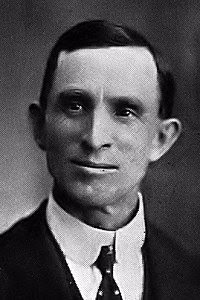
Music – William Gustin Cooper
Born: July 15, 1861, Evansville, Wisconsin.
Died: October 17, 1938, Canton, Maine.
Buried: Silverbrook Cemetery, Wilmington, Delaware.
Cooper was living in Fond du Lac, Wisconsin (1870); Buchanan, Michigan (1880); and Hortonville Village, Wisconsin (1900). He pastored at the Hortonville Community Baptist Church from September 1, 1897 to April 1, 1901. In May 1922, he became pastor of the Baptist church in Ira, Vermont. His works include:
- History of the Baptist Church of Ira, Vermont, with Simon Lewis Peck (Rutland, Vermont: Tuttle Company, 1925)
- Sacred Songs (Canton, Maine: The Pinewood Press, 1936)
A Biblical understanding of peace begins with the Hebrew expression שָׁלוֹם (shalom), a word as rich in meaning as it is lovely in sound. In English we generally think of “peace” in terms of what it is not–as an absence of conflict, or confusion, or struggle. But shalom is defined positively, as the presence of certain qualities, such as “completeness,” “soundness,” and “wellness” (Brown, 1022). In this sense it was (and still is) used in Hebrew as an all-purpose greeting and farewell (Jewish Encyclopedia). With this in view, it becomes apparent that even when shalom is used in our sense of “peace”–the opposite of war–it is more a state of mind than of situation. One might have shalom even in the midst of all sorts of external stresses and conflicts; it is not dependent on the actions of others.
http://drhamrick.blogspot.com/2013/10/far-away-in-depths-wonderful-peace.html
 The Vine Vigil