
- I have decided to follow Jesus;
I have decided to follow Jesus;
I have decided to follow Jesus;
No turning back, no turning back. - Though I may wonder, I still will follow;
Though I may wonder, I still will follow;
Though I may wonder, I still will follow;
No turning back, no turning back. - The world behind me, the cross before me;
The world behind me, the cross before me;
The world behind me, the cross before me;
No turning back, no turning back. - Though none go with me, still I will follow;
Though none go with me, still I will follow;
Though none go with me, still I will follow;
No turning back, no turning back.- Will you decide now to follow Jesus?
Will you decide now to follow Jesus?
Will you decide now to follow Jesus?
No turning back, no turning back.
- Will you decide now to follow Jesus?
I Have Decided to Follow Jesus
attr. to S. Sundar Singh
Copyright: Public Domain
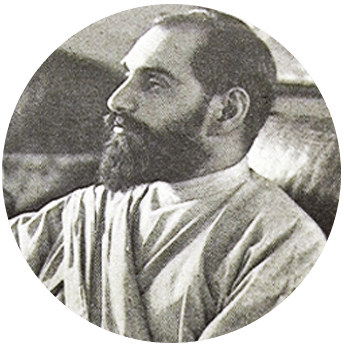
Singh was raised a member of the Sikh religion. Prior to his conversion, Sundar attended a primary school run by the American Presbyterian Mission where the New Testament was read daily as a “textbook.” Sundar “refused to read the Bible at the daily lessons…To some extent the teaching of the Gospel on the love of God attracted me, but I still thought it was false.”
In the midst of such confusion and while only fourteen years old, his mother died, and Sundar underwent a crisis of faith. His mother was a loving saintly woman and they were very close. In his anger, Sundar burned a copy of one of the Gospels in public. Within three days Sundar Singh could bear his misery no longer. Late one night in December 1903, he rose from bed and prayed that God reveal himself to him if he really existed. Otherwise — “I planned to throw myself in front of the train which passed by our house.” For seven hours Sundar Singh prayed. “O God, if there is a God, reveal thyself to me tonight.” The next train was due at five o’clock in the morning. The hours passed. Suddenly the room filled with a glow. A man appeared before him. Sundar Singh heard a voice say, “How long will you deny me? I died for you; I have given my life for you.” He saw the man’s hands, pierced by nails.
Amazed that his vision had taken the unexpected form of Jesus, Sundar was convinced in his heart that Jesus was the true Savior, and that He was alive. Sundar fell on his knees before Him and experienced an astonishing peacefulness which he had never felt before. The vision disappeared, but peace and joy lingered within him.
Despite his family’s pleas, bribes, and threats, Sundar wanted to be baptized in the Christian faith. After his father spoke words of official rejection over him, Sundar became an outcast from his people. He cut off the hair he had worn long like every Sikh man. Against great opposition, he was baptized on his birthday in 1905, in an English church in Simla.
Conventional Indian churches were willing to grant him a pulpit, but their rules were foreign to his spirit. Indeed, he felt that a key reason the gospel was not accepted in India was because it came in a garb foreign to Indians. He decided to become a sadhu, so that he could dedicate himself to the Lord Jesus. He was convinced that this was the best way to introduce the Gospel to his people since it was the only way which his people were accustomed to. As a sadhu, he wore a yellow robe, lived on the charity of others, abandoned all possession and maintained celibacy. In this lifestyle, he was free to devote himself to the Lord. Dressed in his thin yellow robe, Sundar Singh took to the road and began a life of spreading the simple message of love and peace and rebirth through Jesus. He carried no money or other possessions, only a New Testament.
Sundar journeyed much. He traveled all over India and Ceylon. Between 1918-1919, he visited Malaysia, Japan and China. Between 1920-1922 he went to Western Europe, Australia and Israel. He preached in many cities; Jerusalem, Lima, Berlin and Amsterdam among others. Despite his growing fame, Sundar retained a modest nature, desiring only to follow Jesus’ example: to repay evil with kindness and to win over his enemies by love.
He was quite independent of outward Church authority in all his religious life, thought, and work. He dropped out of a Christian seminary that he briefly attended. Neither did he attach much importance to public worship because in his experience the heart prays better in solitude than in a congregation.
He traveled in India and Tibet, as well as the rest of the world, with the message that the modern interpretation of Jesus was sadly watered down. Sundar visited Tibet every summer and in 1929, he visited there and was never seen again.
http://www.ccel.org/ccel/singh
The story of the song is covered in the Book by Dr. P.P. Job and Indian preacher in His book “Why God Why”
An excerpt from the book is given below:About 150 years ago, there was a great revival in Wales, England. As a result of this, many missionaries came from England and Germany to North-East India to spread the Gospel. At the time, north-east India was not divided into many states as it is today. The region was known as Assam and comprised hundreds of tribes. The tribal communities were quite primitive and aggressive by nature. The tribals were also called head-hunters because of a social custom which required the male members of the community to collect as many heads as possible. A man’s strength and ability to protect his wife was assessed by the number of heads he had collected. Therefore, a youth of marriageable age would try and collect as many heads as possible and hang them on the walls of his house. The more heads a man had, the more eligible he was considered. Into this hostile and aggressive community, came a group of Welsh missionaries spreading the message of love, peace and hope of Jesus Christ. Naturally, they were not welcomed. One Welsh missionary succeeded in converting a man, his wife, and two children. This man’s faith proved contagious and many villagers began to accept Christianity. Angry, the village chief summoned all the villagers. He then called the family who had first converted to renounce their faith in public or face execution. Moved by the Holy Spirit, the man instantly composed a song which became famous down the years. He sang:
I have decided to follow Jesus. (3 times)
No turning back, no turning back.
Enraged at the refusal of the man, the chief ordered his archers to arrow down the two children. As both boys lay twitching on the floor, the chief asked, “Will you deny your faith? You have lost both your children. You will lose your wife too.”
But the man sang these words in reply:
Though no one joins me, still I will follow. (3 times)
No turning back, no turning back.
The chief was beside himself with fury and ordered his wife to be arrowed down. In a moment she joined her two children in death. Now he asked for the last time, “I will give you one more opportunity to deny your faith and live.”
In the face of death the man sang the final memorable lines:
The cross before me, the world behind me. (3 times)
No turning back, no turning back.
He was shot dead like the rest of his family. But with their deaths, a miracle took place. The chief who had ordered the killings was moved by the faith of the man. He wondered, “Why should this man, his wife and two children die for a Man who lived in a far-away land on another continent some 2,000 years ago? There must be some supernatural power behind the family, and I too want that supernatural power.”
In a spontaneous confession of faith, he declared, “I too belong to Jesus Christ!” When the crowd heard this from the mouth of their chief, the whole village accepted Christ as their Lord and Savior. This is the power of [God in] demonstration.
 The Vine Vigil