Tag Archives: science

Transhumansim – The Quest to be Gods

Nothing has changed in over 6,000 years.

James Hughes Ph.D., the Executive Director of the Institute for Ethics and Emerging Technologies, is a bioethicist and sociologist at Trinity College in Hartford Connecticut where he teaches health policy and serves as Director of Institutional Research and Planning. He holds a doctorate in sociology from the University of Chicago, where he also taught bioethics at the MacLean Center for Clinical Medical Ethics. Dr. Hughes is author of Citizen Cyborg: Why Democratic Societies Must Respond to the Redesigned Human of the Future , and is working on a second book tentatively titled Cyborg Buddha. Since 1999 he has produced a syndicated weekly radio program, Changesurfer Radio.

As transhuman possibilities increasingly develop, the compatibilities of metaphysics, theodicy, soteriology and eschatology between the transhumanist and religious worldviews will be built upon to create new “trans-spiritualities.”  In this future religious landscape there will be bioconservative and transhumanist wings within all the world’s faiths, and probably new religious traditions inspired by the transhumanist project.  We will create new religious rituals and meanings around biotechnological and cybernetic and cybernetic capabilities, just as we did around fire, the wheel, healing plants, and the book.

James  J. Hughes, The Compatibility of Religious and Transhumanism Views of Metaphysics, Suffering, Virtue, and Transcendence in an Enhanced Future

In the Caltech experiments, the researchers stripped an HIV virus of its disease-causing elements and used it to virally infect single-cell embryos of mice with a gene from a jellyfish.

Any number of different genes could have been selected. For the purpose of the studies, the researchers chose a specific jellyfish gene that could serve as a “marker” to indicate whether the gene transfer was successful. The gene produces a protein that gives the jellyfish a green fluorescence.

When the mice were born, they carried the jellyfish gene in their own genes. Under fluorescent light, all their major tissues and organs—including skin, bones, muscles, lungs, liver, kidney, stomach, brain, and retina—emitted a green glow.

The trait became a permanent feature of the mice genome and was passed along to many of their offspring.  (National Geographic)

This has gone much, much farther than glow mice. This description of the fearsome  locusts in Revelation 9: 6-12 does not sound all that incredible in light of this.

God Designed Geckos

As is so often the case – scientists are studying God’s Creation- and applying it to modern technology. Until recently – it was a mystery, just how geckos were able to cling so easily to even the smoothest surfaces, and still be able to maneuver around on the same surface. But now – the fascinating truth is discovered!

Scientists have already taken advantage of the phospholipids, and are synthesizing adhesives with great potential for formerly unheard of applications.

Dinosaurs Ate Rice

From the Institute for Creation Research ~

www.icr.org


Dinosaurs Ate Rice

by Brian Thomas, M.S. *

Just what did dinosaurs eat?

One way researchers are finding out is by studying coprolites, or fossilized dinosaur dung. And as it turns out, some dinosaurs ate rice plants. But if flowering plants like rice did not evolve until millions of years after dinosaurs lived—as evolution maintains—how could dinosaurs have eaten them?

Some coprolites contain phytoliths, which are uniquely shaped microscopic crystals manufactured by various plant tissues. Most phytoliths are made of silicon dioxide, the same chemical that comprises sand. Scientists examining these tiny grains can often discern from which plant they came.

For example, in 2005, researchers found phytoliths from grass, palm trees, conifers, and other flowering plants in (probably sauropod) dinosaur coprolites from India.1 “It was very unexpected….We will have to rewrite our understanding of its evolution….We may have to add grass to the dioramas of dinosaurs we see in museums,” palaeobotanist Caroline Strömberg told Nature News at the time.2

Recently, Strömberg and two of her co-authors from the 2005 study described coprolite-encased phytoliths that are so similar to those made by certain modern rice plants that those found in dinosaur rocks “can be assigned to the rice tribe, Oryzeae, of grass subfamily Ehrhartoideae.”3 They collected these samples from the same Indian rock layers, the Lameta Formation, that contained their 2005 finds.

This find joins others that have shown that rice, grass, palm trees, and conifers from dinosaur rocks were essentially the same as their living counterparts. It’s as though millions of years of plant evolution never occurred.

The Lameta formation includes sedimentary layers interbedded with volcanic rock layers. It is huge, covering a large area of India.4 The Flood described in the book of Genesis is the best explanation for this scale of upheaval, showing that the fossils found there resulted from the Flood.

Thus, these coprolites show that rice plants existed before the Flood. Either rice had diversified from an originally created grass that was common to many other grasses, like wheat and bamboo, or God created rice grasses separately from other grass kinds. Studies show that rice grasses do not hybridize with other grasses.5 These dinosaur-eaten phytoliths add weight to the idea that rice was a distinct creation from the beginning.

According to Scripture, God created all the grasses, plants, and grazing mammals, along with any grazing dinosaurs like sauropods, by the sixth day of the creation week. As far as what the fossils have shown, Scripture is right.


15 Behold now behemoth, which I made with thee; he eateth grass as an ox. 16 Lo now, his strength is in his loins, and his force is in the navel of his belly. 17 He moveth his tail like a cedar: the sinews of his stones are wrapped together. 18 His bones are as strong pieces of brass; his bones are like bars of iron. 19 He is the chief of the ways of God: He that made him can make His sword to approach unto him. 20 Surely the mountains bring him forth food, where all the beasts of the field play. 21 He lieth under the shady trees, in the covert of the reed, and fens. 22 The shady trees cover him with their shadow; the willows of the brook compass him about. 23 Behold, he drinketh up a river, and hasteth not: he trusteth that he can draw up Jordan into his mouth. 24 He taketh it with his eyes: his nose pierceth through snares. Job 40: 15-24

Elephant Sharks Defy Evolution

Elephant Shark Research Team Misses Creation Clues

by Brian Thomas, M.S. *

When mainstream scientists search for clues about how and when the first bony-skeleton creature evolved from a non-bony creature, do they overlook evidence showing skeletons could never evolve from non-skeletons in the first place? It appears that a large collaboration of scientists that analyzed DNA from a spectacular living fossil called an elephant shark did just that. The title of their report, published in Nature, refers to “unique insights” into evolution, but the facts actually reveal something else.1

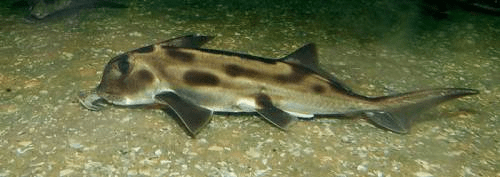
The elephant shark, or Australian ghost shark, is a cartilaginous fish that uses a snout to probe sea-floor sands for small clams in New Zealand and Australian waters. They have other non-shark-like characteristics, including green eyes placed high atop their heads and opercula covering their gills.

Elephant shark fossils occur in Ordovician rocks, assigned a conventional age of 450 million years, and in Permian rocks, assigned an age of 260 million years. Elephant sharks are still living today. Supposedly, they have not changed in form for over 300 million years and this makes them a spectacular example of a living fossil. The Nature authors wrote that their genetic analysis “shows that the C. milii [elephant shark] genome is evolving significantly slower than other vertebrates, including the coelacanth, which is considered a ‘living fossil.’”1

To say that the elephant shark has evolved slowly because its form has not changed dramatically understates the situation—it has not evolved at all! The study authors wrote, “The factors contributing to the lower evolutionary rate of C. milii are not known.”1 (One explanation they evidently didn’t consider for why these fish have not evolved is that God created their basic form right from the start.)

The main purpose of this secular research project was to find clues that might explain how jawed fishes evolved from jawless fishes—an evolutionarily biased approach. So, the researchers fitted their elephant shark’s genomic data into an evolutionary narrative about how jawless fishes evolved into the first cartilaginous-jawed fish and how some of its descendants then evolved into the first bony-jawed fish. And this despite the fact that all three groups suddenly appear side by side as contemporaries in Cambrian system strata!

Each step in the supposed evolution of vertebrates would require a wholesale restructuring of the ancestor’s anatomy. The Nature authors wrote, “This transition was accompanied by many morphological and phenotypic innovations.”1 But there are no demonstrations of creatures innovating even one new body part, let alone many. Plus, undisputed transitions are still no-shows in the fossil record.

What if these fish were created much as we find them today and never did evolve? This report ignores such questions, and its conclusions drip with evolutionary bias. For example, the authors wrote, “Overall, the C. milii genome is the least derived [least evolved] among known vertebrates.”1 But what empirical foundation supports a “least derived” designation? It is purely subjective since another research group could just as easily assert—perhaps on the basis of another organism’s perfectly unique genetic makeup and fossil occurrence in lower strata—an entirely different creature as being the least-derived vertebrate.2

Supposedly, elephant sharks “constitute a critical outgroup for understanding the evolution and diversity of bony vertebrates.”1 How do the researchers know that this fish kind is a critical outgroup? This designation comes not from data, but from an evolutionary-slanted assertion.

The Nature authors wrote of the elephant shark’s genome, “Its value for comparative genomic studies is illustrated by our analysis of genetic events that led to the ossification of endoskeleton in bony vertebrates.”1 Wait a minute—did these authors really study genetic events? Do they have a time machine that enabled them to go back and observe these alleged events? In reality, it appears they forced a high-functioning and one-of-a-kind genome into an evolutionary model.

The most significant insights that the elephant shark study revealed are that it simply has not evolved over supposed hundreds of millions of years and that secularists insist on fitting it into an evolutionary narrative despite the evidence. But its lack of evolution makes perfect sense if God created these fish to reproduce after their kind, just like He said.3

http://www.icr.org/article/7879/

What a fascinating creature!  These fish remind me of butterflies in the manner that they swim.  Extraordinary! If you do not recognize the hand of God in the creation  – you are doomed. 

JOB 12:7-9

But ask now the beasts, and they shall teach thee; and the fowls of the air, and they shall tell thee:

Or speak to the earth, and it shall teach thee: and the fishes of the sea shall declare unto thee.

Who knoweth not in all these that the hand of the Lord hath wrought this?

Baby Dinosaurs Looked Like Dragons

Dinosaur Youngster Looks Like Dragon Figurines

by Brian Thomas, M.S. *

Phil Currie, one of Canada’s leading paleontologists, helped excavate a virtually complete skeleton of what is likely the youngest ceratopsian dinosaur ever found. Ceratopsians include the famous Triceratops, but others within the group possessed different body sizes, head frills and various numbers of horns.

Juvenile dinosaurs are rare enough, but to find a three-year-old almost completely intact specimen—only its front legs are missing—is so rare that it may be one of a kind. Currie told LiveScience, “The big ones just preserve better.”1 Nobody is quite sure why.

This juvenile from Canada had no horns, and the fossil looked eerily familiar. Remarkably, ancient burial artifacts from within what is today northeastern China bear a striking resemblance to this juvenile ceratopsian fossil find. The Hongshan culture expertly carved figurines into the shapes of animals, dragons and people out of valuable materials like jade.

Auction houses sell the dinosaur-like carvings as “pig-dragons” because of the pig-like noses on some of the figurines. But some Hongshan figurines are actually pigs, clearly showing that the carvers knew their subject matter.

Some of their ancient depictions are difficult to identify, but others are plain to see. The dragon figurines don’t resemble any standard zoo animal alive today, and one wonders how the carvers could have carved the animal look-alikes without looking at the live animal. Presumably, ancient Chinese artists did not have access to fossils in Canada or even Mongolia where paleontologists found protoceratops fossils in the mid-20th century, nor would one expect the artists to have developed the expertise to reconstruct whole animals from mere skeletal fragments.

Plus there’s the question of motivation. Why would they portray skeletal remains as a living animal?

Further, what are the chances that any ancient culture—Chinese or not—would have stumbled upon such a rare fossil, then used it as a template to carve figurines right alongside those of other living animals and people?

At this point, the best explanation for these jade figurines may be that long ago peoples expertly carved likenesses of then-living dinosaurs—even juvenile ceratopsians.

http://www.icr.org/article/7852/

Job 40:15-24

King James Version (KJV)

15 Behold now behemoth, which I made with thee; he eateth grass as an ox.

16 Lo now, his strength is in his loins, and his force is in the navel of his belly.

17 He moveth his tail like a cedar: the sinews of his stones are wrapped together.

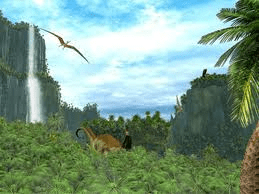
dinosaur

18 His bones are as strong pieces of brass; his bones are like bars of iron.

19 He is the chief of the ways of God: he that made him can make his sword to approach unto him.

20 Surely the mountains bring him forth food, where all the beasts of the field play.

21 He lieth under the shady trees, in the covert of the reed, and fens.

22 The shady trees cover him with their shadow; the willows of the brook compass him about.

23 Behold, he drinketh up a river, and hasteth not: he trusteth that he can draw up Jordan into his mouth.

24 He taketh it with his eyes: his nose pierceth through snares.

Creation Week – Day 6 – Part 1

“The Cambrian Explosion occurred in a geological moment, and we have reason to think that all major anatomical designs may have made their evolutionary appearance at that time. …not only the phylum Chordata itself, but also all its major divisions, arose within the Cambrian Explosion. So much for chordate uniqueness… Contrary to Darwin’s expectation that new data would reveal gradualistic continuity with slow and steady expansion, all major discoveries of the past century have only heightened the massiveness and geological abruptness of this formative event…” (Gould, Stephen J., Nature, vol. 377, October 1995, p.682.) “

“And God said, Let the earth bring forth the living creature after his kind, cattle, and creeping thing, and beast of the earth after his kind: and it was so. And God made the beast of the earth after his kind, and cattle after their kind, and every thing that creepeth upon the earth after his kind: and God saw that it was good.” Genesis 1: 24-25

The word kind is used five times in the above passage. It is translated from the Hebrew word miyn (pronounced meen) = to portion out; a sort; i.e. species. All fossils and life forms exhibit attributes that are fully functional. There is not one, not one, example of a transitional form anywhere – living – or in the fossil record.

The missing links are still missing. The current evolutionary theories include “gradualistic evolution,” “punctuated equilibrium,” and “panspermia.” The true believers of each of these beliefs have yet to provide any evidence.

When speaking of evolution – there are two viewpoints to consider. Macro-evolution requires the development of one kind or genus of animal, into another completely different kind. Case in point – the idea that reptiles evolved into birds. Scales into feathers, teeth into beaks, solid bones into hollow ones – and last but not least – front legs into wings!!

But the other view point – that of micro-evolution, is evidenced in every life form on earth today. Micro-evolution is the variation within specie, providing for distinct and separate qualities. This is natural selection – and it has never been documented to provide new genetic material. It demonstrates the loss of genetic material.

dogs

The most obvious example we can use here – is the astonishing variety of dog breeds, which have been artificially selected, as opposed to natural selection – but the same principle applies.

No other genus in the world has as much variation as the dog “kind.” Our loving Creator has used man’s best friend, to teach us a truth that can be so plainly seen by anyone.  A toy poodle will never turn into, or give birth to an African wild dog – yet they are both 100% dog kind.  The small poodle has had the ability to breed a wild dog – “selected out” of its gene pool.  The same goes for “Darwin’s finches.”  Variations in bill size and feather striation is due to micro evolution – they are all still 100% finch.   My husband has curly hair, mine is straight.  Two of our children have my hair, one has a combination – yet they are obviously our progeny.  Should the straight haired ones marry another straight haired person, their chance of producing a curly haired child would be 1 out of four.  If that same scenario plays out for 2-3 more generations, the gene for curly hair will be lost.  Natural selection does not produce new genetic material, but rather the loss of genetic material.

“All flesh is not the same flesh: but there is one kind of flesh of men, another flesh of beasts, another of fishes, and another of birds.” 1 Corinthians 15: 39

sage