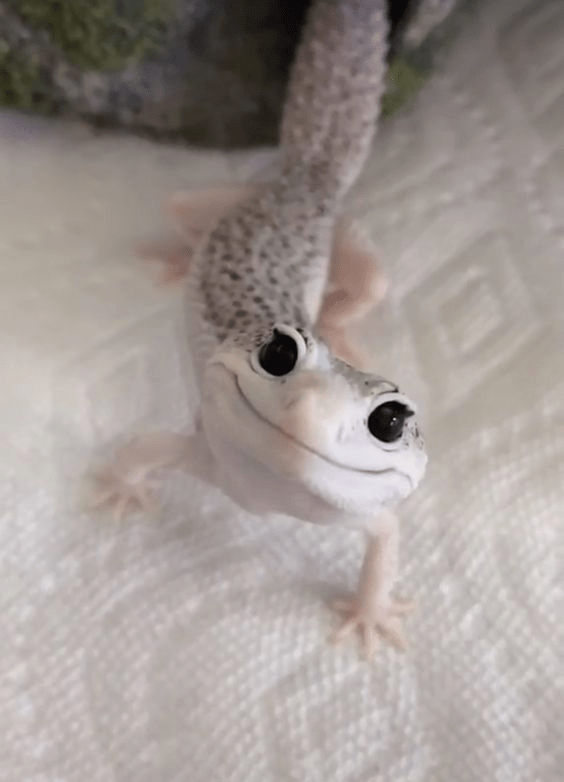
As is so often the case – scientists are studying God’s Creation- and applying it to modern technology. Until recently – it was a mystery, just how geckos were able to cling so easily to even the smoothest surfaces, and still be able to maneuver around on the same surface. But now – the fascinating truth is discovered!
Even though gecko toe pads adhere strongly to almost any surface, they can peel off of those surfaces quickly. That’s because the pads have tiny hair-like projections made from the tough protein keratin that can only be seen at incredibly strong magnification. If the geckos’ feet and tiny keratin fibers got dirty, that sticky interaction wouldn’t work, making them instantly vulnerable to predators.
In an effort to find out how geckos keep their feet clean, researchers based at the University of Akron (UA) found that phospholipids, which are special kinds of thin oils, are manufactured and excreted to keep the keratin hairs clean and serve as the temporary contact adhesive between geckos’ toes and the surface on which they’re walking. (Brian Thomas, M.S.)
Scientists have already taken advantage of the phospholipids, and are synthesizing adhesives with great potential for formerly unheard of applications.
For by Him were all things created, that are in heaven, and that are in earth, visible and invisible, whether they be thrones, or dominions, or principalities, or powers: all things were created by Him, and for Him.
Colossians 1: 16
For the invisible things of Him from the creation of the world are clearly seen, being understood by the things that are made, even His eternal power and Godhead; so that they are without excuse.
Beyond the sunset, O blissful morning, When with our Savior, heaven is begun; Earth’s toiling ended, O glorious dawning, Beyond the sunset when day is done.
Beyond the sunset, no clouds will gather, No storms will threaten, no fears annoy; O day of gladness, O day unending, Beyond the sunset eternal joy!
Beyond the sunset, a hand will guide me To God the Father whom I adore; His glorious presence, His words of welcome, Will be my portion on that fair shore.
Beyond the sunset, O glad reunion, With our dear loved ones who’ve gone before; In that fair homeland we’ll know no parting, Beyond the sunset forever more!
Virgil Prentiss Brock – Lyrics 1887-1978
Born: January 6, 1887, Mercer County, Ohio. Buried: Warsaw, Indiana.
Blanche Kerr Brock – Composer 1888-1958
Born: February 3, 1888, Greens Fork, Indiana. Died: January 3, 1958, Winona Lake, Indiana. Buried: Warsaw, Indiana.
One of the best-known and widely-used songs in the entire field of gospel hymnody is “Beyond the Sunset.” Mr. Brock has left the following account of its writing:
This song was born during a conversation at the dinner table, one evening in 1936, after watching a very unusual sunset at Winona Lake Indiana, with a blind guest—my cousin Horace Burr—and his wife Grace. A large area of the water appeared ablaze with the glory of God, yet there were threatening storm clouds gathering overhead. Returning to our home, we went to the dinner table still talking about the impressive spectacle we had witnessed. Our blind guest excitedly remarked the he had never seen a more beautiful sunset.
“People are always amazed when you talk about seeing,” I told him, “I can see,” Horace replied. “I see through other peoples eyes, and think I often see more; I see beyond the sunset.”
The phrase “beyond the sunset” and the striking inflection of his voice struck me so forcibly, I began singing the first few measures. “That’s beautiful!” his wife interrupted, “Please go to the piano and sing it.
We went to the piano nearby and completed the first verse. “You should have a verse about the storm clouds,” our guest urged, and the words for this verse came quickly as well. Recalling how closely our guest had walked hand in hand together for so many years due to his blindness, the third verse was soon added. Before the evening meal was finished, all four stanzas had been written and we sang the entire song together.
And God shall wipe away all tears from their eyes; and there shall be no more death, neither sorrow, nor crying, neither shall there be any more pain: for the former things are passed away.
sage
p.s. This post is dedicated to my husband for our 33rd anniversary.
“Ye are all the children of light, and the children of the day: we are not of the night, nor of darkness.”
The best fishermen not only know where the fish are biting, but exactly what type of bait or lure is needed to catch the big ones. That’s why I say that the best fisherman of all is not a man but a bird.
The black heron knows exactly where and when the fish are biting. He goes fishing for his food by wading into shallow lakes and ponds. But there’s a problem. Fish avoid the water’s surface to avoid the bright rays of the sun. Even if a fish does come close to the surface, the black heron is unable to see it because he is blinded by the sun’s reflection.
But like I said, this bird is a master fisherman. What he does is shape his wings into a large black umbrella. He then crouches down until his wings are almost touching the water, effectively turning daylight into darkness, and attracting fish to the shade. Under cover of his umbrella, the black heron pokes his head into the water and comes out with a squirming fish in his beak.
This kind of fishing is known as canopy feeding. How did the black heron learn to fish like this? Creationists know, but evolutionists have no reasonable answer. They only have a term. Yes, evolutionists are good at coming up with terms like “canopy feeding”, but when it comes to explaining how such a thing originated in the first place, they are still very much in the dark.
This article intrigued me so much, that I decided to investigate further. My father was an avid fisherman, and always took the boat to shady areas of the lake for the best fishing. Even my mother would have admitted that my dad’s brain was larger than the umbrella bird’s brain is. This is another fascinating example of God’s provision and care. My father learned through experience to fish in shady areas. The Black Heron does this without being taught.
From wiki: The black heron (Egretta ardesiaca) also known as the black egret, is an Africanheron. It is a medium-sized (42.5–66 cm in height), black-plumaged heron with black legs and yellow feet. It is found south of the Sahara Desert, including Madagascar, and prefers shallow open waters, such as the edges of freshwater lakes and ponds. It may also be found in marshes, river edges, rice fields, and seasonally flooded grasslands. In coastal areas, it may be found feeding along tidal rivers and creeks, in alkaline lakes, and tidal flats. Its breeding range is between Senegal and Sudan and to the south. It is found mainly on the eastern half of the continent. It has also been observed in Greece.[2]
This map displays the Black Heron’s (umbrella birds) distribution:
Notice the narrator in the next video repeatedly mentions how amazing it is that this bird “adapted” itself to fish in this ingenious manner. Very clever bird-brain!
As you can see, black heron are colony nest builders. Many heron families live together in the same large tree. It is quite noisy at feeding time!
IN THE BIBLE, ALL HERON SPECIES ARE IN THE LIST OF UNCLEAN FLYING CREATURES.
Leviticus 11:18-20
18 And the swan, and the pelican, and the gier eagle,
19 And the stork, the heron after her kind, and the lapwing, and the bat.
20 All fowls that creep, going upon all four, shall be an abomination unto you.
Deuteronomy 14:17-19
17 And the pelican, and the gier eagle, and the cormorant,
18 And the stork, and the heron after her kind, and the lapwing, and the bat.
19 And every creeping thing that flieth is unclean unto you: they shall not be eaten.
It is to be noted that birds of prey, and carnivorous animals were named as being abominations for food. While we are not under such dietary laws now – it is interesting to think about God’s care for His people. Animals and birds that eat other creatures are prone to more parasites and diseases than herbivores are. Scientifically – they are not safe to eat!http://www.eufic.org/article/en/food-safety-quality/animal-health/expid/review-animal-diseases/
Egyptian and other cultures surrounding Israel, had diets that included many of these “unclean” animals.
And said, If thou wilt diligently hearken to the voice of the Lord thy God, and wilt do that which is right in his sight, and wilt give ear to his commandments, and keep all his statutes, I will put none of these diseases upon thee, which I have brought upon the Egyptians: for I am the Lord that healeth thee.
Truly – I thought I knew about every kind of hummingbird there was. One word will describe this jewel of God’s creation – breathtaking.
Isaiah 28:5
“In that day shall the LORD of hosts be for a crown of glory, and for a diadem of beauty, unto the residue of his people.”
In 1835, when scientists first saw Peru’s most unusual hummingbird, they were so overcome with its beauty that they gave it the name “Marvellous”.
This little bird treats the eye to iridescent green, yellow, orange, and purple feathers. But its most unusual feature is its tail. While most birds have eight to twelve tail feathers, the Marvelous hummingbird has only four. Two of these are long, pointed, thorn-like feathers that don’t seem to help much in flying or landing. The other two feathers are truly marvelous. They are six inches long, three times the length of the bird’s two-inch body. On the end of these two long narrow feathers are large feather fans that nearly equal the surface area of its wings.
Astonishingly, the Marvellous hummingbird has complete control of these feathers. At rest, the bird perches with these two feathers hanging down an inch or so from its body, and then crossing them until they are horizontal. In flight and landing, they provide remarkable maneuverability. During mating, the hummingbird moves them as semaphores. Interestingly enough, evolutionists admit that they are stumped as to why these unusual feathers should have evolved.
Watching the video makes me wonder what the Garden of Eden was really like, and wonder further what it will be like when He returns and restores everything. Sigh . . .
Psalm 86:10
For Thou art great, and doest wondrous things: Thou art God alone.



 The black heron knows exactly where and when the fish are biting. He goes fishing for his food by wading into shallow lakes and ponds. But there’s a problem. Fish avoid the water’s surface to avoid the bright rays of the sun. Even if a fish does come close to the surface, the black heron is unable to see it because he is blinded by the sun’s reflection.

 The Vine Vigil