
Arise, my soul, arise; shake off thy guilty fears;
The bleeding sacrifice in my behalf appears:
Before the throne my surety stands,
Before the throne my surety stands,
My name is written on His hands.
He ever lives above, for me to intercede;
His all redeeming love, His precious blood, to plead:
His blood atoned for all our race,
His blood atoned for all our race,
And sprinkles now the throne of grace.
Five bleeding wounds He bears; received on Calvary;
They pour effectual prayers; they strongly plead for me:
“Forgive him, O forgive,” they cry,
“Forgive him, O forgive,” they cry,
“Nor let that ransomed sinner die!”
The Father hears Him pray, His dear anointed One;
He cannot turn away, the presence of His Son;
His Spirit answers to the blood,
His Spirit answers to the blood,
And tells me I am born of God.
My God is reconciled; His pardoning voice I hear;
He owns me for His child; I can no longer fear:
With confidence I now draw nigh,
With confidence I now draw nigh,
And “Father, Abba, Father,” cry.
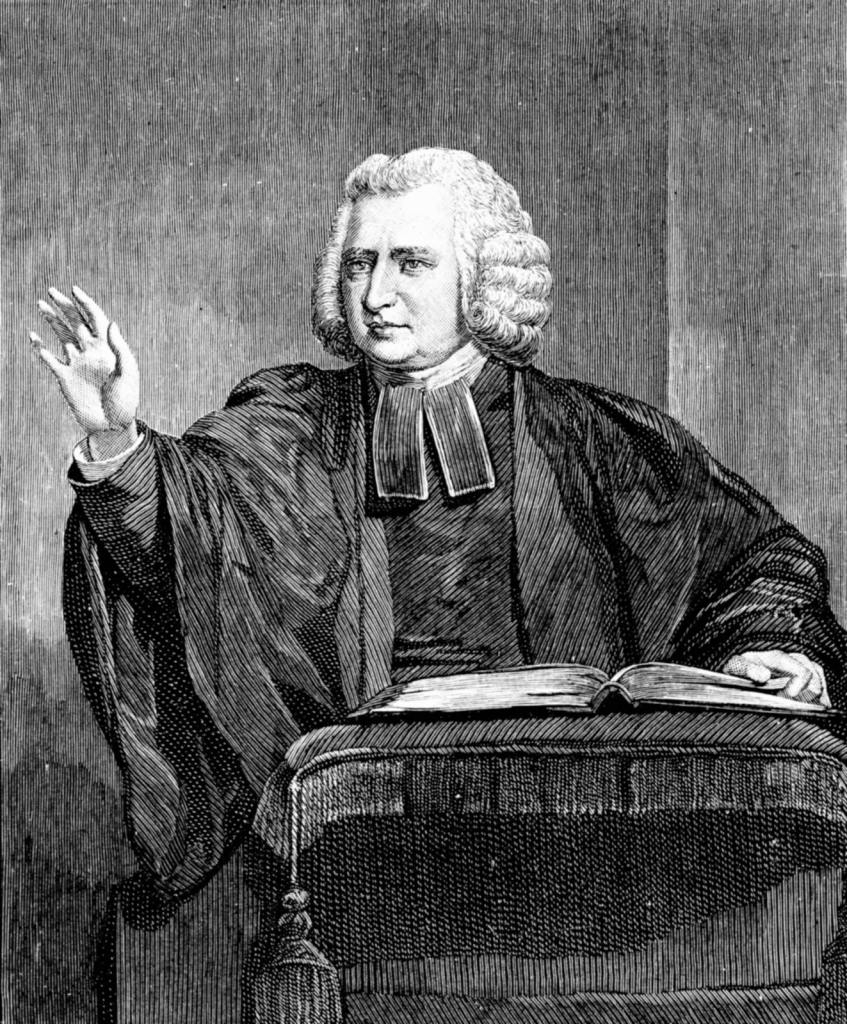
Charles Wesley 1707-1788
Charles Wesley, the son of Samuel Wesley, was born at Epworth, Dec. 18, 1707. He was educated at Westminster School and afterwards at Christ Church, Oxford, where he graduated M.A. In 1735, he took Orders and immediately proceeded with his brother John to Georgia, both being employed as missionaries of the S.P.G. He returned to England in 1736. For many years he engaged with his brother in preaching the Gospel. He died March 29, 1788. To Charles Wesley has been justly assigned the appellation of the “Bard of Methodism.” His prominence in hymn writing may be judged from the fact that in the “Wesleyan Hymn Book,” 623 of the 770 hymns were written by him; and he published more than thirty poetical works, written either by himself alone, or in conjunction with his brother. The number of his separate hymns is at least five thousand. http://www.hymnary.org/person/Wesley_Charles
“I have a record,” said a Wesleyan missionary laboring in the West Indies, “of two hundred persons, young and old, who received the most direct evidence of the forgiveness of their sins while singing ‘Arise, my soul.’ The conversion of the greater number of these persons took place while I was a missionary abroad.”
Sankey, p. 115
 The Vine Vigil