Creation in the 21st Century Is Back! – YouTube
Leave a reply

Ecclesiastes 3:11 KJV He hath made every thing beautiful in his time: also he hath set the world in their heart, so that no man can find out the work that God maketh from the beginning to the end.

It astounds me that these beautiful flowers grew from dust-like seeds in seven months’ time! Each is different and beautiful. The Lord says that no matter what we do to ourselves as far as embellishments go, we will never be as gorgeous as flowers. Very humbling, from my perspective. Thank You, Lord Jesus!
sage

Are you fortunate enough to live among trees? The Word of God is replete with references to trees – in the histories and prophecies. I often think of the old adage – “he can’t see the forest for the trees,” when faced with the obstinate refusal of sinners to see the sin that they are mired in. As they are in the midst of it – they fail to see how immense sin truly is. The Lord made all trees and plants on the third day of creation – and He made them very, very good. . . not just good for food, shelter, clothing, and outright beauty. . .but good for our souls.
Trees Really Are ‘Pleasant to the Sight’
by Brian Thomas, M.S. *
Genesis 2:9 records one of the Lord’s original intentions for creating trees, saying, “Out of the ground the LORD God made every tree grow that is pleasant to the sight and good for food. The tree of life was also in the midst of the garden, and the tree of the knowledge of good and evil.” A new study has quantified just how pleasant to the sight trees can be, inadvertently confirming the truthfulness of this ancient biblical passage.
Professor William Sullivan and lecturer Bin Jiang of the University of Illinois’ department of landscape architecture measured stress levels in participants who watched six-minute-long 3D panoramic videos of neighborhoods. The amount of tree canopy coverage in the various neighborhoods ranged from 2 to 62 percent.1
The researchers used three tactics to gauge stress: measuring salivary cortisol levels, detecting skin conductance, and conducting self-reports. Adrenal glands secrete cortisol hormone in response to stress, and sweaty skin—another response to stress—conducts electricity more efficiently than dry skin.
Their analysis revealed that those participants exposed to 62 percent tree coverage experienced a 60 percent reduction in stress.
Their results also showed that 41 percent of participants showed no change in stress levels when only a quarter or less of the neighborhood canopies had trees. However, according to University of Illinois news, “when the percentage of tree canopy increased to 36 percent, more than 90 percent of viewers reported feeling calm or relaxed while watching the videos.”1
These findings support the idea that urban planners and landscape architects who incorporate green spaces into their plans could help foster a healthier, calmer populace.
How could the calming sense of pleasure that comes from looking at trees have evolved? Did it somehow help mankind out-compete some ancient and unfeeling animals from which we supposedly emerged?
Rather, God built trees to meet humanity’s God-given ability to appreciate them and thus their Maker. What better disposition from which to appreciate the Lord than one of simple pleasure? Viewed from a biblical perspective, the positive effect of merely looking at tree canopies confirms the words of Genesis that God made certain trees—not just the tree of the knowledge of good and evil—to be pleasant to the eyes.
References
* Mr. Thomas is Science Writer at the Institute for Creation Research.
Please enjoy this lovely rendition of Joyce Kilmer’s/Oscar Rasbach’s “Trees,” sung by Bob McGrath, in classical Irish tenor style...

The next time you are outside, stop and take a whiff of the oxygen and fragrance that trees provide. Really pause, and look up at their branches moving in the wind. Thank our Creator for giving us such beautiful, wonderful things, things that we so often overlook in our busy lives.
Please enjoy this full screen with your family!
Wonderful Moody Science video, beautiful cinematography, completely reverent. Enjoy full screen!
1 Thessalonians 5:5
“Ye are all the children of light, and the children of the day: we are not of the night, nor of darkness.”
The best fishermen not only know where the fish are biting, but exactly what type of bait or lure is needed to catch the big ones. That’s why I say that the best fisherman of all is not a man but a bird.
 The black heron knows exactly where and when the fish are biting. He goes fishing for his food by wading into shallow lakes and ponds. But there’s a problem. Fish avoid the water’s surface to avoid the bright rays of the sun. Even if a fish does come close to the surface, the black heron is unable to see it because he is blinded by the sun’s reflection.
But like I said, this bird is a master fisherman. What he does is shape his wings into a large black umbrella. He then crouches down until his wings are almost touching the water, effectively turning daylight into darkness, and attracting fish to the shade. Under cover of his umbrella, the black heron pokes his head into the water and comes out with a squirming fish in his beak.
This kind of fishing is known as canopy feeding. How did the black heron learn to fish like this? Creationists know, but evolutionists have no reasonable answer. They only have a term. Yes, evolutionists are good at coming up with terms like “canopy feeding”, but when it comes to explaining how such a thing originated in the first place, they are still very much in the dark.
This article intrigued me so much, that I decided to investigate further. My father was an avid fisherman, and always took the boat to shady areas of the lake for the best fishing. Even my mother would have admitted that my dad’s brain was larger than the umbrella bird’s brain is. This is another fascinating example of God’s provision and care. My father learned through experience to fish in shady areas. The Black Heron does this without being taught.
From wiki: The black heron (Egretta ardesiaca) also known as the black egret, is an Africanheron. It is a medium-sized (42.5–66 cm in height), black-plumaged heron with black legs and yellow feet. It is found south of the Sahara Desert, including Madagascar, and prefers shallow open waters, such as the edges of freshwater lakes and ponds. It may also be found in marshes, river edges, rice fields, and seasonally flooded grasslands. In coastal areas, it may be found feeding along tidal rivers and creeks, in alkaline lakes, and tidal flats. Its breeding range is between Senegal and Sudan and to the south. It is found mainly on the eastern half of the continent. It has also been observed in Greece.[2]
This map displays the Black Heron’s (umbrella birds) distribution:

Notice the narrator in the next video repeatedly mentions how amazing it is that this bird “adapted” itself to fish in this ingenious manner. Very clever bird-brain!

As you can see, black heron are colony nest builders. Many heron families live together in the same large tree. It is quite noisy at feeding time!
Leviticus 11:18-20
18 And the swan, and the pelican, and the gier eagle,
19 And the stork, the heron after her kind, and the lapwing, and the bat.
20 All fowls that creep, going upon all four, shall be an abomination unto you.
Deuteronomy 14:17-19
17 And the pelican, and the gier eagle, and the cormorant,
18 And the stork, and the heron after her kind, and the lapwing, and the bat.
19 And every creeping thing that flieth is unclean unto you: they shall not be eaten.
It is to be noted that birds of prey, and carnivorous animals were named as being abominations for food. While we are not under such dietary laws now – it is interesting to think about God’s care for His people. Animals and birds that eat other creatures are prone to more parasites and diseases than herbivores are. Scientifically – they are not safe to eat! http://www.eufic.org/article/en/food-safety-quality/animal-health/expid/review-animal-diseases/
Egyptian and other cultures surrounding Israel, had diets that included many of these “unclean” animals.
And said, If thou wilt diligently hearken to the voice of the Lord thy God, and wilt do that which is right in his sight, and wilt give ear to his commandments, and keep all his statutes, I will put none of these diseases upon thee, which I have brought upon the Egyptians: for I am the Lord that healeth thee.
Evidence for Creation › Evidence from Science › Evidence from the Life Sciences › Life Was Created Fully Functional
Even children learn that plants and animals depend on one another. Plants release oxygen for animals to breathe, and plants make food—mostly sugar—for animals to eat. In turn, animals produce carbon dioxide so plants can grow using sunlight. This ecological interdependence shows enough divine design to inspire any honest thinker to consider a Creator, but a recently discovered interaction between pitcher plants and bats shows even more.1
Pitcher plants in tropical Borneo, the largest island in Asia, attract a particular species of bat to roost right inside their pitchers. The plants absorb nitrogen from the bat waste that drops to the bottom of the pitchers, and the bats enjoy comfy digs. Researchers already knew that pitcher plants in South American jungles grow flowers that attract bats for pollination, but the Asian version is unique. They give bats a safe place to roost during daylight hours. How do bats discern these preferred pitcher plants from the surrounding dense jungle foliage, and does the answer to that question help explain how this all might have evolved?
German specialists worked with biologists from Brunei, Borneo to track down the specifics on how pitcher plants attract bats. They published their results in Current Biology.2 The pitcher plants present concave reflectors that attract their bat buddies. Bats’ high-pitched sound waves bounce off the reflector, so it stands out against the drab-sounding jungle background. The pitcher’s sonic reflector has three other precise design features.
1. The plant’s reflector is situated just above the pitcher’s opening. To the bat, the reflector sounds very loud, but the opening below absorbs sound. The bats easily pick out this distinct contrast.
2. The area containing the reflector is larger than related pitcher plants that attract insects, increasing its sonic signal.
3. It reflects distinct sonic patterns on either side so that the bats can detect it from many angles.
The plant reflector’s size and side-reflecting patterns only work when a certain range of sound frequencies strike it. Of course, these exactly match the vocal range of these local bats, which happen to hold the record for highest frequencies of all bats so far measured. For more about animal sonar, watch our short video here.
How did all this interdependent fine-tuning happen? For a pitcher plant to construct the right size and shape reflector in the right place, it needs just the right building instructions in its DNA. And no number of high-pitched bat calls can somehow reach into plant-seed DNA and write new reflector construction code.
The Current Biology study authors wrote, “In the Neotropics, a few bat-pollinated plants found an efficient solution to attract bats by developing floral ultrasound reflectors, which enabled them to exploit the bats’ echolocation system.”2 But when is the last time a plant, animal, or any non-person willfully changed its DNA to solve an environmental challenge? Plus, how would these plants ever “know” about the benefits of bat guano’s nitrogen until after they already had fully formed bat homes to attract it?
The plants found no solution, developed no reflectors, and exploited no echolocation. People alone can perform these kinds of creative tasks, and the best example is the person of the Lord Jesus Christ, “For by Him all things were created that are in heaven and that are on earth, visible and invisible.”3
Pitcher plant reflectors reflect creation—His creation—and this interdependent pitcher plant-bat system showcases the ingenious design within that creation.
References
*Mr. Thomas is Science Writer at the Institute for Creation Research.
http://www.icr.org/article/8959
In the Bible, bats are considered “night birds.” They are mentioned as being unclean to eat, and are also mentioned as part of the end-times judgment. Bats are fascinating creatures in God’s creation. They testify of His wonders, and may we never tire of learning about Him.
Leviticus 11: 13And these are they which ye shall have in abomination among the fowls; they shall not be eaten, they are an abomination: the eagle, and the ossifrage, and the ospray, 14And the vulture, and the kite after his kind; 15Every raven after his kind; 16And the owl, and the night hawk, and the cuckow, and the hawk after his kind, 17And the little owl, and the cormorant, and the great owl, 18And the swan, and the pelican, and the gier eagle, 19And the stork, the heron after her kind, and the lapwing, and the bat.
Isaiah 2: 17And the loftiness of man shall be bowed down, and the haughtiness of men shall be made low: and the LORD alone shall be exalted in that day. 18And the idols he shall utterly abolish. 19And they shall go into the holes of the rocks, and into the caves of the earth, for fear of the LORD, and for the glory of his majesty, when he ariseth to shake terribly the earth. 20In that day a man shall cast his idols of silver, and his idols of gold, which they made each one for himself to worship, to the moles and to the bats; 21To go into the clefts of the rocks, and into the tops of the ragged rocks, for fear of the LORD, and for the glory of his majesty, when he ariseth to shake terribly the earth.
The Scriptural use of bats relates to the spiritual darkness of man in the world. They fly only at night, which is the same domain of the spiritually lost. The light of the world is Jesus Christ, the god of this world is Satan, and there is no light in him. Lucifer is the false light. The light that the evil one emits, can be likened to the light given off by electric bug zappers. The insects fly towards the light, which deceives them into thinking it is the moon. But, the false light of the bug zapper, only leads to their destruction, just as the false light of Lucifer leads to man’s destruction.
Jesus is the Light of the World. As believers, we reflect His glorious light to a lost and dying world.
Recent discoveries of symbiotic relationships in nature, have been blanketed with the ubiquitous label “co-evolution.” Never mind that it is mathematically and statistically impossible, the creation deniers soothe themselves with this bizarre idea. One single organism evolving is far fetched enough. But two organisms evolving to be interdependent? No algorithm can be developed to cover any such mechanisms.
‘All of the problems with evolutionary theory, as outlined in Genetic Entropy and the Mystery of the Genome, have now been rigorously proven using numerical simulation. We did this using “Mendel’s Accountant”, a state-of-the-art computer analytical tool for genetic systems. Five scientists—John Baumgardner, Wes Brewer, Paul Gibson, Walter ReMine, and I—developed this tool. We reported these new findings in two secular publications, and they will soon be discussed in a second book, Genetic Entropy and Mendel’s Accountant.’
Genesis 1:11
“And God said, Let the earth bring forth grass, the herb yielding seed, and the fruit tree yielding fruit after his kind, whose seed is in itself, upon the earth: and it was so.”
The next time you enjoy a vanilla ice cream cone, keep in mind that vanilla wouldn’t even exist if evolution were true. Evolutionists don’t have a blooming idea about the origin of a special symbiotic relationship between a particular flower and a very special bee.
 You see, vanilla comes from the vanilla planifolia plant which develops into the Mexican vanilla orchid. Unlike most orchids, this one blooms only one morning each year. The orchid also has a hood-like membrane that covers the part that produces pollen. These two facts make pollination almost impossible.
But the God who created this plant also created the Mexican Melipona Bee – the only insect that knows how to pollinate the orchid. After landing on the flower, the bee lifts up the hood, collects the pollen and then flies off to another flower. Once pollinated, the orchid produces a vanilla bean. If not pollinated within eight to twelve hours, the flower wilts and drops from the mother vine.
Without the Mexican Melipona Bee, you wouldn’t be able to enjoy any of the delicious foods made with vanilla extract. So we would ask evolutionists – which came first: the orchid or the bee? And how did the bee learn to pollinate the vanilla orchid?
At best, evolutionists can only offer guesses. But creationists know that the bee and the flower are a match made in heaven. They enjoy a symbiotic relationship so that each can survive … and so we can enjoy the fruit of their labor!
http://us1.campaign-archive2.com/?u=ef70e621be0fb33b32fc8d969&id=3c57a732da&e=c0bce84adc
This video demonstrates human beings hand pollinating vanilla orchids in Uganda. It is not easy to do! The stingless Melipona bee does not need to be taught how to pollinate the Vanilla orchid. It is what they do.
We serve a Holy and Wonderful God. As “earth day” (April 22) is celebrated by pagans around the world, let us pause to worship the creator of this earth, and the fascinating variety of life and beauty that comes from His handiwork.
A family reunion among spiders is not a pretty thing. Many of the some 35,000 species of spiders begin eating their siblings as soon as they hatch. For this reason, spiders are typically lone hunters. Evolutionists have always explained that spiders evolved this way because it works best for them.
 But a few species of spiders are social. They live together in large communities, caring for each other’s young and working together to get food. Their social structure is not like that of bees or ants; but, as one researcher put it, spider society is more like a herd of wildebeests. A South American social spider lives in multi generational colonies that can have hundreds of thousands of members. Australia’s crab spider is also social, building a nest of eucalyptus leaves. The colonial orb weaving spider of Mexico and the U.S. Southwest builds huge colonies out of individual orb webs. The largest colony web ever found was 12 feet deep, six feet high and 600 feet long. It contained hundreds of thousands of members!
Evolutionary scientists have been struggling not just with an explanation for how social spiders evolved, but how it happened independently among eight unrelated families of spiders. But the answer should be obvious. The same Creator Who made the wildebeest a herd animal also made social spiders the same way. He did it so we might recognize His existence and then learn of His love for us in sending His Son to be our Savior.
Prayer:
We praise You, Father, for the amazing creativity with which You have signed Your creation so we might seek You. Amen.
Notes:
Laura Helmuth, “Spider Solidarity Forever,” Science News, May 8, 1999, v. 155, p. 300. Photo: Crab spider. Courtesy of André Karwath. Licensed under the Creative Commons Attribution-Share Alike 2.5 Generic license.
http://www.creationmoments.com/radio/transcripts/social-spiders-0
The scope and variety of God’s creation is breathtaking to behold. Anomalies such as the social spider, fly in the face of evolutionary thinking. I thank the Lord, that He is omniscient, and has provided for us so many indelible proofs of His glory and majesty over all things, in heaven and earth.
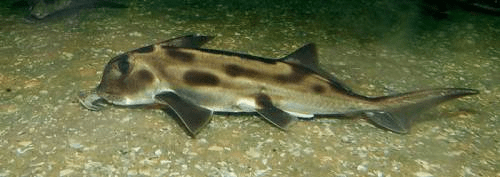
When mainstream scientists search for clues about how and when the first bony-skeleton creature evolved from a non-bony creature, do they overlook evidence showing skeletons could never evolve from non-skeletons in the first place? It appears that a large collaboration of scientists that analyzed DNA from a spectacular living fossil called an elephant shark did just that. The title of their report, published in Nature, refers to “unique insights” into evolution, but the facts actually reveal something else.1
The elephant shark, or Australian ghost shark, is a cartilaginous fish that uses a snout to probe sea-floor sands for small clams in New Zealand and Australian waters. They have other non-shark-like characteristics, including green eyes placed high atop their heads and opercula covering their gills.
Elephant shark fossils occur in Ordovician rocks, assigned a conventional age of 450 million years, and in Permian rocks, assigned an age of 260 million years. Elephant sharks are still living today. Supposedly, they have not changed in form for over 300 million years and this makes them a spectacular example of a living fossil. The Nature authors wrote that their genetic analysis “shows that the C. milii [elephant shark] genome is evolving significantly slower than other vertebrates, including the coelacanth, which is considered a ‘living fossil.’”1
To say that the elephant shark has evolved slowly because its form has not changed dramatically understates the situation—it has not evolved at all! The study authors wrote, “The factors contributing to the lower evolutionary rate of C. milii are not known.”1 (One explanation they evidently didn’t consider for why these fish have not evolved is that God created their basic form right from the start.)
The main purpose of this secular research project was to find clues that might explain how jawed fishes evolved from jawless fishes—an evolutionarily biased approach. So, the researchers fitted their elephant shark’s genomic data into an evolutionary narrative about how jawless fishes evolved into the first cartilaginous-jawed fish and how some of its descendants then evolved into the first bony-jawed fish. And this despite the fact that all three groups suddenly appear side by side as contemporaries in Cambrian system strata!
Each step in the supposed evolution of vertebrates would require a wholesale restructuring of the ancestor’s anatomy. The Nature authors wrote, “This transition was accompanied by many morphological and phenotypic innovations.”1 But there are no demonstrations of creatures innovating even one new body part, let alone many. Plus, undisputed transitions are still no-shows in the fossil record.
What if these fish were created much as we find them today and never did evolve? This report ignores such questions, and its conclusions drip with evolutionary bias. For example, the authors wrote, “Overall, the C. milii genome is the least derived [least evolved] among known vertebrates.”1 But what empirical foundation supports a “least derived” designation? It is purely subjective since another research group could just as easily assert—perhaps on the basis of another organism’s perfectly unique genetic makeup and fossil occurrence in lower strata—an entirely different creature as being the least-derived vertebrate.2
Supposedly, elephant sharks “constitute a critical outgroup for understanding the evolution and diversity of bony vertebrates.”1 How do the researchers know that this fish kind is a critical outgroup? This designation comes not from data, but from an evolutionary-slanted assertion.
The Nature authors wrote of the elephant shark’s genome, “Its value for comparative genomic studies is illustrated by our analysis of genetic events that led to the ossification of endoskeleton in bony vertebrates.”1 Wait a minute—did these authors really study genetic events? Do they have a time machine that enabled them to go back and observe these alleged events? In reality, it appears they forced a high-functioning and one-of-a-kind genome into an evolutionary model.
The most significant insights that the elephant shark study revealed are that it simply has not evolved over supposed hundreds of millions of years and that secularists insist on fitting it into an evolutionary narrative despite the evidence. But its lack of evolution makes perfect sense if God created these fish to reproduce after their kind, just like He said.3
http://www.icr.org/article/7879/

Phil Currie, one of Canada’s leading paleontologists, helped excavate a virtually complete skeleton of what is likely the youngest ceratopsian dinosaur ever found. Ceratopsians include the famous Triceratops, but others within the group possessed different body sizes, head frills and various numbers of horns.
Juvenile dinosaurs are rare enough, but to find a three-year-old almost completely intact specimen—only its front legs are missing—is so rare that it may be one of a kind. Currie told LiveScience, “The big ones just preserve better.”1 Nobody is quite sure why.
This juvenile from Canada had no horns, and the fossil looked eerily familiar. Remarkably, ancient burial artifacts from within what is today northeastern China bear a striking resemblance to this juvenile ceratopsian fossil find. The Hongshan culture expertly carved figurines into the shapes of animals, dragons and people out of valuable materials like jade.
Auction houses sell the dinosaur-like carvings as “pig-dragons” because of the pig-like noses on some of the figurines. But some Hongshan figurines are actually pigs, clearly showing that the carvers knew their subject matter.
Some of their ancient depictions are difficult to identify, but others are plain to see. The dragon figurines don’t resemble any standard zoo animal alive today, and one wonders how the carvers could have carved the animal look-alikes without looking at the live animal. Presumably, ancient Chinese artists did not have access to fossils in Canada or even Mongolia where paleontologists found protoceratops fossils in the mid-20th century, nor would one expect the artists to have developed the expertise to reconstruct whole animals from mere skeletal fragments.
Plus there’s the question of motivation. Why would they portray skeletal remains as a living animal?
Further, what are the chances that any ancient culture—Chinese or not—would have stumbled upon such a rare fossil, then used it as a template to carve figurines right alongside those of other living animals and people?
At this point, the best explanation for these jade figurines may be that long ago peoples expertly carved likenesses of then-living dinosaurs—even juvenile ceratopsians.
http://www.icr.org/article/7852/
King James Version (KJV)

Most people are aware of the central nervous system, and its role in interpreting information that our senses come in contact with, through sight, touch and smell. Evolutionists have argued that these complex funtions only occur in the “higher life forms.”
Psalm 104:14
“He causeth the grass to grow for the cattle, and herb for the service of man: that he may bring forth food out of the earth….”
The dodder is a very unusual plant and is known as one of the ten worst weeds found in the United States. A newly sprouted dodder seed does not bother to grow roots. Rather, it sprouts a tendril that grows out, looking for other plants. It has, at most, a week to find a plant from which to steal water and nutrients.

The dodder is a parasite and while it does not kill its victims, it will take enough water and nutrition to stunt their growth. The dodder actually costs California tomato growers $4,000,000 a year in losses. Researchers found that the species of dodder that causes most trouble to tomato plants actually “sniffs out” its victims. Scientists knew that plants emit pheromones or scents unique to each species. The researchers gave a sprouting dodder seed a choice of targets to grow toward, including a tomato plant. When the dodder seed sprouted, it immediately sent a tendril out to the tomato. In a more rigorous test, researchers connected possible targets in separate enclosures to the sprouting dodder with curved tubes. The dodder still found the tomato plant.
The dodder has no nervous system, and scientists marvel at what it can do. Rather, they should be marveling at what our Creator can do in providing for the needs of all living things.
http://www.creationmoments.com/radio/transcripts/plant-sniffs-out-prey
https://player.pbs.org/viralplayer/2341198769/
While scientists are thrilled at the performance of the Dodder plant – they offer no evidence on how such a capability, in such a “simple life form,” could possible have developed through random mutations.
 The Vine Vigil