Tag Archives: genetics

Transhumansim – The Quest to be Gods

Nothing has changed in over 6,000 years.

James Hughes Ph.D., the Executive Director of the Institute for Ethics and Emerging Technologies, is a bioethicist and sociologist at Trinity College in Hartford Connecticut where he teaches health policy and serves as Director of Institutional Research and Planning. He holds a doctorate in sociology from the University of Chicago, where he also taught bioethics at the MacLean Center for Clinical Medical Ethics. Dr. Hughes is author of Citizen Cyborg: Why Democratic Societies Must Respond to the Redesigned Human of the Future , and is working on a second book tentatively titled Cyborg Buddha. Since 1999 he has produced a syndicated weekly radio program, Changesurfer Radio.

As transhuman possibilities increasingly develop, the compatibilities of metaphysics, theodicy, soteriology and eschatology between the transhumanist and religious worldviews will be built upon to create new “trans-spiritualities.”  In this future religious landscape there will be bioconservative and transhumanist wings within all the world’s faiths, and probably new religious traditions inspired by the transhumanist project.  We will create new religious rituals and meanings around biotechnological and cybernetic and cybernetic capabilities, just as we did around fire, the wheel, healing plants, and the book.

James  J. Hughes, The Compatibility of Religious and Transhumanism Views of Metaphysics, Suffering, Virtue, and Transcendence in an Enhanced Future

In the Caltech experiments, the researchers stripped an HIV virus of its disease-causing elements and used it to virally infect single-cell embryos of mice with a gene from a jellyfish.

Any number of different genes could have been selected. For the purpose of the studies, the researchers chose a specific jellyfish gene that could serve as a “marker” to indicate whether the gene transfer was successful. The gene produces a protein that gives the jellyfish a green fluorescence.

When the mice were born, they carried the jellyfish gene in their own genes. Under fluorescent light, all their major tissues and organs—including skin, bones, muscles, lungs, liver, kidney, stomach, brain, and retina—emitted a green glow.

The trait became a permanent feature of the mice genome and was passed along to many of their offspring.  (National Geographic)

This has gone much, much farther than glow mice. This description of the fearsome  locusts in Revelation 9: 6-12 does not sound all that incredible in light of this.
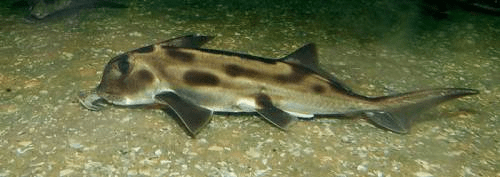
Elephant Sharks Defy Evolution

Elephant Shark Research Team Misses Creation Clues

by Brian Thomas, M.S. *

When mainstream scientists search for clues about how and when the first bony-skeleton creature evolved from a non-bony creature, do they overlook evidence showing skeletons could never evolve from non-skeletons in the first place? It appears that a large collaboration of scientists that analyzed DNA from a spectacular living fossil called an elephant shark did just that. The title of their report, published in Nature, refers to “unique insights” into evolution, but the facts actually reveal something else.1

The elephant shark, or Australian ghost shark, is a cartilaginous fish that uses a snout to probe sea-floor sands for small clams in New Zealand and Australian waters. They have other non-shark-like characteristics, including green eyes placed high atop their heads and opercula covering their gills.

Elephant shark fossils occur in Ordovician rocks, assigned a conventional age of 450 million years, and in Permian rocks, assigned an age of 260 million years. Elephant sharks are still living today. Supposedly, they have not changed in form for over 300 million years and this makes them a spectacular example of a living fossil. The Nature authors wrote that their genetic analysis “shows that the C. milii [elephant shark] genome is evolving significantly slower than other vertebrates, including the coelacanth, which is considered a ‘living fossil.’”1

To say that the elephant shark has evolved slowly because its form has not changed dramatically understates the situation—it has not evolved at all! The study authors wrote, “The factors contributing to the lower evolutionary rate of C. milii are not known.”1 (One explanation they evidently didn’t consider for why these fish have not evolved is that God created their basic form right from the start.)

The main purpose of this secular research project was to find clues that might explain how jawed fishes evolved from jawless fishes—an evolutionarily biased approach. So, the researchers fitted their elephant shark’s genomic data into an evolutionary narrative about how jawless fishes evolved into the first cartilaginous-jawed fish and how some of its descendants then evolved into the first bony-jawed fish. And this despite the fact that all three groups suddenly appear side by side as contemporaries in Cambrian system strata!

Each step in the supposed evolution of vertebrates would require a wholesale restructuring of the ancestor’s anatomy. The Nature authors wrote, “This transition was accompanied by many morphological and phenotypic innovations.”1 But there are no demonstrations of creatures innovating even one new body part, let alone many. Plus, undisputed transitions are still no-shows in the fossil record.

What if these fish were created much as we find them today and never did evolve? This report ignores such questions, and its conclusions drip with evolutionary bias. For example, the authors wrote, “Overall, the C. milii genome is the least derived [least evolved] among known vertebrates.”1 But what empirical foundation supports a “least derived” designation? It is purely subjective since another research group could just as easily assert—perhaps on the basis of another organism’s perfectly unique genetic makeup and fossil occurrence in lower strata—an entirely different creature as being the least-derived vertebrate.2

Supposedly, elephant sharks “constitute a critical outgroup for understanding the evolution and diversity of bony vertebrates.”1 How do the researchers know that this fish kind is a critical outgroup? This designation comes not from data, but from an evolutionary-slanted assertion.

The Nature authors wrote of the elephant shark’s genome, “Its value for comparative genomic studies is illustrated by our analysis of genetic events that led to the ossification of endoskeleton in bony vertebrates.”1 Wait a minute—did these authors really study genetic events? Do they have a time machine that enabled them to go back and observe these alleged events? In reality, it appears they forced a high-functioning and one-of-a-kind genome into an evolutionary model.

The most significant insights that the elephant shark study revealed are that it simply has not evolved over supposed hundreds of millions of years and that secularists insist on fitting it into an evolutionary narrative despite the evidence. But its lack of evolution makes perfect sense if God created these fish to reproduce after their kind, just like He said.3

http://www.icr.org/article/7879/

What a fascinating creature!  These fish remind me of butterflies in the manner that they swim.  Extraordinary! If you do not recognize the hand of God in the creation  – you are doomed. 

JOB 12:7-9

But ask now the beasts, and they shall teach thee; and the fowls of the air, and they shall tell thee:

Or speak to the earth, and it shall teach thee: and the fishes of the sea shall declare unto thee.

Who knoweth not in all these that the hand of the Lord hath wrought this?