Find out how to successfully grow radishes at home and discover the essential tips that will ensure a thriving garden.
Growing Radishes At Home: Step-by-Step Guide to Grow It Yourself

Find out how to successfully grow radishes at home and discover the essential tips that will ensure a thriving garden.
Growing Radishes At Home: Step-by-Step Guide to Grow It Yourself
On this page, we invite our readers to share their thrifty ideas with us and other readers. It behooves the truly born-again Christian, to make proper use of whatever God gives. I always like to think, that the more frugal I am, the more I will have to support missions, ministries, and to give to worthy causes – like the crisis pregnancy center. Wastefulness has no place in the family of God, especially when we consider that every breath we draw is a gift from Him.
I’ll get it started with some of my major thrifty stuff. Please feel free to share your frugal fun with us in the comment section – and if I deem any of them to be superior – they will be edited into the post.

Cut down old flannel sheets, shirts, and anything else that is 100% cotton, into handkerchiefs. Serge or overcast the edges, or pink if no sewing machine is available. Wash with bleach or borax and hot water for sanitation, since it doesn’t matter what color they are as long as they are clean. A good size is 10 x 10.
Use plastic lids that have a deep lip as plant saucers to catch water run off. For example – the lid to large Nesquick canisters are ample saucers for a 5″ pot.

Use large clear “pretzel barrels” as mini cloches/greenhouses for your early tomato and pepper plants. They are the perfect size, and will protect tender plants from late frosts and torrential downpours. A lot of snack foods come in these barrels now. And you can use the lids as plant saucers!
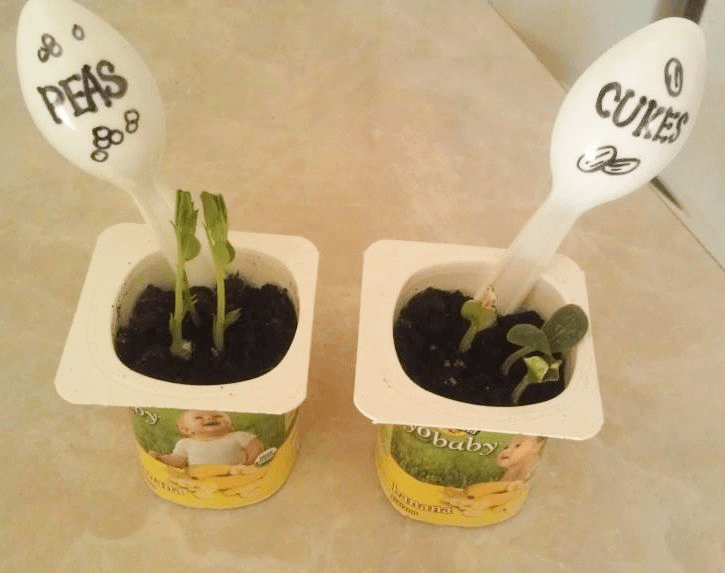
Empty yogurt containers make ideal seed starting pots, with holes poked in the bottom for drainage. Filled with cheap soilless planting media you can save oodles of money by starting your own plants from seeds. Especially if you save seeds!
Cat Mahm:
Keep the heat in at Christmas-time by lining the windows with “fake snow”. This could be cotton fluff from the inside of an old pillow, or I even sometimes use white dish clothes.
Keeping heat in can reduce the heating bill, so I line everything with towels or insulating materials. It especially helps around the bases of the windows!

Cat Mahm:

Yes it does.
Need to kill the weeds in the driveway? Don’t buy all of that expensive weed killer.
During the spring/summer/fall months, I get a tea kettle to boil. Shortly after it has boiled, I pour it on the dandelions or persistent grass growing up through concrete. I go out the next morning and the weeds have completely withered and are easy to pull up. My driveway is weed free all year long.
Cat Mahm:
I never go out to eat. I never do take out. It’s never healthier, it’s addictive, and it’s way more expensive.
I buy my ground beef in bulk and chop it up into individual pounds, and store them in the freezer. You can do this with so many things. I would love to get a chest freezer someday. Buy everything on sale, freeze it. So many things can go in a chest freezer.
Please share your thrifty secrets with us!

Are you fortunate enough to live among trees? The Word of God is replete with references to trees – in the histories and prophecies. I often think of the old adage – “he can’t see the forest for the trees,” when faced with the obstinate refusal of sinners to see the sin that they are mired in. As they are in the midst of it – they fail to see how immense sin truly is. The Lord made all trees and plants on the third day of creation – and He made them very, very good. . . not just good for food, shelter, clothing, and outright beauty. . .but good for our souls.
Trees Really Are ‘Pleasant to the Sight’
by Brian Thomas, M.S. *
Genesis 2:9 records one of the Lord’s original intentions for creating trees, saying, “Out of the ground the LORD God made every tree grow that is pleasant to the sight and good for food. The tree of life was also in the midst of the garden, and the tree of the knowledge of good and evil.” A new study has quantified just how pleasant to the sight trees can be, inadvertently confirming the truthfulness of this ancient biblical passage.
Professor William Sullivan and lecturer Bin Jiang of the University of Illinois’ department of landscape architecture measured stress levels in participants who watched six-minute-long 3D panoramic videos of neighborhoods. The amount of tree canopy coverage in the various neighborhoods ranged from 2 to 62 percent.1
The researchers used three tactics to gauge stress: measuring salivary cortisol levels, detecting skin conductance, and conducting self-reports. Adrenal glands secrete cortisol hormone in response to stress, and sweaty skin—another response to stress—conducts electricity more efficiently than dry skin.
Their analysis revealed that those participants exposed to 62 percent tree coverage experienced a 60 percent reduction in stress.

Their results also showed that 41 percent of participants showed no change in stress levels when only a quarter or less of the neighborhood canopies had trees. However, according to University of Illinois news, “when the percentage of tree canopy increased to 36 percent, more than 90 percent of viewers reported feeling calm or relaxed while watching the videos.”1
These findings support the idea that urban planners and landscape architects who incorporate green spaces into their plans could help foster a healthier, calmer populace.
How could the calming sense of pleasure that comes from looking at trees have evolved? Did it somehow help mankind out-compete some ancient and unfeeling animals from which we supposedly emerged?
Rather, God built trees to meet humanity’s God-given ability to appreciate them and thus their Maker. What better disposition from which to appreciate the Lord than one of simple pleasure? Viewed from a biblical perspective, the positive effect of merely looking at tree canopies confirms the words of Genesis that God made certain trees—not just the tree of the knowledge of good and evil—to be pleasant to the eyes.
References
* Mr. Thomas is Science Writer at the Institute for Creation Research.
Please enjoy this lovely rendition of Joyce Kilmer’s/Oscar Rasbach’s “Trees,” sung by Bob McGrath, in classical Irish tenor style...

The next time you are outside, stop and take a whiff of the oxygen and fragrance that trees provide. Really pause, and look up at their branches moving in the wind. Thank our Creator for giving us such beautiful, wonderful things, things that we so often overlook in our busy lives.
Most people are aware of the central nervous system, and its role in interpreting information that our senses come in contact with, through sight, touch and smell. Evolutionists have argued that these complex funtions only occur in the “higher life forms.”
Psalm 104:14
“He causeth the grass to grow for the cattle, and herb for the service of man: that he may bring forth food out of the earth….”
The dodder is a very unusual plant and is known as one of the ten worst weeds found in the United States. A newly sprouted dodder seed does not bother to grow roots. Rather, it sprouts a tendril that grows out, looking for other plants. It has, at most, a week to find a plant from which to steal water and nutrients.

The dodder is a parasite and while it does not kill its victims, it will take enough water and nutrition to stunt their growth. The dodder actually costs California tomato growers $4,000,000 a year in losses. Researchers found that the species of dodder that causes most trouble to tomato plants actually “sniffs out” its victims. Scientists knew that plants emit pheromones or scents unique to each species. The researchers gave a sprouting dodder seed a choice of targets to grow toward, including a tomato plant. When the dodder seed sprouted, it immediately sent a tendril out to the tomato. In a more rigorous test, researchers connected possible targets in separate enclosures to the sprouting dodder with curved tubes. The dodder still found the tomato plant.
The dodder has no nervous system, and scientists marvel at what it can do. Rather, they should be marveling at what our Creator can do in providing for the needs of all living things.
http://www.creationmoments.com/radio/transcripts/plant-sniffs-out-prey
https://player.pbs.org/viralplayer/2341198769/
While scientists are thrilled at the performance of the Dodder plant – they offer no evidence on how such a capability, in such a “simple life form,” could possible have developed through random mutations.
 The Vine Vigil