Redeemed, how I love to proclaim it! Redeemed by the blood of the Lamb; Redeemed through His infinite mercy, His child and forever I am.
Refrain
Redeemed, redeemed, Redeemed by the blood of the Lamb; Redeemed, redeemed, His child and forever I am.
Redeemed, and so happy in Jesus, No language my rapture can tell; I know that the light of His presence With me doth continually dwell.
Refrain
I think of my blessèd Redeemer, I think of Him all the day long: I sing, for I cannot be silent; His love is the theme of my song.
Refrain
I know there’s a crown that is waiting, In yonder bright mansion for me, And soon, with the spirits made perfect, At home with the Lord I shall be.
Refrain
“Oh, what a happy child I am,
although I cannot see!
I am resolved that in this world,
contented I will be!”
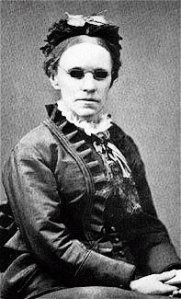
Fanny Crosby, (March 24, 1820 – February 12, 1915)
1 Peter 1:18-19
18 Forasmuch as ye know that ye were not redeemed with corruptible things, as silver and gold, from your vain conversation received by tradition from your fathers;
19 But with the precious blood of Christ, as of a lamb without blemish and without spot:
1 “Though your sins be as scarlet, they shall be as white as snow; though your sins be as scarlet, they shall be as white as snow. Though they be red like crimson, They shall be as wool. Though your sins be as scarlet, though your sins be as scarlet, they shall be as white as snow, they shall be as white as snow.”
2 Hear the voice that entreats you, O return ye unto God! Hear the voice that entreats you, O return ye unto God! He is great compassion, and of wondrous love. Hear the voice that entreats you, hear the voice that entreats you, O return ye unto God! O return ye unto God!
3 He’ll forgive your transgressions, and remember them no more: he’ll forgive your transgressions, and remember them no more. “Look unto me, ye people,” saith the Lord your God. He’ll forgive your transgressions, he’ll forgive your transgression, and remember them no more, and remember them no more.
Fanny Crosby 1820-1915
She could compose at any time and did not need to wait for any special inspiration, and her best hymns have come on the spur of the moment. She always composed with an open book in her hand, generally a copy of Golden Hymns, held closely over her eyes, bottom side up. She learned to play on the guitar and piano while at the institution, and has a clear soprano voice. She also received a technical training in music, and for this reason she could, and did, compose airs for some of her hymns. One of these is, “Jesus, dear, I come to Thee, Thou hast said I may,” both words and music of which are wonderfully sweet. “Safe in the arms of Jesus”, probably one of her best known hymns, was her own favorite. Fanny loved her work, and was happy in it. She was always ready either to sympathize or join in a mirthful conversation, as the case may be. The secret of this contentment dates from her first composition at the age of eight years. “It has been the motto of my life,” she says. It is: “O what a happy soul am I! Although I cannot see, I am resolved that in this world Contented I will be;”
This has continued to be her philosophy. She says that had it not been for her affliction she might not have so good an education, nor so great an influence, and certainly not so fine a memory. She knows a great many portions of the Bible by heart, and had committed to memory the first four books of the Old Testament, and also the four Gospels before she was ten years of age.
17 Learn to do well; seek judgment, relieve the oppressed, judge the fatherless, plead for the widow.
18 Come now, and let us reason together, saith the Lord: though your sins be as scarlet, they shall be as white as snow; though they be red like crimson, they shall be as wool.
19 If ye be willing and obedient, ye shall eat the good of the land
Tell me the story of Jesus, Write on my heart every word; Tell me the story most precious, Sweetest that ever was heard. Tell how the angels in chorus, Sang as they welcomed His birth, “Glory to God in the highest! Peace and good tidings to earth.”
Refrain: Tell me the story of Jesus, Write on my heart every word; Tell me the story most precious, Sweetest that ever was heard.
Fasting alone in the desert, Tell of the days that are past, How for our sins He was tempted, Yet was triumphant at last. Tell of the years of His labor, Tell of the sorrow He bore; He was despised and afflicted, Homeless, rejected and poor.
Tell of the cross where they nailed Him, Writhing in anguish and pain; Tell of the grave where they laid Him, Tell how He liveth again. Love in that story so tender, Clearer than ever I see; Stay, let me weep while you whisper, “Love paid the ransom for me.”
Tell how He’s gone back to heaven, Up to the right hand of God: How He is there interceding While on this earth we must trod. Tell of the sweet Holy Spirit He has poured out from above; Tell how He’s coming in glory For all the saints of His love.
SONG WRITER: Fanny Crosby MUSIC WRITER: John R. Sweney WHEN WRITTEN: 1880
Blindness never produced self-pity in Fanny and she did not look on her blindness as a terrible thing. At eight years old she composed this little verse:
Oh, what a happy child I am, although I cannot see! I am resolved that in this world contented I will be! How many blessings I enjoy that other people don’t! So weep or sigh because I’m blind, I cannot – nor I won’t.
Alas! and did my Savior bleed And did my Sovereign die? Would He devote that sacred head For sinners such as I? [originally, For such a worm as I?]
Refrain
At the cross, at the cross where I first saw the light, And the burden of my heart rolled away, It was there by faith I received my sight, And now I am happy all the day!
Thy body slain, sweet Jesus, Thine— And bathed in its own blood— While the firm mark of wrath divine, His Soul in anguish stood.
Was it for crimes that I had done He groaned upon the tree? Amazing pity! grace unknown! And love beyond degree!
Well might the sun in darkness hide And shut his glories in, When Christ, the mighty Maker died, For man the creature’s sin.
Thus might I hide my blushing face While His dear cross appears, Dissolve my heart in thankfulness, And melt my eyes to tears.
But drops of grief can ne’er repay The debt of love I owe: Here, Lord, I give my self away ’Tis all that I can do.
Words: Isaac Watts, Hymns and Spiritual Songs, 1707;
[***Note from sage – you may not be familiar with this rendition – but it was the one that Fanny Crosby was referring to in 1880. The music sung in churches today was not written until 1885 when the well known refrain was added]
Hudson, Ralph E. Hudson, Songs of Peace, Love and Joy (Alliance, Ohio: 1885) It is with this tune that the hymn is known as At the Cross.
Fanny Crosby wrote of this hymn:
[In] the autumn of 1850…revival meetings were being held in the Thirtieth Street Methodist Church [, New York City]. Some of us went down every evening; and, on two occasions, I sought peace at the atlar [sic], but did not find the joy I craved, until one evening, November 20, 1850, it seemed to me that the light must indeed come then or never; and so I arose and went to the altar alone. After a prayer was offered, they began to sing the grand old consecration hymn, “Alas, and did my Saviour bleed, And did my Sovereign die?” And when they reached the third line of the fourth [sic] stanza, “Here Lord, I give myself away,” my very soul was flooded with a celestial light. I sprang to my feet, shouting “hallelujah,” and then for the first time I realized that I had been trying to hold the world in one hand and the Lord in the other.
As earnest Christian pastor told of a young man about whom he had long felt much anxiety, as he had seemed so unconcerned about his soul, and was, in reality, a real cause of disturbance and interruption in classes for other young men. Meeting him one day, the loving pastor sought once more to influence him, urging, “We want you for Christ and his service.” There was a certain change in his manner which did not escape the eye of the prayerful watcher for souls, and—lacking time to do more—he seized the opportunity to secure the presence of his young friend at a Christian Endeavor meeting soon to be held. True to his promise he was there. When an opportunity was given for some of the young men to choose a song, it was seen that he was urging his companion to select some particular hymn. The other, yielding to his request, asked if the hymn, “Pass me not, O gentle Saviour,” might be sung; and both young men joined in the singing with evident interest and heartiness. Later in the evening it was requested that all who were definitely on the Lord’s side would confess their allegiance by standing. Whereupon the one over whom the heart of the pastor was specially yearning rose at once, and with decision.
“Tell me about your conversion,” the thankful pastor requested at the close of the meeting, when hands were clasped in glad, brotherly welcome and recognition.
“Oh, yes,” assented the other. “It was all through that hymn we have just sung. I was working on the canal at G–, and there was a meeting being held at the Mariner’s Chapel, nearby. The words floated out over the water, and from the tug where I was working I could hear them plainly enough. When they were just going to sing those lines—‘While on others Thou are calling, Do not pass me by!’ a great fear came over me, and I thought, ‘Oh, if the Lord were to pass me by, how terrible it would be!’ Then and there, on the tug, I cried out, ‘O Lord, do not pass me by.’ And”—with a bright smile—“he didn’t pass me by. I am saved.’”
The Lord is not slack concerning His promise, as some men count slackness; but is longsuffering to us-ward, not willing that any should perish, but that all should come to repentance.
Jesus, keep me near the cross, There a precious fountain Free to all, a healing stream Flows from Calvary’s mountain.
Refrain
In the cross, in the cross, Be my glory ever; Till my raptured soul shall find Rest beyond the river.
Near the cross, a trembling soul, Love and mercy found me; There the bright and morning star Sheds its beams around me.
Refrain
Near the cross! O Lamb of God, Bring its scenes before me; Help me walk from day to day, With its shadows o’er me.
Refrain
Near the cross I’ll watch and wait Hoping, trusting ever, Till I reach the golden strand, Just beyond the river.
Refrain
Text: Fanny J. Crosby, 1820-1915 Music: William H. Doane, 1832-1915
“It may seem a little old-fashioned, always to begin one’s work with prayer, but I never undertake a hymn without first asking the good Lord to be my inspiration.”
Galatians 6:14
But God forbid that I should glory, save in the cross of our Lord Jesus Christ, by Whom the world is crucified unto me, and I unto the world.
Rescue the perishing, care for the dying, Snatch them in pity from sin and the grave; Weep o’er the erring one, lift up the fallen, Tell them of Jesus, the mighty to save.
Refrain
Rescue the perishing, care for the dying, Jesus is merciful, Jesus will save.
Though they are slighting Him, still He is waiting, Waiting the penitent child to receive; Plead with them earnestly, plead with them gently; He will forgive if they only believe.
Refrain
Down in the human heart, crushed by the tempter, Feelings lie buried that grace can restore; Touched by a loving heart, wakened by kindness, Chords that were broken will vibrate once more.
Refrain
Rescue the perishing, duty demands it; Strength for thy labor the Lord will provide; Back to the narrow way patiently win them; Tell the poor wand’rer a Savior has died.
Refrain
As I was addressing a large company of working men one hot August evening, the thought kept forcing itself upon my mind that some mother’s boy must be rescued that very night or perhaps not at all. So I requested that, if there was any boy present, who had wandered away from mother’s teaching, he would come to the platform at the conclusion of the service. A young man of eighteen came forward and said, “Did you mean me? I have promised my mother to meet her in heaven; but as I am now living that will be impossible.” We prayed for him; he finally arose with a new light in his eyes; and exclaimed triumphantly, “Now, I can meet mother in heaven; for I have found her God.”
A few days before, Mr. Doane had sent me the subject “Rescue the Perishing,” and while I sat there that evening the line came to me, “Rescue the perishing, care for the dying.” I could think of nothing else that night. When I arrived it my home I went to work on it at once; and before I retired the entire hymn was ready for a melody. The next day my words were written and forwarded to Mr. Doane, who wrote the beautiful and touching music as it now stands.
In November, 1903, I went to Lynn, Massachusetts, to speak before the Young Men’s Christian Association. I told them the incident that led me to write “Rescue the Perishing,” as I have just related it. After the meeting a large number of men shook hands with me, and among them was a man, who seemed to be deeply moved. You may imagine my surprise when he said, “Miss Crosby, I was the boy, who told you more than thirty-five years ago that I had wandered from my mother’s God. The evening that you spoke at the mission I sought and found peace, and I have tried to live a consistent Christian life ever since. If we never meet again on earth, we will meet up yonder.” As he said this, he raised my hand to his lips; and before I had recovered from my surprise he had gone; and remains to this day a nameless friend, who touched a deep chord of sympathy in my heart. It is these notes of sympathy that vibrate when a voice calls them forth from the dim memories of the past, and the music is celestial. http://cyberhymnal.org/htm/r/e/rescuetp.htm
Isaiah 52:7
How beautiful upon the mountains are the feet of him that bringeth good tidings, that publisheth peace; that bringeth good tidings of good, that publisheth salvation; that saith unto Zion, Thy God reigneth!
To God be the glory, great things He hath done, So loved He the world that He gave us His Son, Who yielded His life an atonement for sin, And opened the life gate that all may go in.
Refrain: Praise the Lord, praise the Lord, let the earth hear His voice! Praise the Lord, praise the Lord, let the people rejoice! Oh, come to the Father, through Jesus the Son, And give Him the glory, great things He hath done.
Oh, perfect redemption, the purchase of blood, To every believer the promise of God; The vilest offender who truly believes, That moment from Jesus a pardon receives.
Great things He hath taught us, great things He hath done, And great our rejoicing through Jesus the Son; But purer, and higher, and greater will be Our wonder, our transport, when Jesus we see
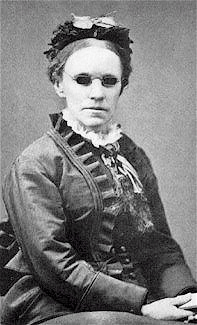
Fanny Crosby
1820-1915
Frances Jane “Fanny” Crosby (1820-1915), American hymn writer and poetess who wrote over 8,000 hymns. Once a preacher sympathetically remarked, “I think it is a great pity that the Master did not give you sight when He showered so many other gifts upon you.” She replied quickly, “Do you know that if at birth I had been able to make one petition, it would have been that I should be born blind?” “Why?” asked the surprised minister. “Because when I get to heaven, the first face that shall ever gladden my sight will be that of my Savior!”
4 Say to them that are of a fearful heart, Be strong, fear not: behold, your God will come with vengeance, even God with a recompense; He will come and save you.
5 Then the eyes of the blind shall be opened, and the ears of the deaf shall be unstopped.
6 Then. shall the lame man leap as an hart, and the tongue of the dumb sing: for in the wilderness shall waters break out, and streams in the desert. Isaiah 35: 4-6
This beloved hymn came from the grateful heart of Fanny Crosby after she had received a direct answer to her prayer.
One day when she desperately needed five dollars and had no idea where she could obtain it, Fanny followed her usual custom and began to pray about the matter. A few minutes later a stranger appeared at her door with the exact amount.
I have no way of accounting for this, she said, except to believe that God put it into the heart of this good man to bring the money. My first thought was that it is so wonderful the way the Lord leads me, and I immediately wrote the poem.
_________________________________________________
For this God is our God for ever and ever: He will be our guide even unto death.




 The Vine Vigil
