Love divine, all loves excelling, Joy of Heav’n to earth come down; Fix in us thy humble dwelling; All thy faithful mercies crown! Jesus, Thou art all compassion, Pure unbounded love Thou art; Visit us with Thy salvation; Enter every trembling heart.
Breathe, O breathe Thy loving Spirit, Into every troubled breast! Let us all in Thee inherit; Let us find that second rest. Take away our bent to sinning; Alpha and Omega be; End of faith, as its beginning, Set our hearts at liberty.
Come, Almighty to deliver, Let us all Thy life receive; Suddenly return and never, Never more Thy temples leave. Thee we would be always blessing, Serve Thee as Thy hosts above, Pray and praise Thee without ceasing, Glory in Thy perfect love.
Finish, then, Thy new creation; Pure and spotless let us be. Let us see Thy great salvation Perfectly restored in Thee; Changed from glory into glory, Till in Heav’n we take our place, Till we cast our crowns before Thee, Lost in wonder, love, and praise.
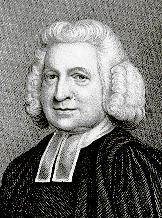
Charles Wesley (1707-1788)
In 1961, during the Manchester, England, crusade…just as the meetings were about to start, Billy Graham became quite seriously ill…Billy had been scheduled to speak to the ministers of London just before the crusade opened. You can imagine my feelings when he sent word that I should represent him and speak at that meeting. The British pastors are themselves thorough scholars and often brilliant preachers. And they were expecting to hear Billy Graham, not me!
At the beginning of that meeting in Westminster’s Central Hall, the ministers joined in singing this great hymn of Charles Wesley. Most of these British clergymen were also well acquainted with hymn texts and hymn tunes, and they sang gloriously. Accompanied by the grand piano and the great pipe organ and using the Welsh tune “Blaenwern,” these familiar words lifted our hearts in praise and prayer to God. I felt God’s strength evident through the singing; He blessed our meeting together despite my fears and their disappointment.
1 Once to ev’ry man and nation Comes the moment to decide, In the strife of truth and falsehood, For the good or evil side; Some great cause, some great decision, Off’ring each the bloom or blight, And the choice goes by forever ‘Twixt that darkness and that light.
2 Then to side with truth is noble, When we share her wretched crust, Ere her cause bring fame and profit, And ’tis prosperous to be just; Then it is the brave man chooses While the coward stands aside. Till the multitude make virtue Of the faith they had denied.
3 By the light of burning martyrs, Christ, Thy bleeding feet we track, Toiling up new Calv’ries ever With the cross that turns not back; New occasions teach new duties, Ancient values test our youth; They must upward still and onward, Who would keep abreast of truth.
4 Tho’ the cause of evil prosper, Yet the truth alone is strong; Tho’ her portion be the scaffold, And upon the throne be wrong; Yet that scaffold sways the future, And, behind the dim unknown, Standeth God within the shadow, Keeping watch above His own.
Short Name:
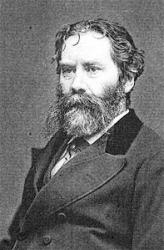
James Russell Lowell
Full Name:
Lowell, James Russell, 1819-1891
Birth Year:
1819
Death Year:
1891
Lowell, James Russell, LL.D., was born at Cambridge, Massachusetts, February 22, 1819; graduated at Harvard College, 1838, and was called to the Bar in 1840. Professor of Modern Languages and Literature (succeeding the Poet Longfellow) in Harvard, 1855; American Minister to Spain, also to England in 1881. He was editor of the Atlantic Monthly, from 1857 to 1862; and of the North American Review from 1863 to 1872. Professor Lowell is the most intellectual of American poets, and first of her art critics and humorists. He has written much admirable moral and sacred poetry, but no hymns. One piece, “Men, whose boast it is that ye” (Against Slavery), is part of an Anti-Slavery poem, and in its present form is found in Hymns of the Spirit, 1864. Part of this is given in Songs for the Sanctuary, N.Y., 1865, as “They are slaves who will not choose.” [Rev. F. M. Bird, M.A.] –John Julian, Dictionary of Hymnology (1907) http://www.hymnary.org/person/Lowell_JR
1 Kings 18:21
And Elijah came unto all the people, and said, How long halt ye between two opinions? if the Lord be God, follow Him: but if Baal, then follow him. And the people answered him not a word.
1 Open my eyes, that I may see glimpses of truth thou hast for me. Place in my hands the wonderful key that shall unclasp and set me free. Silently now I wait for thee, ready, my God, thy will to see. Open my eyes; illumine me, Spirit divine!
2 Open my ears, that I may hear voices of truth thou sendest clear. And while the wave notes fall on my ear, everything false will disappear. Silently now I wait for thee, ready, my God, thy will to see. Open my ears; illumine me, Spirit divine!
3 Open my mouth, and let me bear gladly the warm truth everywhere. Open my heart, and let me prepare love with thy children thus to share. Silently now I wait for thee, ready, my God, thy will to see. Open my heart; illumine me, Spirit divine!
Clara H. Scott (December 3, 1841 – June 21, 1897) was an American composer, hymnwriter and publisher.[1] She was the first woman to publish a volume of anthems, the Royal Anthem Book, in 1882.[2] Scott was also well known for her hymn, Open My Eyes, That I May See, written in 1895.[3] The hymn was inspired by Psalm 119, verse 18.[4] She died in 1897 after being thrown from her carriage by a spooked horse. http://en.wikipedia.org/wiki/Clara_H._Scott
Psalm 119:18
Open thou mine eyes, that I may behold wondrous things out of Thy law.
1 O perfect Love, all human thought transcending, lowly we kneel in prayer before thy throne, that theirs may be the love which knows no ending, whom thou in sacred vow dost join in one.
2 O perfect Life, be thou their full assurance of tender charity and steadfast faith, of patient hope and quiet, brave endurance, with childlike trust that fears no pain or death.
3 Grant them the joy which brightens earthly sorrow; grant them the peace which calms all earthly strife; grant them the vision of the glorious morrow that will reveal eternal love and life.
Short Name:
Dorothy F. Gurney
Full Name:
Gurney, Dorothy F., 1858-1932
Birth Year:
1858
Death Year:
1932
Blomfield, Dorothy F. , was born at 3 Finsbury Circus, Oct. 4, 1858. Miss Blomfield is the eldest daughter of the late Rev. F. G. Blomfield, sometime Rector of St. Andrew’s Undershaft, London, and granddaughter of the late Dr. Blomfield, Bishop of London. Her very beautiful hymn for Holy Matrimony, “O perfect Love, all human thought transcending,” was written for her sister’s marriage in 1883, and was intended to be sung to Strength and Stay, in Hymns Ancient & Modern, No. 12. Subsequently it was set as an anthem by J. Barnby for the marriage of the Duke of Fife with the Princess Louise of Wales, on July 27, 1889. In 1889 it was included in the Supplemental Hymns to Hymns Ancient & Modern, and in 1890 in the Hymnal Companion.
–John Julian, Dictionary of Hymnology, Appendix, Part II (1907)
Like a river glorious, is God’s perfect peace, Over all victorious, in its bright increase; Perfect, yet it floweth, fuller every day, Perfect, yet it groweth, deeper all the way.
Refrain
Stayed upon Jehovah, hearts are fully blest Finding, as He promised, perfect peace and rest.
Hidden in the hollow of His blessed hand, Never foe can follow, never traitor stand; Not a surge of worry, not a shade of care, Not a blast of hurry touch the spirit there.
Refrain
Every joy or trial falleth from above, Traced upon our dial by the Sun of Love; We may trust Him fully all for us to do. They who trust Him wholly find Him wholly true.
Refrain
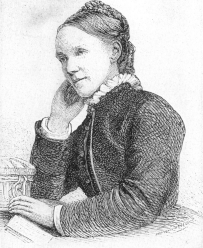
Frances Ridley Havergal
Frances Ridley Havergal was an English religious poet and hymn writer. Take My Life and Let it Be and Thy Life for Me are two of her best known hymns. She also wrote hymn melodies, religious tracts, and works for children. Wikipedia
When Frances Havergal was vacationing in the south of Wales, 1876, she caught a severe cold, accompanied by inflammation of the lungs. Hearing how ill she was, and that she might die, she replied, “If I am really going, it is too good to be true.” Her friends were amazed at how peacefully she received this information. She did survive that illness, and later that year she wrote the hymn “Like a River Glorious” in which she pointed to the source of her perfect peace: “Stayed upon Jehovah, hearts are fully blessed, finding, as He promised, perfect peace and rest.”
Miss Havergal, a devout Bible scholar, echoed Isaiah in “Like a River Glorious” in which God promises “peace like a river.” She also incorporated Isaiah 26:3, which states “You will keep him in perfect peace, whose mind is stayed on You, because he trusts in You.” “Like a River Glorious” paints the picture of this peace.
Miss Havergal wrote to another hymn writer who had also written about peace. In her letter, Miss Havergal quoted Romans 5:1 “We have peace with God,” adding “It is yours already, purchased for you, made for you, sealed for you, pledged to you – by the word of the Father and the precious blood of Jesus.”
6 Be careful for nothing; but in every thing by prayer and supplication with thanksgiving let your requests be made known unto God.
7 And the peace of God, which passeth all understanding, shall keep your hearts and minds through Christ Jesus.
8 Finally, brethren, whatsoever things are true, whatsoever things are honest, whatsoever things are just, whatsoever things are pure, whatsoever things are lovely, whatsoever things are of good report; if there be any virtue, and if there be any praise, think on these things.
This post was dedicated to our gracious and merciful lord and savior, Jesus Christ, and to a cyber friend and follower who had gone through terrible loss, and had shared her grief and glowing testimony.
1 Jesus, the very thought of thee with sweetness fills the breast; but sweeter far thy face to see, and in thy presence rest.
2 O hope of every contrite heart, O joy of all the meek, to those who fall, how kind thou art! How good to those who seek!
3 But what to those who find? Ah, this nor tongue nor pen can show; the love of Jesus, what it is, none but his loved ones know.
4 Jesus, our only joy be thou, as thou our prize wilt be; Jesus, be thou our glory now, and through eternity.
“Down through the ages many great hymns have been written. Many of them have survived the centuries and decades and still minister to people today. This week’s choice comes from the height of the Middle Ages, the period of history often called “The Dark Ages.” The spiritual and moral darkness of the church had reached a new blackness. The institution founded by Christ some 1,000 years prior was mainly degenerate and corrupt. The moral standards of many of its prominent leaders were characterized by disgrace and shame. Yet within this system of religious confusion, God laid it upon the heart of a dedicated monk, Bernard of Clairvaux (1091- 1153) to write a devotional poem about his Lord. At an early age Bernard was known for his piety and scholarship. With his natural charms and talents, he had many opportunities open to him for a successful secular life. While still in his early 20s, however, he chose the life of a monk at the monastery of Citeaux, France. Within three years Bernard’s forceful personality, talents, and leadership qualities were recognized, and he was asked to form other branches of this order throughout Europe. Within Bernard’s lifetime, 162 other such orders were founded. One of these new monasteries was at Clairvaux, France, where Bernard was made its abbot. He remained there until his death in 1153. The English Translation of this hymn is attributed to Edward Caswall, (1814–1876). Meditate upon these great words this week which call us to love and worship Jesus, our hope and our only joy. Does the very thought of Him fill you with sweetness?”
15 For without are dogs, and sorcerers, and whoremongers, and murderers, and idolaters, and whosoever loveth and maketh a lie.
16 I Jesus have sent mine angel to testify unto you these things in the churches. I am the root and the offspring of David, and the bright and morning star.
17 And the Spirit and the bride say, Come. And let him that heareth say, Come. And let him that is athirst come. And whosoever will, let him take the water of life freely.
God never moves without purpose or plan
When trying His servant or molding a man.
Give thanks to the Lord though your testing seems long
In darkness He giveth a song.
Oh, rejoice in the Lord
He makes no mistakes
He knoweth the end of each path that I take
For when I am tried and purified
I shall come forth as gold.
I could not see through the shadows ahead
So I looked at the cross of my Savior instead.
I bowed to the will of the Master that day
Then peace came and tears fled away.
Oh, rejoice in the Lord
He makes no mistakes
He knoweth the end of each path that I take
For when I am tried and purified
I shall come forth as gold.
Now, I can see testing comes from above
God strengthens His children and purges in love.
My Father knows best and I trust in His care
Through purging, more fruit I will bear.
Oh, rejoice in the Lord
He makes no mistakes
He knoweth the end of each path that I take
For when I am tried and purified
I shall come forth as gold.
Ron Hamilton never planned to become a pirate; it just happened, in a divine way. In 1975, the discovery of cancer in Ron’s left eye resulted in the loss of his eye. The surgeon removed the bandages a week later and presented Hamilton with a black eye patch—the real-life prop that thrust him into his role as a pirate evangelist. Everywhere he went, children pointed and exclaimed, “Look! A pirate!” “Hearing a doctor say I had cancer and may die was a very sobering experience,” he says. “Many people would see the loss of my eye and the need for wearing a patch as a great trial. But I see it as one of the greatest blessings of my life. It reminds me that God teaches us the greatest lessons in the deepest valleys.” Immediately following the loss of his eye due to cancer, Ron Hamilton penned a song based on Philippians 4:4. Its message has encouraged many folks while journeying through a dark valley. https://www.majestymusic.com/about-majesty-music
Philippians 4:4-5
4 Rejoice in the Lord always: and again I say, Rejoice.
5 Let your moderation be known unto all men. The Lord is at hand.
p.s. Many decades ago, we received Patch the Pirate through A Beka Home School and it was a blessing to me and my little ones for many years, as it was considered a treat during our long hours of study. However – there is some question as to the newer Pirate music, as it is trending towards CCM. As always – use Biblical discretion with music, especially music for little ones. It is better always – to err on the side of caution. Solid Christian music can be found on this blog, as well as some radio stations. I recommend http://www.familyradio.com/bible-readings/streaming-audio/ with a strong caution against the regularly aired teaching of Harold Camping. Excellent music, thrilling KJV Bible reading, and very dicey teachings.
Sing them over again to me, wonderful words of life, Let me more of their beauty see, wonderful words of life; Words of life and beauty teach me faith and duty.
Refrain
Beautiful words, wonderful words, wonderful words of life, Beautiful words, wonderful words, wonderful words of life.
Christ, the blessèd One, gives to all wonderful words of life; Sinner, list to the loving call, wonderful words of life; All so freely given, wooing us to heaven.
Refrain
Sweetly echo the Gospel call, wonderful words of life; Offer pardon and peace to all, wonderful words of life; Jesus, only Savior, sanctify us forever.
Refrain
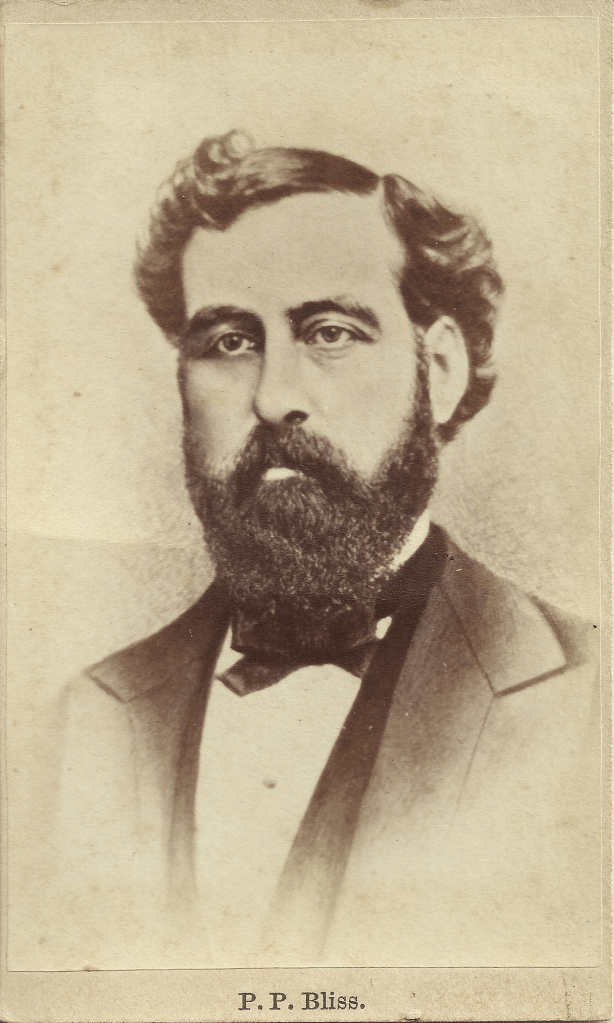
Philip Paul Bliss (9 July 1838 – 29 December 1876) was an American composer, conductor, writer of hymns and a bass-baritone[1]Gospel singer. He wrote many well-known hymns, including Almost Persuaded, Hallelujah, What a Saviour!, Let the Lower Lights Be Burning, Wonderful Words of Life, and the tune for Horatio Spafford‘s It Is Well with My Soul.
I carried that song through two seasons of evangelistic work, never thinking it possessed much merit, or that it had the element of special usefulness, particularly for solo purposes. It occurred to me to try it one day during the campaign in New Haven, [Connecticut, 1878,] and, with the help of Mrs. Stebbins, we sang it as a duet. To our surprise the song was received with the greatest enthusiasm and from that time on to the close of the meetings was the favorite of all the hymns used. As an illustration of the hold it got upon the people all about that section of the country, I received a letter from the Secretary of the Connecticut State Sunday School Association offering me what seemed an absurdly large sum of money, if I would, with Mrs. Stebbins, come to the State Convention and sing that one song.
Tell me the story of Jesus, Write on my heart every word; Tell me the story most precious, Sweetest that ever was heard. Tell how the angels in chorus, Sang as they welcomed His birth, “Glory to God in the highest! Peace and good tidings to earth.”
Refrain: Tell me the story of Jesus, Write on my heart every word; Tell me the story most precious, Sweetest that ever was heard.
Fasting alone in the desert, Tell of the days that are past, How for our sins He was tempted, Yet was triumphant at last. Tell of the years of His labor, Tell of the sorrow He bore; He was despised and afflicted, Homeless, rejected and poor.
Tell of the cross where they nailed Him, Writhing in anguish and pain; Tell of the grave where they laid Him, Tell how He liveth again. Love in that story so tender, Clearer than ever I see; Stay, let me weep while you whisper, “Love paid the ransom for me.”
Tell how He’s gone back to heaven, Up to the right hand of God: How He is there interceding While on this earth we must trod. Tell of the sweet Holy Spirit He has poured out from above; Tell how He’s coming in glory For all the saints of His love.
SONG WRITER: Fanny Crosby MUSIC WRITER: John R. Sweney WHEN WRITTEN: 1880
Blindness never produced self-pity in Fanny and she did not look on her blindness as a terrible thing. At eight years old she composed this little verse:
Oh, what a happy child I am, although I cannot see! I am resolved that in this world contented I will be! How many blessings I enjoy that other people don’t! So weep or sigh because I’m blind, I cannot – nor I won’t.
All for Jesus, all for Jesus! All my being’s ransomed pow’rs: All my thoughts and words and doings, All my days and all my hours.
Refrain 1: All for Jesus! All for Jesus! All my days and all my hours; All for Jesus! All for Jesus! All my days and all my hours.
Let my hands perform His bidding, Let my feet run in His ways; Let my eyes see Jesus only, Let my lips speak forth His praise.
Refrain 2: All for Jesus! All for Jesus! Let my lips speak forth His praise; All for Jesus! All for Jesus! Let my lips speak forth His praise.
Since my eyes were fixed on Jesus, I’ve lost sight of all beside; So enchained my spirit’s vision, Looking at the Crucified.
Refrain 3: All for Jesus! All for Jesus! Looking at the Crucified; All for Jesus! All for Jesus! Looking at the Crucified.
Oh, what wonder! How amazing! Jesus, glorious King of kings, Deigns to call me His beloved, Lets me rest beneath His wings.
Refrain 4: All for Jesus! All for Jesus! Resting now beneath His wings; All for Jesus! All for Jesus! Resting now beneath His wings.
Short Name:
Mary D. James
Full Name:
James, Mary D. (Mary Dagworthy), 1810-1883
Birth Year:
1810
Death Year:
1883
Born: August 10, 1810, Trenton, New Jersey. Died: October 4, 1883, New York City. Buried: Mercer Cemetery, Trenton, New Jersey.
When she was 13 years old, James began teaching Sunday school in the Methodist Episcopal church. She became a prominent figure in the Wesleyan Holiness movement, assisting Phoebe Palmer, and often leading meetings at Ocean Grove, New Jersey, and elsewhere. She wrote about 50 hymns, and articles by her appeared in the Guide to Holiness, the New York Christian Advocate, The Contributor, The Christian Witness, The Christian Woman, The Christian Standard, and the Ocean Grove Record. Her works include:
The Soul Winner: A Sketch of Life and Fact and Incidents in the Life and Labors of Edmund J. Yard, 1883
I beseech you therefore, brethren, by the mercies of God, that ye present your bodies a living sacrifice, holy, acceptable unto God, which is your reasonable service.
Please enjoy the wonderfully complex choir work, of this beloved hymn. The many layers are indicative of the depth of the Savior’s eternal love and mercy for mankind.
Refrain
There is a balm in Gilead To make the wounded whole; There is a balm in Gilead To heal the sin sick soul.
Some times I feel discouraged, And think my work’s in vain, But then the Holy Spirit Revives my soul again.
Refrain
If you can’t preach like Peter, If you can’t pray like Paul, Just tell the love of Jesus, And say He died for all.
Refrain
Question: “What is the balm of Gilead?”
Answer: A balm is an aromatic, medicinal substance derived from plants. Gilead was an area east of the Jordan River, well known for its spices and ointments. The “balm of Gilead” was, therefore, a high-quality ointment with healing properties. The balm was made from resin taken from a flowering plant in the Middle East, although the exact species is unknown. It was also called the “balsam of Mecca.” Myrrh is taken from a similar plant—Commiphora myrrha.The Bible uses the term “balm of Gilead” metaphorically as an example of something with healing or soothing powers.
“Balm of Gilead” has three references in the Bible. In Genesis 37:25, as Joseph’s brothers contemplated how to kill him, a caravan of Ishmaelites passed by on their way to Egypt from Gilead. In their cargo were “spices, balm, and myrrh.” Jeremiah 8 records God’s warning to Judah of what Babylon would do to them. Upon hearing the news, Jeremiah laments, “Is there no balm in Gilead?” (verse 22). His question is a poetic search for hope—a plea for healing. Then, in Jeremiah 46:11, as God describes an impending judgment on Egypt, He taunts them: “Go up to Gilead and obtain balm, O virgin daughter of Egypt! In vain have you multiplied remedies; there is no healing for you!”
These scriptural references to the balm of Gilead have inspired many literary and cultural allusions, including references in “The Raven” by Edgar Allen Poe and movies such as The Spitfire Grill. Notably, “There Is a Balm in Gilead” is an African-American spiritual that compares the healing balm to the saving power of Jesus—the one true treatment that never fails to heal our spiritual wounds.
Precious Lord, take my hand, Lead me on, let me stand, I am tired, I am weak, I am worn; Through the storm, through the night, Lead me on to the light:
Refrain
Take my hand, precious Lord, Lead me home.
When my way grows drear, Precious Lord, linger near, When my life is almost gone, Hear my cry, hear my call, Hold my hand lest I fall:
Refrain
When the darkness appears And the night draws near, And the day is past and gone, At the river I stand, Guide my feet, hold my hand:
Refrain
Words: Thomas A. Dorsey, 1932. Dorsey wrote this song in Chicago, Illinois, after his wife Nettie died while giving birth to a child (who also died shortly thereafter). Dorsey sang the song for his friend, Gospel singer Theodore Frye, and Frye’s choir sang it the next Sunday at the Ebenezer Baptist Church.
3 Blessed be God, even the Father of our Lord Jesus Christ, the Father of mercies, and the God of all comfort;
4 Who comforteth us in all our tribulation, that we may be able to comfort them which are in any trouble, by the comfort wherewith we ourselves are comforted of God.
5 For as the sufferings of Christ abound in us, so our consolation also aboundeth by Christ.
6 And whether we be afflicted, it is for your consolation and salvation, which is effectual in the enduring of the same sufferings which we also suffer: or whether we be comforted, it is for your consolation and salvation.
7 And our hope of you is stedfast, knowing, that as ye are partakers of the sufferings, so shall ye be also of the consolation.
This hymn is also known under the title “Jesus! What A Friend For Sinners!
Jesus! what a Friend for sinners! Jesus! Lover of my soul; Friends may fail me, foes assail me, He, my Savior, makes me whole.
Refrain
Hallelujah! what a Savior! Hallelujah! what a Friend! Saving, helping, keeping, loving, He is with me to the end.
Jesus! what a Strength in weakness! Let me hide myself in Him. Tempted, tried, and sometimes failing, He, my Strength, my victory wins.
Refrain
Jesus! what a Help in sorrow! While the billows over me roll, Even when my heart is breaking, He, my Comfort, helps my soul.
Refrain
Jesus! what a Guide and Keeper! While the tempest still is high, Storms about me, night overtakes me, He, my Pilot, hears my cry.
Refrain
Jesus! I do now receive Him, [or Jesus! I do now adore Him,] More than all in Him I find. He hath granted me forgiveness, I am His, and He is mine.
Refrain
John Wilbur Chapman (June 17, 1859, Richmond, Indiana – December 25, 1918, New York, New York) was a Presbyterian evangelist in the late 19th Century, generally traveling with gospel singer Charles Alexander. His parents were Alexander H. and Lorinda (McWhinney) Chapman.
Chapman grew up attending Quaker Day School and Methodist Sunday School. At age 17, he made a public declaration of his Christian faith and joined the Richmond Presbyterian Church. He received his Bachelor of Arts degree from Lake Forest College and his seminary degree from Lane Theological Seminary in Cincinnati, Ohio. He completed his ordination into the ministry 13 April 1881, while still attending Lane. He was later awarded a Doctorate in Divinity from the College of Wooster and an LL.D. from Heidelberg University.
In May 1882, Chapman married Irene Steddon. In April 1886, she bore him a daughter, Bertha Irene Chapman. Irene Steddon Chapman died in May 1886. Chapman remarried on November 4, 1888 to Agnes Pruyn Strain; they had four children: Robert (who died in infancy), John Wilbur, Jr., Alexander Hamilton, and Agnes Pruyn. His second wife died on June 25, 1907 and Chapman married a third and final time on August 30, 1910 to Mabel Cornelia Moulton.
Chapman took on several pastorates before shifting to the evangelistic circuit. He began preaching with the legendary D. L. Moody in 1893, as well as leading many evangelistic events of his own. Among Chapman’s disciples on the evangelistic circuit was Billy Sunday.
In 1905, John H. Converse, a wealthy Presbyterian philanthropist, offered to underwrite Chapman’s expenses if he would re-enter the evangelistic field full-time. Converse also set up a trust fund so as to finance Chapman’s crusades posthumously. Chapman accepted the offer and in 1907, joined forces with popular gospel singer Charles McCallon Alexander to launch the “Chapman-Alexander Simultaneous Campaign.”
The duo assembled an impressive team of evangelists and song leaders and took to the streets. The first joint campaign was held in Philadelphia from March 12 to April 19, 1908. They partitioned the city into 42 sections covered by 21 evangelist-musicians teams. They spent three weeks on each half of the city, resulting in approximately 8000 conversions. It was at a similar Chapman-Alexander event in North Carolina that the legendary King James Only proponent, David Otis Fuller, committed to the Christian faith.
In 1909, Chapman demanded that any field evangelist who doubted the inerrancy of Scripture be removed from ministry. Chapman’s biography reports, “The first Chapman-Alexander worldwide campaign left Vancouver, British Columbia on March 26, 1909, and returned on November 26, 1909.
My faith looks up to Thee, Thou Lamb of Calvary, Savior divine! Now hear me while I pray, take all my guilt away, O let me from this day be wholly Thine!
May Thy rich grace impart Strength to my fainting heart, my zeal inspire! As Thou hast died for me, O may my love to Thee, Pure warm, and changeless be, a living fire!
While life’s dark maze I tread, And griefs around me spread, be Thou my Guide; Bid darkness turn to day, wipe sorrow’s tears away, Nor let me ever stray from Thee aside.
When ends life’s transient dream, When death’s cold sullen stream over me roll; Blest Savior, then in love, fear and distrust remove; O bear me safe above, a ransomed soul!
Ray Palmer wrote these lyrics upon receiving a vision of Christ shortly after his graduation from Yale University, while working as a tutor at a New York school. However, he kept them to himself until meeting Lowell Mason on a street in Boston, Massachusetts. When Mason asked him to write something for a new hymnal, Palmer dug out his old notes and produced these lyrics, written two years earlier. After taking the lyrics home and reading them, Mason composed this tune. Several days later he saw Palmer again and said:
You may live many years and do many good things, but I think you will be best known to posterity as the author of My Faith Looks Up to Thee.
An interesting story connected with this hymn:
Mrs. Layyah Barakat, a native of Syria, was educated in Beirut and then taught for a time in Egypt. Driven out in 1882 by the insurrection of Arabi Pasha, she, with her husband and child, came to America by way of Malta and Marseilles. Her history is a strange illustration of God’s providential care, as they were without any direction or friends in Philadelphia when they landed. But the Lord took them into His own keeping, and brought them to those who had known of her in Syria. While in this country she frequently addressed large audiences, to whom her deep earnestness and broken but piquant English proved unusually attractive. Among other incidents she related that she had been permitted to see the conversion of her whole family, who were Maronites of Mount Lebanon. Her mother, sixty-two years of age, had been taught ‘My Faith Looks Up to Thee’ in Arabic. They would sit on the house roof and repeat it together; and when the news came back to Syria that the daughter was safe in America, the mother could send her no better proof of her faith and love than in the beautiful words of this hymn, assuring her that her faith still looked up to Christ.
In Whom we have boldness and access with confidence by the faith of Him.
“The words for these stanzas were born out of my own soul with very little effort. I recall that 1 wrote the verses with tender emotion. . . . When writing the last line, “O bear me safe above, a ransomed soul!” the thought that the whole work of redemption and salvation was involved in those words. . . brought me to a degree of emotion that brought abundant tears.”
This beautiful song of praise, is characterized as “plain-song,” which was developed during the earliest centuries of the church age. It shows influence from both the ancient singing of the Jewish synagogue, and the Greek modal style. The heartfelt worship of the only begotten Son of God is the theme.
1. Of the Father’s love begotten Ere the worlds began to be, He is Alpha and Omega, He the Source, the Ending He, Of the things that are, that have been, And that future years shall see Evermore and evermore.
2. Oh, that birth forever blessed When the Virgin, full of grace, By the Holy Ghost conceiving, Bare the Savior of our race, And the Babe, the world’s Redeemer, First revealed His sacred face Evermore and evermore.
3. O ye heights of heaven, adore Him; Angel hosts, His praises sing; Powers, dominions, bow before Him And extol our God and King. Let no tongue on earth be silent, Every voice in concert ring Evermore and evermore.
4. This is He whom Heaven-taught singers Sang of old with one accord; Whom the Scriptures of the prophets Promised in their faithful word. Now He shines, the Long-expected; Let creation praise its Lord Evermore and evermore.
5. Christ, to Thee, with God the Father, And, O Holy Ghost, to Thee Hymn and chant and high thanksgiving And unending praises be, Honor, glory, and dominion, And eternal victory Evermore and evermore.
“Of the Father’s Love Begotten” by Aurelius C. Prudentius, 413, cento Translated by John. M. Neale, 1818-1866 and Henry W. Baker, 1821-1977
Revelation 1:7-8
7 Behold, He cometh with clouds; and every eye shall see Him, and they also which pierced Him: and all kindreds of the earth shall wail because of Him. Even so, Amen.
8 I am Alpha and Omega, the beginning and the ending, saith the Lord, which is, and which was, and which is to come, the Almighty.
In times like these, we need a Savior In times like these, we need an anchor Be very sure, be very sure Your anchor holds and grips the Solid Rock
This Rock is Jesus, Yes, He’s the one This Rock is Jesus, The only One Be very sure, be very sure Your anchor holds and grips the Solid Rock
In times like these oh be not idle In times like these we need the bible Be very sure, be very sure Your anchor holds and grips the Solid Rock
That Rock is Jesus, Yes, He’s the one That Rock is Jesus, The only One Be very sure, oh you’ve gotta be sure That your anchor holds, and it grips the Solid Rock Your anchor it holds, and it grips the Solid Rock
In times like these, I have a Savior In times like these, I have an anchor I’m very sure, I’m very sure My anchor holds and grips the Solid Rock
That Rock is Jesus, Yes, He’s the one That Rock is Jesus, The only One Be very sure, oh you’ve gotta be sure That your anchor it holds, and it grips the Solid Rock
Author: Ruth Caye Jones
Born: 1902, Wilmerding, Pennsylvania. Died: August 18, 1972, Erie, Pennsylvania. A self taught pianist and organist, Ruth married Bert Jones, and together they worked in the evangelism field. In 1948, they founded a radio ministry in Erie, Pennsylvania, broadcasting a weekly family devotional program from their home called “A Visit with the Jones.” http://www.hymnary.org/text/in_times_like_these_you_need_a_savior
Psalm 95:1-3
95 O come, let us sing unto the Lord: let us make a joyful noise to the rock of our salvation.
2 Let us come before His presence with thanksgiving, and make a joyful noise unto Him with psalms.
3 For the Lord is a great God, and a great King above all gods.
Is there a heart bent o’erbound by sorrow? Is there a life weighed down by care? Come to the cross, each burden bearing; All your anxiety—leave it there.
Refrain
All your anxiety, all your care, Bring to the mercy seat, leave it there, Never a burden He cannot bear, Never a friend like Jesus!
No other friend so swift to help you, No other friend so quick to hear, No other place to leave your burden, No other one to hear your prayer.
Refrain
Come then at once; delay no longer! Heed His entreaty kind and sweet, You need not fear a disappointment; You shall find peace at the mercy seat.
Words & Music: Edward H. Joy, 1920, alt. (MIDI, score). Joy, a Salvation Army musician, introduced the song to the Thornton Heath Corps, and later used it throughout Canada. It was published in The Musical Salvationist in 1929.
Joy joined the Salvation Army (SA) in Canterbury, then played in the band at Folkestone, and became an SA officer in 1894. He went on serve the SA Corps at Tunstall, then the SA International headquarters in 1917, where he was Under Secretary in the Foreign Office. After 1919, he served as Immigration Secretary in western Canada, and in 1932 became editor-in-chief of The War Cry in South Africa. He rose to the rank of SA colonel, and retired in 1938.
The love of God is greater far Than tongue or pen can ever tell; It goes beyond the highest star, And reaches to the lowest hell; The guilty pair, bowed down with care, God gave His Son to win; His erring child He reconciled, And pardoned from his sin.
Refrain
O love of God, how rich and pure! How measureless and strong! It shall forevermore endure The saints’ and angels’ song.
When years of time shall pass away, And earthly thrones and kingdoms fall, When men, who here refuse to pray, On rocks and hills and mountains call, God’s love so sure, shall still endure, All measureless and strong; Redeeming grace to Adam’s race— The saints’ and angels’ song.
Refrain
Could we with ink the ocean fill, And were the skies of parchment made, Were every stalk on earth a quill, And every man a scribe by trade, To write the love of God above, Would drain the ocean dry. Nor could the scroll contain the whole, Though stretched from sky to sky.
Refrain
Words: Frederick M. Lehman; he wrote this song in 1917 in Pasadena, California, and it was published in Songs That Are Different, Volume 2, 1919. The lyrics are based on the Jewish poem Haddamut, written in Aramaic in 1050 by Meir Ben Isaac Nehorai, a cantor in Worms, Germany; they have been translated into at least 18 languages.
One day, during short intervals of inattention to our work, we picked up a scrap of paper and, seated upon an empty lemon box pushed against the wall, with a stub pencil, added the (first) two stanzas and chorus of the song…Since the lines (3rd stanza from the Jewish poem) had been found penciled on the wall of a patient’s room in an insane asylum after he had been carried to his grave, the general opinion was that this inmate had written the epic in moments of sanity.
Frederick M. Lehman, “History of the Song, The Love of God,” 1948
Music: Frederick Lehman; arranged by his daughter, Claudia L. Mays
Beneath the cross of Jesus I fain would take my stand, The shadow of a mighty rock within a weary land; A home within the wilderness, a rest upon the way, From the burning of the noontide heat, and the burden of the day.
O safe and happy shelter, O refuge tried and sweet, O trysting place where Heaven’s love and Heaven’s justice meet! As to the holy patriarch that wondrous dream was given, So seems my Savior’s cross to me, a ladder up to heaven.
There lies beneath its shadow but on the further side The darkness of an awful grave that gapes both deep and wide And there between us stands the cross two arms outstretched to save A watchman set to guard the way from that eternal grave.
Upon that cross of Jesus mine eye at times can see The very dying form of One Who suffered there for me; And from my stricken heart with tears two wonders I confess; The wonders of redeeming love and my unworthiness.
I take, O cross, thy shadow for my abiding place; I ask no other sunshine than the sunshine of His face; Content to let the world go by to know no gain or loss, My sinful self my only shame, my glory all the cross.
Clephane, Elizabeth Cecilia, third daughter of Andrew Clephane, Sheriff of Fife, was born at Edinburgh, June 18, 1830, and died at Bridgend House, near Melrose, Feb. 19, 1869. Her hymns appeared, almost all for the first time, in the Family Treasury, under the general title of Breathings on the Border. In publishing the first of these in the Treasury, the late Rev. W. Arnot, of Edinburgh, then editor, thus introduced them:—
“These lines express the experiences, the hopes, and the longings of a young Christian lately released. Written on the very edge of this life, with the better land fully, in the view of faith, they seem to us footsteps printed on the sands of Time, where these sands touch the ocean of Eternity. These footprints of one whom the Good Shepherd led through the wilderness into rest, may, with God’s blessing, contribute to comfort and direct succeeding pilgrims.”
1. Nearer, still nearer, close to Thy heart, Draw me, my Savior—so precious Thou art! Fold me, oh, fold me close to Thy breast. Shelter me safe in that Haven of Rest; Shelter me safe in that Haven of Rest.
2. Nearer, still nearer, nothing I bring, Naught as an offering to Jesus, my king; Only my sinful, now contrite heart. Grant me the cleansing Thy blood doth impart. Grant me the cleansing Thy blood doth impart.
3. Nearer, still nearer, Lord, to be Thine! Sin, with its follies, I gladly resign, All of its pleasures, pomp and its pride, Give me but Jesus, my Lord, crucified. Give me but Jesus, my Lord, crucified.
4. Nearer, still nearer, while life shall last. Till safe in glory my anchor is cast; Through endless ages ever to be Nearer, my Savior, still nearer to Thee; Nearer, my Savior, still nearer to Thee!
Lelia N. Morris. Usage Mrs. C. H. Morris. Born: April 15, 1862, Pennsville, Ohio. Died: July 23, 1929, Auburn, New York (at her daughter’s home). Buried: McConnelsville, Ohio. Leila Naylor Morris(1862-1929) As a child, Leila lived in Malta and McConnelsville, Ohio. In 1881, she married Charles H. Morris. Leila was active in the Methodist church, camp meetings, and song writing, authoring more than 1,000 Gospel songs. When her eyes began to fail in 1913, her son built a 28-foot blackboard with oversized staff lines, so she could continue composing. –hymntime.com/tch
“I Heard the Voice of Jesus Say” by Horatius Bonar, 1808-1899
1. I heard the voice of Jesus say, “Come unto Me and rest; Lay down, thou weary one, lay down, Thy head upon My breast.” I came to Jesus as I was, Weary and worn and sad; I found in Him a resting-place, And He has made me glad.
2. I heard the voice of Jesus say, “Behold, I freely give The living water; thirsty one, Stoop down and drink and live.” I came to Jesus, and I drank Of that life-giving stream. My thirst was quenched, my soul revived, And now I live in Him.
3. I heard the voice of Jesus say, “I am this dark world’s Light. Look unto Me; thy morn shall rise And all thy day be bright.” I looked to Jesus, and I found In Him my Star, my Sun; And in that Light of Life I’ll walk Till traveling days are done.
Words: Horatius Bonar, Hymns Original and Selected 1846.
Music: Vox Dilecti John B. Dykes, 1868 The key change halfway through accents the positive message of the last two lines, I came to Jesus…
The last time that Henry Ward Beecher was in his pulpit—6th March, 1887—he remained for some time at the close of the evening service listening to the choir practising, and was evidently moved by their rendering of this hymn. While sitting and listening he noticed two street arabs coming into the church to enjoy the music also. He came down, and speaking to them tenderly he drew them to his heart and kissed them. Whether this touch of humanity was due to the hymn or simply the response of his deeply emotional nature in seeing two unfortunates before him, with all their undeveloped possibilities, we cannot say, but of this we are sure, that the last grand utterance that he heard in his church was this hymn: I Heard the Voice, etc., for, a few hours afterwards the shadows of the long night fell upon his ethereal spirit; the silver cord that bound him with the outer world was loosed, and though the soul still lingered over the mortal frame which she had filled with abundant life for seventy-four years, as if loath to depart, the eyes, the senses were all but sealed, and the lips on which listening thousands had hung for half a century were silent. It was fitting that he who took such an active part in the emancipation of the slave should close his life under the inspiration of this tender hymn, and take those two street arabs to his heart as representing the humanity he loved so well!
Alas! and did my Savior bleed And did my Sovereign die? Would He devote that sacred head For sinners such as I? [originally, For such a worm as I?]
Refrain
At the cross, at the cross where I first saw the light, And the burden of my heart rolled away, It was there by faith I received my sight, And now I am happy all the day!
Thy body slain, sweet Jesus, Thine— And bathed in its own blood— While the firm mark of wrath divine, His Soul in anguish stood.
Was it for crimes that I had done He groaned upon the tree? Amazing pity! grace unknown! And love beyond degree!
Well might the sun in darkness hide And shut his glories in, When Christ, the mighty Maker died, For man the creature’s sin.
Thus might I hide my blushing face While His dear cross appears, Dissolve my heart in thankfulness, And melt my eyes to tears.
But drops of grief can ne’er repay The debt of love I owe: Here, Lord, I give my self away ’Tis all that I can do.
Words: Isaac Watts, Hymns and Spiritual Songs, 1707;
[***Note from sage – you may not be familiar with this rendition – but it was the one that Fanny Crosby was referring to in 1880. The music sung in churches today was not written until 1885 when the well known refrain was added]
Hudson, Ralph E. Hudson, Songs of Peace, Love and Joy (Alliance, Ohio: 1885) It is with this tune that the hymn is known as At the Cross.
Fanny Crosby wrote of this hymn:
[In] the autumn of 1850…revival meetings were being held in the Thirtieth Street Methodist Church [, New York City]. Some of us went down every evening; and, on two occasions, I sought peace at the atlar [sic], but did not find the joy I craved, until one evening, November 20, 1850, it seemed to me that the light must indeed come then or never; and so I arose and went to the altar alone. After a prayer was offered, they began to sing the grand old consecration hymn, “Alas, and did my Saviour bleed, And did my Sovereign die?” And when they reached the third line of the fourth [sic] stanza, “Here Lord, I give myself away,” my very soul was flooded with a celestial light. I sprang to my feet, shouting “hallelujah,” and then for the first time I realized that I had been trying to hold the world in one hand and the Lord in the other.
As earnest Christian pastor told of a young man about whom he had long felt much anxiety, as he had seemed so unconcerned about his soul, and was, in reality, a real cause of disturbance and interruption in classes for other young men. Meeting him one day, the loving pastor sought once more to influence him, urging, “We want you for Christ and his service.” There was a certain change in his manner which did not escape the eye of the prayerful watcher for souls, and—lacking time to do more—he seized the opportunity to secure the presence of his young friend at a Christian Endeavor meeting soon to be held. True to his promise he was there. When an opportunity was given for some of the young men to choose a song, it was seen that he was urging his companion to select some particular hymn. The other, yielding to his request, asked if the hymn, “Pass me not, O gentle Saviour,” might be sung; and both young men joined in the singing with evident interest and heartiness. Later in the evening it was requested that all who were definitely on the Lord’s side would confess their allegiance by standing. Whereupon the one over whom the heart of the pastor was specially yearning rose at once, and with decision.
“Tell me about your conversion,” the thankful pastor requested at the close of the meeting, when hands were clasped in glad, brotherly welcome and recognition.
“Oh, yes,” assented the other. “It was all through that hymn we have just sung. I was working on the canal at G–, and there was a meeting being held at the Mariner’s Chapel, nearby. The words floated out over the water, and from the tug where I was working I could hear them plainly enough. When they were just going to sing those lines—‘While on others Thou are calling, Do not pass me by!’ a great fear came over me, and I thought, ‘Oh, if the Lord were to pass me by, how terrible it would be!’ Then and there, on the tug, I cried out, ‘O Lord, do not pass me by.’ And”—with a bright smile—“he didn’t pass me by. I am saved.’”
The Lord is not slack concerning His promise, as some men count slackness; but is longsuffering to us-ward, not willing that any should perish, but that all should come to repentance.
Thy way, not mine, O Lord, However dark it be; Lead me by Thine own hand, Choose out the path for me.
Smooth let it be or rough, It will be still the best; Winding or straight, it leads Right onward to Thy rest.
I dare not choose my lot; I would not, if I might; Choose Thou for me, my God, So I shall walk aright.
Take Thou my cup, and it With joy or sorrow fill, As best to Thee may seem; Choose Thou my good and ill.
Choose Thou for me my friends, My sickness or my health; Choose Thou my cares for me My poverty or wealth.
The kingdom that I seek Is Thine: so let the way That leads to it be Thine, Else I must surely stray.
Not mine, not mine the choice In things or great or small; Be Thou my Guide, my Strength My Wisdom, and my All.
Horatius Bonar
Born: December 19, 1808, Old Broughton, Edinburgh, Scotland.
Died: July 31, 1889, Edinburgh, Scotland.
Buried: Canongate churchyard.
Bonar has been called “the prince of Scottish hymn writers.” After graduating from the University of Edinburgh, he was ordained in 1838, and became pastor of the North Parish, Kelso. He joined the Free Church of Scotland after the “Disruption” of 1843, and for a while edited the church’s The Border Watch. Bonar remained in Kelso for 28 years, after which he moved to the Chalmers Memorial church in Edinburgh, where he served the rest of his life. Bonar wrote more than 600 hymns. At a memorial service following his death, his friend, Rev. E. H. Lundie, said:
His hymns were written in very varied circumstances, sometimes timed by the tinkling brook that babbled near him; sometimes attuned to the ordered tramp of the ocean, whose crested waves broke on the beach by which he wandered; sometimes set to the rude music of the railway train that hurried him to the scene of duty; sometimes measured by the silent rhythm of the midnight stars that shone above him.
Luke 16:10
He that is faithful in that which is least is faithful also in much: and he that is unjust in the least is unjust also in much.
Unruly behavior is one thing – unruly mouths are another. Using our mouths to glorify Him is wisdom, which only comes from Him.
Proverbs 10:13
In the lips of him that hath understanding wisdom is found:
Any wisdom that comes forth from our mouths comes from Him. Having understanding is different than having knowledge. The depth of our understanding will be commensurate to our walk with Him. Many sheeple devote their energies to earning advanced degrees or to studying the evil antics of politicians. From a humanistic perspective, they could be identified as having great knowledge. Yet – they do not have understanding. No passage in Scripture expresses this difference better than the following:
Job 42:5-6
5 I have heard of Thee by the hearing of the ear: but now mine eye seeth Thee.
6 Wherefore I abhor myself, and repent in dust and ashes.
In the forty-two chapters of the Book of Job, he makes an arduous journey from the mere knowledge of God – to the true understanding of God. When Job submits – he receives understanding.
but a rod is for the back of him that is void of understanding.
At its very essence – the above verse means exactly what it says . . . rejecting Jesus Christ demonstrates a complete void of understanding.
Is that a tired and trite old saying – “Hate the sin, love the sinner?” The ecumenical church movement has hijacked the Biblical definition of love, and morphed it into a mushy, weak-willed tolerance. Tolerance is not love! Oh you who say that God is Love, must also recognize that God is Truth – and His Truth can not lie. And His Truth will not allow us to lie to ourselves. We can dig into this even deeper. . .
Proverbs 10:12
Hatred stirreth up strifes:
The infamous Westboro Baptist Church perfectly typifies this Proverb. Their hatred has consumed them, and causes people outside the faith to make assumptions about others who carry the name of Baptist. Hatred blinds us to the Truth – the Truth of the Gospel, which includes the truth of our own sin. Hatred causes families to fall apart, and continuous strife between people for every reason under the sun. If there is no forgiveness – there is hatred, resentment, bitterness, and misery. Often lasting a lifetime.
Do you have someone you hate? Perhaps you were abused or neglected, and have good reason. But the hatred and bitterness you hold for that person or people, will eat away inside you, causing internal strife – and stealing your inner peace.
but love covereth all sins.
Wow. Take a good long look at the above picture. That is an aged parent and adult child clasping hands. It isn’t always a parent that has hurt us – sometimes it’s a sibling, neighbor, employer, teacher, friend, spouse, religious leader, peers, coworker, some corrupt entity or other . . . no matter what the source – the resentment and hatred is the same. It could be something like a visceral hatred of the government – to the girl who made fun of you in 7th grade. Only when you let that go – and allow yourself to forgive (we’re not saying you will forget) and stop holding so tightly to the hatred that is sustaining you – can you experience the Perfect Love that covereth all sins.
You can’t do it on your own, pray to Him for help, and He will relieve you of that burden. Once you are relieved of that terrible canker eating away at you, you will feel the covering of that sin like a soothing blanket, and the terror and anguish and hatred of whoever or whatever was the recipient of that hatred (deserving or not) will fade away like yesterdays clouds on a sunny day.
It is His love, and His love alone, that makes this possible.
1 John 4:17-19
17 Herein is our love made perfect, that we may have boldness in the day of judgment: because as He is, so are we in this world.
18 There is no fear in love; but perfect love casteth out fear: because fear hath torment. He that feareth is not made perfect in love.
19 We love Him, because He first loved us.
1 Corinthians 13:7
Beareth all things, believeth all things, hopeth all things, endureth all things.
If you do not forgive – your unforgiveness will grow and fester into hate.
Let His perfect love cast out that resentment, and feel the freedom of His perfect love. Love does not require you to become someone’s doormat – love frees you from hatred. Your view will change – and you will see the the person you hated – as a miserable sinner who needs salvation. Suddenly, things that seemed really important will diminish, and the Gospel and the sharing of it, will become what is most important to you.
Oh, the power of the tongue to commit good and evil! Wars have been waged over verbal missteps. Studies show that children parrot what their parents say -good or bad. Throughout Scripture, we are taught to speak with measure and care. The unsaved will judge the entire church and the Godhead by what just one Christian says! It is so important, that there are dozens and dozens of verses relating to what people say with their mouths, not just their actions.
Proverbs 10:11
The mouth of a righteous man is a well of life:
With our words we can encourage, comfort, teach, edify, and otherwise do great things through the Righteousness of Christ. We can ask Him to speak through us – to use us to glorify Him. The only righteousness the believer can possess is the Righteousness of Jesus Christ – it is His Holy Spirit working through us that allows our words to be a well of life. And done in His Spirit – our words can do the work we are here for. We can worship Him – and we can witness about Him. All with words. And at the Judgment Seat of Christ we will be rewarded for what we have done with words.
When we talk about the gospel to the unsaved – we are giving someone a lifeline – we are giving living water from the well of life – Jesus Christ!
The second half of this Proverb must be fairly important, because it is repeated twice in Proverbs 10.
but violence covereth the mouth of the wicked.
Once again we see that the wicked will not be able to speak to defend themselves. Right now – it seems that the wicked are in great power, and have control of the air waves, and all media. Scripture assures us that this will not last much longer. And these scorners and mockers of Jesus Christ will not be allowed to speak at the Great White Throne Judgment when the charges are made against them. No lawyers to speak for them, or juries to empathize with them. Jesus Christ is the Judge, and Jury.
Revelation 20:11-13
11 And I saw a great white throne, and Him that sat on it, from Whose face the earth and the heaven fled away; and there was found no place for them.
12 And I saw the dead, small and great, stand before God; and the books were opened: and another book was opened, which is the book of life: and the dead were judged out of those things which were written in the books, according to their works.
13 And the sea gave up the dead which were in it; and death and hell delivered up the dead which were in them: and they were judged every man according to their works.
Please don’t delay getting right with the LORD. Now is the right time to find Him – not after you are dead. After this life is over – there is an eternity – and it is up to you to choose how you will spend it. That is the free- will given to man by God. We must choose Him. And we must come to Him by the way He specifies in His Word – the Bible. If you would like to talk to us about it – please email at:
Is it enough to worry only about our own sins? So many lovely Christians feel they should not ever judge, and allow people to work out their own misery. But where do we draw the line? Do we let someone drown in water? Do we let someone drown in sin? Is there any difference?
Proverbs 10:10
He that winketh with the eye causeth sorrow:
In the true understanding of the 1611 KJV, “winketh with the eye,” quite literally means “turning a blind eye.” This is something that everyone is guilty of, including Christians. We need to speak up, not sit on our hands! Just the fact that Christians as a whole have been cowed into passivity in the past does not mean we need to let it continue. If you see something that is wrong – speak out! Yes – especially if it is in your church. . .
God has “turned a blind eye” intentionally to the world’s free-fall into utter depravity, but He will not always do so!
Acts 17:29-31
29 Forasmuch then as we are the offspring of God, we ought not to think that the Godhead is like unto gold, or silver, or stone, graven by art and man’s device.
30 And the times of this ignorance God winked at; but now commandeth all men every where to repent:
31 Because He hath appointed a day, in the which He will judge the world in righteousness by that Man whom He hath ordained; whereof He hath given assurance unto all men, in that He hath raised Him from the dead.
but a prating fool shall fall.
We all know them, even at church. Give them a mic and they never want to let go. I am saying this as kindly as possible to my brothers and sisters – listening is a great gift that every believer should try to cultivate within themselves. Let’s not think about ourselves, but let us always have in mind the well-being of others. Many times, the well being of others involves listening to them with hearing, understanding and compassion. The less time we spend thinking and talking about ourselves, the more time we will have for others and even more importantly The LORD, and the more filled and empowered with the Holy Spirit we will be.
The title pretty much says it all, but on this blog we like to delve into the “deep things of God.” Most Christians make a cursory pass through the Book of Proverbs, especially the chapters consisting of scores of one verse axioms. Is that really how the Lord wants us to study His precious Word? No, it isn’t. We are admonished over and over again throughout the Bible that His Word is paramount to knowing and serving Him. Each Word. Not just the easy passages which “speak to your heart.”
Proverbs 10:9
He that walketh uprightly walketh surely:
Merriam Webster: upright – marked by strong moral rectitude <an upright citizen>
Marked by “strong moral rectitude?” That means it should be observable by others. No one should ever be able to say – “why would I want to be a Christian – you’re no better or different than anyone else!” The public failures of prominent Christians have done great damage to the furtherance of the Gospel. We have a great obligation – famous or not – to walk uprightly. Not only for our own safety and well-being; but for a walking testimony. Christians will be held to a higher standard because we are a target of the evil one. Do not let the lusts of this world spoil your testimony! Walk surely and safely on the narrow path – for your own sake, as well as the sakes of those watching you.
but he that perverteth his ways shall be known.
Merriam Webster: pervert
a: to cause to turn aside or away from what is good or true or morally right :corrupt
b: to cause to turn aside or away from what is generally done or accepted :misdirect
This second part of the Proverb is interestingly phrased. How often the sinner thinks that he’s “getting away with it.” The idea of “secret sin” is a misnomer if there ever was one. It is sold to us as a “guilty pleasure,” and that you have a “right to indulge yourself.” One of the most over-used copouts of the porn addict is that “it’s not hurting anyone.” Prominent pastors caught in adultery never go into the affair with the idea that they will be found out!
Famous pervert, Oscar Wilde, gave the practice of “secret sin,” the literary treatment in his classic – The Picture of Dorian Gray.
Wilde and his friends knew the effects of the libertine, perverted lifestyle only too well. In this fantasy novel, the beautiful Dorian Gray makes a deal with the evil one, which would cause all the excesses of his licentious activities to only appear on his portrait – not his own face or body. The catch to this was, that the more his sins were hidden, the more perverted he became, even offending his libertine friends. It has long been a trick of Satan to sell the bills of goods, without revealing the “side effects.” Those most deeply immersed in a sinful lifestyle, are usually the last to know how their choices have caught up with them. There is no hiding it – the Proverb says – “his ways shall be known!”
If you are struggling with an addiction, please realize that it is rooted in sin. And sin is sin is sin. Calling it something else does not change what it is. Face up to it, and call on the Lord Jesus Christ to free you from that bondage. Bondage to sin and perversion is not freedom, even though at the outset – it may seem very freeing to be released from moral constraints. But it is not freedom at all – rather – it is the worst kind of bondage to a very harsh taskmaster known as the Father of Lies. And he does not love you or care whether you live or die. But Jesus Christ loves you so much that He died for all the terrible things you’ve done – so that you can live forever and spend eternity with Him.