Happy Thanksgiving from The Vine Vigil
1 Reply

Have a hanky ready. . .
There is no dirt that the Blood of Christ can not wash clean.

_________________________________________________
In the original Greek, the word inspiration, means – breathed. Inspiration of God – quite literally means – God breathed.
While here on earth, in His human form, Jesus Himself said:
The Scripture cannot be broken. John10:35
O fools, and slow of heart to believe all that the prophets have spoken: And beginning in Moses and all the prophets, He expounded unto them in all the Scriptures the things concerning Himself. Luke 24: 25;27
These are the Words which I spake unto you, while I was yet with you, that all things must be fulfilled, which were written in the law of Moses, and in the prophets, and in the Psalms, concerning Me. Luke 24:44
_______________________________________________________
There has been a concerted effort since the Garden of Eden, to diminish and obfuscate the Word of God. Various claims – such as – “Yea, hath God said?”;or – “it is only inspired in the original monographs;” or – “replacement theology” {replacing the word Israel in the New Testament every time it appears, with the word church} Now – a gender neutral “Bible.”
Such devices have brought the church to such an apostate level – it is barely able to testify of Him any longer – let alone hold back the tide of evil.
Yet, despite Satan’s best efforts – we still have the Word of God. And will always have it, because He promised that His Word would never perish.

President George Washington: “It is impossible to rightly govern the world without God and the Bible.”
President Abraham Lincoln: “I believe the Bible is the best gift God has ever given to man.”
____________________________________________________
https://www.kingjamesbibleonline.org/Scientific-Proof-of-Bible.php
| Scientific Fact or Principle | Bible reference | Date of discovery by man |
| Both man and woman possess the seed of life | Genesis 3:15 | 17th Century |
| There is a place void of stars in the North | Job 26:7 | 19th Century |
| Earth is held in place by invisible forces | Job 26:7 | 1650 |
| Taxonomic classification of matter | Genesis 1 | 1735 |
| The Earth is round | Isaiah 40:22 | 15th Century |
| Certain animals carry diseases harmful to man | Leviticus 11 | 16th Century |
| Early diagnosis of leprosy | Leviticus 13 | 17th Century |
| Quarantine for disease control | Leviticus 13 | 17th Century |
| Blood of animals carries diseases | Leviticus 17 | 17th Century |
| Blood is necessary for life | Leviticus 17:11 | 19th Century |
| Oceans have natural paths in them | Psalms 8:8 | 1854 |
| Earth was in nebular form initially | Genesis 1:2 | 1911 |
| Most seaworthy ship design ratio is 30:5:3 | Genesis 6 | 1860 |
| Light is a particle and has mass (a photon) | Job 38:19 | 1932 |
| Radio astronomy (stars give off signals) | Job 38:7 | 1945 |
| Oceans contain fresh water springs | Job 38:16 | 1920 |
| Snow has material value | Job 38:22 | 1905, 1966 |
| Infinite number of stars exist | Genesis 15:5 | 1940 |
| Dust is important to survival | Isaiah 40:12 | 1935 |
| Hubert Spencer’s scientific principles | Genesis 1 | 1820 |
| Air has weight | Job 28:25 | 16th Century |
| Light can be split up into component colors | Job 38:24 | 1650 |
| Matter is made up of invisible particles | Romans 1:20 | 20th Century |
| Plants use sunlight to manufacture food | Job 8:16 | 1920 |
| Arcturus and other stars move through space | Job 38:32 | 19th Century |
| Water cycle | Ecclesiastes 1:7 | 17th Century |
| Life originated in the sea | Genesis 1 | 19th Century |
| Lightning and thunder are related | Job 38:25 | 19th Century |
| Man was the last animal created | Genesis 1 | 15th Century |
Please enjoy this wonderful true story, about two Dutch Christian sisters, Corrie and Betsy Ten Boom, placed in a Nazi concentration camp for helping Jews escape during World War II. One word – incredible.
sage
I could hardly wait to cover this aspect of repentance, as it also covers one of the so-called “contradictions,” in the Bible. If, after this study, any readers still insist this is a contradiction, we will assume that person is not saved, and does not want to know or understand the Word.
OK – DEEP BREATH – HERE WE GO!
OK – Bible critics – Ahah! There it is, right there. A HUGE contradiction. Only – sorry – it’s not a contradiction. It is a PARADOX!
THAT’S RIGHT – IT IS NOT CONTRADICTORY – IT IS PARADOXICAL!!!!
When He makes an UNCONDITIONAL covenant – HE NEVER REPENTS! Israel haters take note – He made such a covenant with Abraham.
Gen. 12:1-3 Now the Lord had said unto Abram, Get thee out of thy country, and from thy kindred, and from thy father’s house, unto a land that I will shew thee 2 And I will make of thee a great nation, and I will bless thee, and make thy name great; and thou shalt be a blessing 3 And I will bless them that bless thee, and curse him that curseth thee: and in thee shall all families of the earth be blessed. It will stand FOREVER because – “The Lord hath sworn, and will not repent.” Ps. 110:4. He made an UNCONDITIONAL covenant with Israel.
“The Lord said, My Spirit shall not always strive with man, for that he also is flesh: yet his days shall be an hundred and twenty years. “
Gen. 6:3 In the days of Noah, God gave the human race 120 years to repent. Only Noah and his family repented and “found grace in the eyes of the Lord.”
Gen. 6:8 Noah and his family met God on His terms and conditions – and so – were not judged with the unrepentant. “The Lord is not slack concerning His promise, as some men count slackness, but is long-suffering to us,“
It is abundantly clear, my Calvinist friends, that God wills to save all lost souls! He is “not willing that any should perish.” To be saved, one must meet His terms and conditions, which are – “repentance towards God, and faith toward our Lord Jesus Christ.” Acts 20:21 IF a sinner does NOT repent and believe in the Lord Jesus Christ, THEN God will repent, CHANGE, and judge the sinner.
THIS IS THE WAY THAT GOD REPENTS
Next up – Impossible to renew unto repentance! If you find Bible doctrine fascinating and irresistible – then you are in good company.
1. Repentance is not sorrow. 2 Cor. 7:9,10- 9 Now I rejoice, not that ye were made sorry, but that ye sorrowed to repentance: for ye were made sorry after a godly manner, that ye might receive damage by us in nothing. 10 For godly sorrow worketh repentance to salvation not to be repented of: but the sorrow of the world worketh death. Godly sorrow is a guilty feeling that LEADS to repentance, but it is not repentance.
2. Repentance is not penance. (a) Jesus did not say – do penance and believe the Gospel. He said – Mark 1:15 – And saying, The time is fulfilled, and the kingdom of God is at hand: repent ye, and believe the gospel.
(b) Peter did not say, do penance and everyone of you be baptized in the name of Jesus Christ. He said,
Acts 2:38 – Then Peter said unto them, Repent, and be baptized every one of you in the name of Jesus Christ for the remission of sins, and ye shall receive the gift of the Holy Ghost.
(c) Paul did not say, God commandeth all men everywhere to do penance. He said
– Acts 17:30 – And the times of this ignorance God winked at; but now commandeth all men every where to repent.
3. Repentance is not reformation. Reformation is a change brought about by the efforts of man for self-glory.
Matt.12:43,45 – 43 When the unclean spirit is gone out of a man, he walketh through dry places, seeking rest, and findeth none. 44 Then he saith, I will return into my house from whence I came out; and when he is come, he findeth it empty, swept, and garnished. 45 Then goeth he, and taketh with himself seven other spirits more wicked than himself, and they enter in and dwell there: and the last state of that man is worse than the first. Even so shall it be also unto this wicked generation.
Reformation is the turning away from known sin, or giving up a bad habit, or trying to make restitution, trying to overhaul the old nature, turning over a new leaf. . .Judas reformed – but it did not save him – neither can it save us.
Matt. 27:3-5 – 3 Then Judas, which had betrayed Him, when he saw that he was condemned, repented himself, and brought again the thirty pieces of silver to the chief priests and elders, 4 Saying, I have sinned in that I have betrayed the innocent blood. And they said, What is that to us? see thou to that. 5 And he cast down the pieces of silver in the temple, and departed, and went and hanged himself.
1. Repentance is a change. This change is always evidenced in three elements.
2. The Parable of the Prodigal Son is a perfect illustration of repentance. He had a change of mind, a change of heart, and a change of will.
11 And he said, A certain man had two sons:
12 And the younger of them said to his father, Father, give me the portion of goods that falleth to me. And he divided unto them his living.
13 And not many days after the younger son gathered all together, and took his journey into a far country, and there wasted his substance with riotous living.
14 And when he had spent all, there arose a mighty famine in that land; and he began to be in want.
15 And he went and joined himself to a citizen of that country; and he sent him into his fields to feed swine.
16 And he would fain have filled his belly with the husks that the swine did eat: and no man gave unto him.
17 And when he came to himself, [intellectual element] he said, How many hired servants of my father’s have bread enough and to spare, and I perish with hunger!
18 I will arise and go to my father, [volitional element] and will say unto him, Father, I have sinned [emotional element] against heaven, and before thee,
19 And am no more worthy to be called thy son: make me as one of thy hired servants.
20 And he arose, and came to his father. But when he was yet a great way off, his father saw him, and had compassion, and ran, and fell on his neck, and kissed him.
21 And the son said unto him, Father, I have sinned against heaven, and in thy sight, and am no more worthy to be called thy son.
22 But the father said to his servants, Bring forth the best robe, and put it on him; and put a ring on his hand, and shoes on his feet:
23 And bring hither the fatted calf, and kill it; and let us eat, and be merry:
24 For this my son was dead, and is alive again; he was lost, and is found. And they began to be merry.
25 Now his elder son was in the field: and as he came and drew nigh to the house, he heard musick and dancing.
26 And he called one of the servants, and asked what these things meant.
27 And he said unto him, Thy brother is come; and thy father hath killed the fatted calf, because he hath received him safe and sound.
28 And he was angry, and would not go in: therefore came his father out, and intreated him.
29 And he answering said to his father, Lo, these many years do I serve thee, neither transgressed I at any time thy commandment: and yet thou never gavest me a kid, that I might make merry with my friends:
30 But as soon as this thy son was come, which hath devoured thy living with harlots, thou hast killed for him the fatted calf.
31 And he said unto him, Son, thou art ever with me, and all that I have is thine.
32 It was meet that we should make merry, and be glad: for this thy brother was dead, and is alive again; and was lost, and is found.
1.	Sing the wondrous love of Jesus;
	sing his mercy and his grace.
	In the mansions bright and blessed
	he'll prepare for us a place.
Refrain:
	When we all get to heaven,
	what a day of rejoicing that will be!
	When we all see Jesus,
	we'll sing and shout the victory!

2.	While we walk the pilgrim pathway,
	clouds will overspread the sky;
	but when traveling days are over,
	not a shadow, not a sigh.
	(Refrain)

3.	Let us then be true and faithful,
	trusting, serving every day;
	just one glimpse of him in glory
	will the toils of life repay.
	(Refrain)

4.	Onward to the prize before us!
	Soon his beauty we'll behold;
	soon the pearly gates will open;
	we shall tread the streets of gold.
	(Refrain)

The author of this text, Eliza Hewitt, was a school teacher in Philadelphia and a Christian lay worker who was deeply devoted to the Sunday school movement. Like many of the other gospel song writers during the latter half of the nineteenth century, Eliza’s goal in writing her songs was to reach children and teach them the basic truths of the gospel. She dedicated this particular song to her own Sunday school class in Philadelphia. Though an invalid for much of her life, Eliza was always active and enjoyed a long personal friendship with Fanny Crosby. These two women met often for fellowship and discussion of their new hymns.
http://hishymnhistory.blogspot.com/2012/11/when-we-all-get-to-heaven.html
Sigh. . .can’t wait – can you? Today’s hymn selection was inspired by our sister Paulette, who we recently prayed for, and was pronounced cancer free. And now she has the news from her son, that he has felt the calling, and desires to enter ministry. Praise Him!
Great is Thy Faithfulness
Refrain:
Great is Thy faithfulness!
Great is Thy faithfulness!
Morning by morning new mercies I see.
All I have needed Thy hand hath provided;
Great is Thy faithfulness, Lord, unto me!
Great is Thy faithfulness, O God my Father;
There is no shadow of turning with Thee;
Thou changest not, Thy compassions, they fail not;
As Thou hast been, Thou forever will be.
Refrain
Summer and winter and springtime and harvest,
Sun, moon and stars in their courses above
Join with all nature in manifold witness
To Thy great faithfulness, mercy and love.
Refrain
Pardon for sin and a peace that endureth
Thine own dear presence to cheer and to guide;
Strength for today and bright hope for tomorrow,
Blessings all mine, with ten thousand beside!
Refrain
Thomas Obadiah Chisolm (1866-1960) had a difficult adult life. His health was so fragile that there were periods of time when he was confined to bed, unable to work. Between bouts of illness he would have to push himself to put in extra hours at various jobs in order to make ends meet.
After coming to Christ at age 27, Thomas found great comfort in the Scriptures, and in the fact that God was faithful to be his strength in time of illness and provide his needs. Lamentations 3:22-23 was one of his favorite scriptures: “It is of the Lord’s mercies that we are not consumed, because His compassions fail not. They are new every morning: great is Thy faithfulness.”
While away from home on a missions trip, Thomas often wrote to one of his good friends, William Runyan, a relatively unknown musician. Several poems were exchanged in these letters. Runyan found one of Williams’ poems so moving that he decided to compose a musical score to accompany the lyrics. Great is Thy Faithfulness was published in 1923.
For several years ,the hymn got very little recognition, until it was discovered by a Moody Bible Institute professor who loved it so much and requested it sung so often at chapel services, that the song became the unofficial theme song of the college.
It was not until 1945 when George Beverly Shea began to sing Great is Thy Faithfulness at the Billy Graham evangelistic crusades, that the hymn was heard around the world.
Thomas Chisolm died in 1960 at age 94. During his lifetime, he wrote more than 1,200 poems and hymns including O To Be Like Thee and Living for Jesus http://www.sharefaith.com/guide/Christian-Music/hymns-the-songs-and-the-stories/great-is-they-faithfulness-the-song-and-the-story.html
Short Name: W. W. Walford
Full Name: Walford, W. W (William W.), 1772-1850
Birth Year: 1772
Death Year: 1850
William W. Walford, a blind preacher of England, is the author of the hymn beginning “Sweet hour of prayer.” This hymn first appeared in print in the New York Observer September 13, 1845. The contributor who furnished the hymn says:
“During my residence at Coleshill, Warwickshire, England, I became acquainted with W. W. Walford, the blind preacher, a man of obscure birth and connections and no education, but of strong mind and most retentive memory. In the pulpit he never failed to select a lesson well adapted to his subject, giving chapter and verse with unerring precision, and scarcely ever misplacing a word in his repetition of the Psalms, every part of the New Testament, the prophecies, and some of the histories, so as to have the reputation of knowing the whole Bible by heart.”
Rev. Thomas Salmon, who was settled as the pastor of the Congregational Church at Coleshill in 1838, remained until 1842, and then removed to the United States, is believed to have been the contributor who says of the hymn: “I rapidly copied the lines with my pencil as he uttered them, and send them for insertion in the Observer if you think them worthy of preservation.”
http://www.hymnary.org/person/Walford_WW

What a Friend we have in Jesus, all our sins and griefs to bear!
What a privilege to carry everything to God in prayer!
O what peace we often forfeit, O what needless pain we bear,
All because we do not carry everything to God in prayer.Have we trials and temptations? Is there trouble anywhere?
We should never be discouraged; take it to the Lord in prayer.
Can we find a friend so faithful who will all our sorrows share?
Jesus knows our every weakness; take it to the Lord in prayer.Are we weak and heavy laden, cumbered with a load of care?
Precious Savior, still our refuge, take it to the Lord in prayer.
Do your friends despise, forsake you? Take it to the Lord in prayer!
In His arms He’ll take and shield you; you will find a solace there.

Joseph M. Scriven
Composer
Joseph Medlicott Scriven, was an Irish poet, best known as the writer of the poem which became the hymn “What a Friend We Have in Jesus”. wikipedia.org
Irish born Joseph M. Scriven (1819-1896) was 25 years old, in love and to be married. The day before his wedding his fiance died in a tragic drowning accident. Heartbroken, Joseph sailed from his homeland to start a new life in Canada. While in Canada working as a teacher, he fell in love again and became engaged to Eliza Roche, a relative of one of his students. Once again, Joseph’s hopes and dreams were shattered when Eliza became ill and died before the wedding could take place.
Although one can only imagine the turmoil within this young man, history tells us that his faith in God sustained him. Soon after Eliza’s death Joseph joined the Plymouth Brethren and began preaching for a Baptist church. He never married, but spent the remainder of his life giving all his time, money and even the clothes off his own back to help the less fortunate and to spread the love and compassion of Jesus wherever he went.
Around the same time that Eliza died, Joseph received word from Ireland that his mother was ill. He could not go to be with her, so he wrote a letter of comfort and enclosed one of his poems entitled What a Friend We Have in Jesus.
Many years later a friend was sitting with Joseph, as he was very ill. During this visit, the friend was very impressed when he ran across his poems, including What a Friend We Have in Jesus. As a result of this visit, almost 30 years after his letter of comfort to his mother, Joseph’s poems were published in a book called Hymns and Other Verses. Soon thereafter, noted musician Charles C. Converse (1834-1918) put music to one of those poems: What a Friend We Have in Jesus. http://hishymnhistory.blogspot.com/2012/11/what-friend-we-have-in-jesus.html
Major Daniel Webster Whittle (born 1840 November 22 in Chicopee Falls, Massachusetts; died 1901 March 4, Northfield, Massachusetts)

Daniel Whittle worked as a cashier for Wells Fargo bank as a teenager and into his early twenties. He was not a wicked man at first, on the contrary, he was quiet religious. He surrendered his life to the Lord one night while acting as a night watchman at the Wells Fargo Bank. He went into the vault, got down on his knees and gave his surrendered his life for the Heavenly Father to use as he would. He even became the Sunday School Superintendent at the great Tabernacle in Chicago where he would meet his wife, Miss Abbie Hanson. He would join the army in 1861 and be commissioned as a 2nd Lieutenant. In the summer of 1862, August as the Civil War began to intensify his unit was called to go South. August 22, 1862, the night before his departure, he and Abbie were married. It would be a year before they would be reunited. In his own words he tells of his departure, “My dear mother was a devout Christian, and parted from me with many a tear, and followed me with many a prayer. She had placed a New Testament in a pocket of the haversack that she’d arranged for me”
This little New Testament would pay a vital part in his rededication. Whittle rose to the rank of Major and while leading a charge, actually filling in, and he was wounded in his sword arm which led to the amputation of his arm and a stay in a prisoner of war camp. It was while he was in this POW camp that out of boredom he began to search for something to read. He found in his personal effects the little New Testament that his Mother had placed there. He read through the New Testament in a matter of days and started through it again. One night the nurse woke him up and told him that one of his men was dying and had been begging for someone to pray for him. The nurse told Major Whittle that he (the nurse) was a wicked man and could not pray. Major Whittle confessed that he too was wicked man with many sins in his own life and could not pray either. The nurse said that he thought Major Whittle was a Christian because he had observed him constantly reading the Scripture and the Major Whittle did not cuss as the other men. The nurse begged Major Whittle to at least accompany him to see the boy as he did not want to return alone. Moved with compassion, Major Whittle reluctantly agreed. Here, in Major Whittle’s own words, is what took place that night: “I dropped on my knees and held the boy’s hand in mine. In a few broken words I confessed my sins and asked Christ to forgive me. I believed right there that He did forgive me. I then prayed earnestly for the boy. He became quiet and pressed my hand as I prayed and pleaded God’s promises. When I arose from my knees, he was dead. A look of peace had come over his troubled face, and I cannot but believe that God who used him to bring me to the Savior, used me to lead him to trust Christ’s precious blood and find pardon. I hope to meet him in heaven.”
Ten years later at the encouragement of his close friend D.L. Moody he would enter into evangelism. Some of his first songs were set to music by Phillip Bliss. Whittle attended and participated in the memorial service for Phillip Bliss. Later he would work closely with the man who would set to music many of his later songs, and who set the music to this song, “I Know Whom I Have Believed”, James McGranahan. Major Whittle died March 4, 1901 after having written over 200 hymns. http://churchchoirmusic.com/the-story-behind-the-song-i-know-whom-i-have-believed

As I was addressing a large company of working men one hot August evening, the thought kept forcing itself upon my mind that some mother’s boy must be rescued that very night or perhaps not at all. So I requested that, if there was any boy present, who had wandered away from mother’s teaching, he would come to the platform at the conclusion of the service. A young man of eighteen came forward and said, “Did you mean me? I have promised my mother to meet her in heaven; but as I am now living that will be impossible.” We prayed for him; he finally arose with a new light in his eyes; and exclaimed triumphantly, “Now, I can meet mother in heaven; for I have found her God.”
A few days before, Mr. Doane had sent me the subject “Rescue the Perishing,” and while I sat there that evening the line came to me, “Rescue the perishing, care for the dying.” I could think of nothing else that night. When I arrived it my home I went to work on it at once; and before I retired the entire hymn was ready for a melody. The next day my words were written and forwarded to Mr. Doane, who wrote the beautiful and touching music as it now stands.
In November, 1903, I went to Lynn, Massachusetts, to speak before the Young Men’s Christian Association. I told them the incident that led me to write “Rescue the Perishing,” as I have just related it. After the meeting a large number of men shook hands with me, and among them was a man, who seemed to be deeply moved. You may imagine my surprise when he said, “Miss Crosby, I was the boy, who told you more than thirty-five years ago that I had wandered from my mother’s God. The evening that you spoke at the mission I sought and found peace, and I have tried to live a consistent Christian life ever since. If we never meet again on earth, we will meet up yonder.” As he said this, he raised my hand to his lips; and before I had recovered from my surprise he had gone; and remains to this day a nameless friend, who touched a deep chord of sympathy in my heart. It is these notes of sympathy that vibrate when a voice calls them forth from the dim memories of the past, and the music is celestial. http://cyberhymnal.org/htm/r/e/rescuetp.htm

The Church’s one foundation
Is Jesus Christ her Lord;
She is His new creation
By water and the Word:
From heav’n He came and sought her
To be His holy Bride;
With His own blood He bought her,
And for her life He died.
Elect from every nation,
Yet one o’er all the earth,
Her charter of salvation,
One Lord, one faith, one birth;
One holy Name she blesses,
Partakes one holy food,
And to one hope she presses,
With every grace endued.
’Mid toil and tribulation,
And tumult of her war,
She waits the consummation
Of peace for evermore;
Till, with the vision glorious,
Her longing eyes are blest,
And the great Church victorious
Shall be the Church at rest.
Yet she on earth hath union
With God the Three in One,
And mystic sweet communion
With those whose rest is won:
O happy ones and holy!
Lord, give us grace that we,
Like them, the meek and lowly,
In love may dwell with Thee.
Source: http://www.hymnal.net/en/hymn/h/833#ixzz2y4Rp4xIi\\

Samuel J. Stone (1839-1900)
This hymn is well known for calling the church to be a community. The basis of the text is from the Bible when Christ tells Peter that the church will be built off of the Rock that is Himself. Written by Samuel J. Stone in 1866, “The Church’s One Foundation,” was one of the most famous of hymns written by Stone. Born in 1839 in Whitmore, Staffordshire, England, Stone was the son of Reverend William Stone. As Samuel became older, he eventually attended Charter School and Oxford College where he was ordained in 1862. Immediately after he was ordained he began serving orders at various different churches until 1870., when he joined his father in his ministries at St Paul’s in Haggerston, England. Four short years later, Samuel J. Stone followed in his fathers footsteps and took over for his father as Vicar at St. Paul’s. S. Stone served as Vicar in Haggerston until 1890, and from then until his death in 1900, he served at All-Hallow-on-the-Wall in London turning it into a safe haven for working girls and women in England. This hymn came at a very important time in the history of the church, a time where there was a great dispute of how the church should work. http://etymologyofhymns.blogspot.com/2012/08/the-churchs-one-foundation.html


Russell Kelso Carter (1849-1928) was a star athlete of a military academy and an excellent student academically, who went on to be a successful teacher and coach. He then spent several years as an ordained Methodist minister, after which he went to medical school. He spent the last of his professional years as a doctor of medicine. Carter was also a musician and songwriter. In 1886, he co-edited Songs of Perfect Love with John Sweney (1837-1899), who wrote the music for such beloved songs as Beulah Land and Fill Me Now. This hymnbook included Carter’s most famous hymn, Standing on the Promises.
Although Carter was a professed Christian most of his life, it wasn’t until a crisis with his natural heart that he began to understand the reality and power of Bible promises. At age 30, his health was in critical condition and the physicians could do no more for him. Carter turned to God for help and healing.He knelt and made a promise that healing or no, his life was finally and forever, fully consecrated to the service of the Lord.
It was from that moment that the written Word of God became alive to Carter. He began to stand upon the promises of healing, determining to believe no matter what his physical condition, no matter how he felt. Over the course of the next several months his strength returned, and his heart was completely healed! Carter lived another healthy 49 years. The hymn Carter had written several years before his healing miracle became more than words and music to him. Standing on the Promises became an integral part of his life.
Have you read the Book of Job? I’ve read it dozens of times, and the part that always stands out to me is this –

Day after day, I fail Him, and day after day, He shows indescribable mercy. The secret pride, the self complacency, the surreptitious coveting, the sluggishness, O God – please – please – help me. And He does. Again and again and again. Again and again when I don’t deserve it. Again and again when I forget Him and allow the cares of this world to consume me. There He is, so gracious, so merciful, so longsuffering.
How can He love me – still. He is so wonderful, my puny vocabulary is insufficient to praise Him. What can I do, this horrible sinner, but give His own perfect Words back to Him?
Thank you, thank you, thank you, our dear precious Savior, our Lord and Righteous King, Jesus Christ.
Refrain:
Trust and obey, for there’s no other way
To be happy in Jesus, but to trust and obey.When we walk with the Lord in the light of His Word,
What a glory He sheds on our way!
While we do His good will, He abides with us still,
And with all who will trust and obey.Refrain
Not a shadow can rise, not a cloud in the skies,
But His smile quickly drives it away;
Not a doubt or a fear, not a sigh or a tear,
Can abide while we trust and obey.Refrain
Not a burden we bear, not a sorrow we share,
But our toil He doth richly repay;
Not a grief or a loss, not a frown or a cross,
But is blessed if we trust and obey.Refrain
But we never can prove the delights of His love
Until all on the altar we lay;
For the favor He shows, for the joy He bestows,
Are for them who will trust and obey.Refrain
Then in fellowship sweet we will sit at His feet.
Or we’ll walk by His side in the way.
What He says we will do, where He sends we will go;
Never fear, only trust and obey.
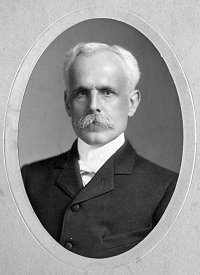
John H. Sammis (1846-1919), gave up his life as a businessman and part-time YMCA worker to study for the ministry. He was ordained a Presbyterian minister in 1880 and then served at several pastorates. In his later years, Sammis taught at the Bible Institute of Los Angeles.
Daniel B. Towner (1850-1919) was music director for several well-known churches and schools, including the Moody Bible Institute. He published several music books and wrote the music for many well-loved hymns, including At Calvary and Only A Sinner Saved By Grace.
In 1887, just following an evangelistic meeting held by Dwight L. Moody, a young man stood to share his story in an after-service testimony meeting. As he was speaking, it became clear to many that he knew little about the Bible or acceptable Christian doctrine. His closing lines, however, spoke volumes to seasoned and new believers alike: I’m not quite sure. But I’m going to trust, and I’m going to obey.
Daniel Towner was so struck by the power of those simple words that he quickly jotted them down, then delivered them to John Sammis, who developed the lyrics to Trust and Obey. Towner composed the music and the song quickly became a favorite. It remains popular with hymn singers today.
Psalm 34:22
Though I speak with the tongues of men and of angels, and have not charity, I am become as sounding brass, or a tinkling cymbal.
If the Holy Spirit is controlling us – no law is needed to cause us to live a righteous life. How do we live a Spirit controlled life?
12 I beseech you therefore, brethren, by the mercies of God, that ye present your bodies a living sacrifice, holy, acceptable unto God, which is your reasonable service.
2 And be not conformed to this world: but be ye transformed by the renewing of your mind, that ye may prove what is that good, and acceptable, and perfect, will of God.
Put your all on the altar, so that the Holy Spirit may fill your heart with the love of God.
And hope maketh not ashamed; because the love of God is shed abroad in our hearts by the Holy Ghost which is given unto us.

 The Vine Vigil


