This is the full length movie, suitable for ages 10 and up, Christ honoring from start to finish, although, alas – not KJV.
Creation Family Theater – God of Wonders
Leave a reply

This is the full length movie, suitable for ages 10 and up, Christ honoring from start to finish, although, alas – not KJV.
Please enjoy this full screen with your family!
This wonderful article from the Institute for Creation Research gives glory to our Creator – and His perfect, preserved Word.

Zookeepers in Reynosa, Mexico, recently witnessed a female zebra give birth to a “zonkey.” So far, this rare hybrid animal appears to be in good health.1 Meanwhile, an Irish farmer’s sheep chases its baby “geep,” sired by a goat.2 What do zonkeys and geeps have to do with Noah’s Ark?
The zebra mother had grown familiar with a neighboring dwarf albino donkey. Although its father was colorless, the zonkey progeny has striped legs and a mostly brown torso.1 Zebras and donkeys actually have different numbers of chromosomes, making fertilization quite challenging, but cellular machinery sometimes somehow finds a way to form a viable offspring. It appears life was designed to do just that.
Similarly, the typical goat has 60 chromosomes, and most domestic sheep have but 54. Modern science has attached separate genus names for the two varieties, but the fact that they can interbreed demonstrates that they descended from a single kind. They both fall under a broader category: the subfamily called “Caprinae.”
Family names, or in this case the subfamily, for animals seems to best approximate the Genesis kind. Adding those of air-breathing, land-dwelling animals yields a population that would not even take up half the Ark’s calculated volume.3
Nevertheless, Bible skeptics discount the Ark, insisting that it could not possibly have carried all the required creatures. When asked to estimate how many creatures entered the vessel, they sometimes suggest millions—an unrealistic number by far. But they sometimes add sea creatures to their tallies, and they may also be counting various versions of sheep, goats, zebras, donkeys, and horses separately.
Noah and his sons only needed two of each kind, and if two creatures can interbreed, they essentially belong to the same kind. Noah’s family also only needed land-dwelling, air-breathing animals. The text says, “Of the birds after their kind, of animals after their kind, and of every creeping thing of the earth after its kind, two of every kind will come to you to keep them alive.”4 That rules out fish and a host of other water creatures, which comprise the largest chunk of currently tallied animal names—Nemo and Flipper need not apply.
How did today’s animal varieties arise, anyway? Since creatures continue to diversify into newly named varieties as they pioneer new environments and breed with neighbors of their own general kind, it stands to reason that the few number of animals on the ark rapidly diversified after the Flood into the vastly diverse animal kingdom we see today. For example, over a thousand named species of finches and sparrows have been linked through breeding studies to a single, interbreeding kind.5 And that’s where rare animals like zonkeys and geeps come in, showing that today’s varieties trace back to basic kinds.
Were horses, zebras, donkeys, sheep and goats on the ark separately? Maybe, but based on these rare cross breeds, perhaps the two basic kinds were represented by animals that looked more like zonkeys and geeps.
You can have confidence that every Word of your Bible is true – despite the tenacious efforts of the wicked to prove otherwise.
Isaiah 28:5
“In that day shall the LORD of hosts be for a crown of glory, and for a diadem of beauty, unto the residue of his people.”
In 1835, when scientists first saw Peru’s most unusual hummingbird, they were so overcome with its beauty that they gave it the name “Marvellous”.
This little bird treats the eye to iridescent green, yellow, orange, and purple feathers. But its most unusual feature is its tail. While most birds have eight to twelve tail feathers, the Marvelous hummingbird has only four. Two of these are long, pointed, thorn-like feathers that don’t seem to help much in flying or landing. The other two feathers are truly marvelous. They are six inches long, three times the length of the bird’s two-inch body. On the end of these two long narrow feathers are large feather fans that nearly equal the surface area of its wings.
Astonishingly, the Marvellous hummingbird has complete control of these feathers. At rest, the bird perches with these two feathers hanging down an inch or so from its body, and then crossing them until they are horizontal. In flight and landing, they provide remarkable maneuverability. During mating, the hummingbird moves them as semaphores. Interestingly enough, evolutionists admit that they are stumped as to why these unusual feathers should have evolved.
One look at our creation clearly shows that our Creator appreciates beauty. But even the beautiful Marvelous hummingbird is but a poor and cloudy hint of the beauty of our Creator Himself. http://www.creationmoments.com/radio/transcripts/peru-s-marvellous-hummingbird
Watching the video makes me wonder what the Garden of Eden was really like, and wonder further what it will be like when He returns and restores everything. Sigh . . .
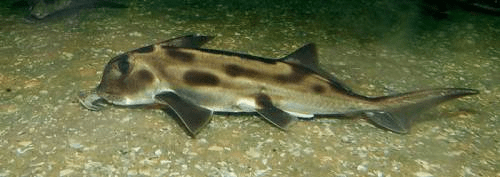
When mainstream scientists search for clues about how and when the first bony-skeleton creature evolved from a non-bony creature, do they overlook evidence showing skeletons could never evolve from non-skeletons in the first place? It appears that a large collaboration of scientists that analyzed DNA from a spectacular living fossil called an elephant shark did just that. The title of their report, published in Nature, refers to “unique insights” into evolution, but the facts actually reveal something else.1
The elephant shark, or Australian ghost shark, is a cartilaginous fish that uses a snout to probe sea-floor sands for small clams in New Zealand and Australian waters. They have other non-shark-like characteristics, including green eyes placed high atop their heads and opercula covering their gills.
Elephant shark fossils occur in Ordovician rocks, assigned a conventional age of 450 million years, and in Permian rocks, assigned an age of 260 million years. Elephant sharks are still living today. Supposedly, they have not changed in form for over 300 million years and this makes them a spectacular example of a living fossil. The Nature authors wrote that their genetic analysis “shows that the C. milii [elephant shark] genome is evolving significantly slower than other vertebrates, including the coelacanth, which is considered a ‘living fossil.’”1
To say that the elephant shark has evolved slowly because its form has not changed dramatically understates the situation—it has not evolved at all! The study authors wrote, “The factors contributing to the lower evolutionary rate of C. milii are not known.”1 (One explanation they evidently didn’t consider for why these fish have not evolved is that God created their basic form right from the start.)
The main purpose of this secular research project was to find clues that might explain how jawed fishes evolved from jawless fishes—an evolutionarily biased approach. So, the researchers fitted their elephant shark’s genomic data into an evolutionary narrative about how jawless fishes evolved into the first cartilaginous-jawed fish and how some of its descendants then evolved into the first bony-jawed fish. And this despite the fact that all three groups suddenly appear side by side as contemporaries in Cambrian system strata!
Each step in the supposed evolution of vertebrates would require a wholesale restructuring of the ancestor’s anatomy. The Nature authors wrote, “This transition was accompanied by many morphological and phenotypic innovations.”1 But there are no demonstrations of creatures innovating even one new body part, let alone many. Plus, undisputed transitions are still no-shows in the fossil record.
What if these fish were created much as we find them today and never did evolve? This report ignores such questions, and its conclusions drip with evolutionary bias. For example, the authors wrote, “Overall, the C. milii genome is the least derived [least evolved] among known vertebrates.”1 But what empirical foundation supports a “least derived” designation? It is purely subjective since another research group could just as easily assert—perhaps on the basis of another organism’s perfectly unique genetic makeup and fossil occurrence in lower strata—an entirely different creature as being the least-derived vertebrate.2
Supposedly, elephant sharks “constitute a critical outgroup for understanding the evolution and diversity of bony vertebrates.”1 How do the researchers know that this fish kind is a critical outgroup? This designation comes not from data, but from an evolutionary-slanted assertion.
The Nature authors wrote of the elephant shark’s genome, “Its value for comparative genomic studies is illustrated by our analysis of genetic events that led to the ossification of endoskeleton in bony vertebrates.”1 Wait a minute—did these authors really study genetic events? Do they have a time machine that enabled them to go back and observe these alleged events? In reality, it appears they forced a high-functioning and one-of-a-kind genome into an evolutionary model.
The most significant insights that the elephant shark study revealed are that it simply has not evolved over supposed hundreds of millions of years and that secularists insist on fitting it into an evolutionary narrative despite the evidence. But its lack of evolution makes perfect sense if God created these fish to reproduce after their kind, just like He said.3
http://www.icr.org/article/7879/
Watching my dog in the snow – I always marvel that my feet in snow boots are ice cold – while she is completely comfortable, having her feet even deep in the snow. This is so exciting – I thought you might be interested – even if you live in Florida or California.
Why Dogs Don’t Need Snow Boots
by Brian Thomas, M.S. *
Human feet would quickly freeze if exposed to snow and ice without proper gear, but dogs don’t seem to mind the cold. Since the pads of their feet aren’t protected by fur like the rest of their bodies, it would seem that they’d be especially susceptible to freezing—but they aren’t. Japanese researchers recently discovered why.
It turns out that dog paws have tiny blood vessels arranged as counter-current heat exchangers. This way, dogs’ internal body heat is not lost through the soles of their feet. Instead, cold blood is warmed right in their paws before it re-enters the main blood supply. Plus, most of the core body blood recirculates back into the body, instead of straight to the feet, to keep the animals’ temperature consistently warm even when walking on ice.
In their study published in the journal Veterinary Dermatology, the researchers found the dogs’ “wonderful network” of veins by injecting something like liquid rubber into the blood vessels of the dogs’ feet.1 They were then able to examine the three-dimensional vessel network after the chemical hardened. The vessels “formed a vein-artery-vein triad” where heat could flow at just the right pace across the system.2
This discovery only adds to the long list of known dog features that identify them as intentionally created creatures, including the dog’s straight back that “better absorbs the power that is generated by the hindquarters when the animal is moving.”3 Animal anatomist Daniel Schmitt called dog locomotion “an evolutionary miracle in my view.”4
Also, a dog’s sense of smell is so acute that it can distinguish between identical twins,5 and its hearing is so well-developed that it can hear sounds up to 40,000 cycles per second—twice what human ears can hear. And their ear structure enables them to hear “about 4 times farther than humans are capable of hearing.”6
Superior dog engineering, from head to toe, should point thinking people to a superior Engineer.
ICR Article here.
Even though my dog is very old for her breed, if fresh snow has fallen – it seems to give her an injection of puppiness for a short while. And – what heart does not melt at the sight of dogs playing in the snow?
I suggest turning the volume down or even off for this youtube – the soundtrack for this video does not enhance viewing and may actually disrupt your and/or your children’s enjoyment of it.
p.s. – I put this article together several years ago for another blog. My darling girl has since left us, this past July, at the age of fourteen. I am still grieving for her . . .
Most people are aware of the central nervous system, and its role in interpreting information that our senses come in contact with, through sight, touch and smell. Evolutionists have argued that these complex funtions only occur in the “higher life forms.”
Psalm 104:14
“He causeth the grass to grow for the cattle, and herb for the service of man: that he may bring forth food out of the earth….”
The dodder is a very unusual plant and is known as one of the ten worst weeds found in the United States. A newly sprouted dodder seed does not bother to grow roots. Rather, it sprouts a tendril that grows out, looking for other plants. It has, at most, a week to find a plant from which to steal water and nutrients.

The dodder is a parasite and while it does not kill its victims, it will take enough water and nutrition to stunt their growth. The dodder actually costs California tomato growers $4,000,000 a year in losses. Researchers found that the species of dodder that causes most trouble to tomato plants actually “sniffs out” its victims. Scientists knew that plants emit pheromones or scents unique to each species. The researchers gave a sprouting dodder seed a choice of targets to grow toward, including a tomato plant. When the dodder seed sprouted, it immediately sent a tendril out to the tomato. In a more rigorous test, researchers connected possible targets in separate enclosures to the sprouting dodder with curved tubes. The dodder still found the tomato plant.
The dodder has no nervous system, and scientists marvel at what it can do. Rather, they should be marveling at what our Creator can do in providing for the needs of all living things.
http://www.creationmoments.com/radio/transcripts/plant-sniffs-out-prey
https://player.pbs.org/viralplayer/2341198769/
While scientists are thrilled at the performance of the Dodder plant – they offer no evidence on how such a capability, in such a “simple life form,” could possible have developed through random mutations.
People are not often aware of how scientists frequently base their research on things already existing in the natural world that God created. Until the invention of the electron microscope, cells were believed to be simple, consisting of nothing but indeterminate protoplasm. Cells are now know to be anything but simple – each one a miracle of complexity. Scientists are now adapting the structure of fascinating deep sea sponges – to achieve phenomenal strength – coupled with flexibility. From Creation Moments:
Psalm 107:24
“These see the works of the LORD, and his wonders in the deep.”
“The most perfect design I’ve ever seen.” Those words were uttered by a materials engineer after studying a deep sea sponge from the Pacific Ocean. And, indeed, the Euplectella aspergillun, claimed to be an early and primitive sponge, can teach modern materials engineers a number of useful things.
The sponge’s body is made up of a thin layer of cells over an intricate glass skeleton. The sponge grows into a cylindrical shape about 8 inches long and about an inch across. The wonder lies in the glass skeleton that is made up of vertical and horizontal beams of glass. Diagonal beams strengthen this grid. One-third of these beams are thicker than the others, adding the extra strength of ridges to the cylinder. What’s more, each of these glass beams is made up of small cylinders of glass glued together with more glass-like tree rings. The result is a structure that spreads the pressures that might crush an ordinary glass structure this size. It is a delicate looking, but nearly unbreakable, glass structure.
In a less-than-scientific test, one researcher noted that one has to jump full weight on one of these cylinders to even produce any cracking, and such jumping will still not break it. “The most perfect design I’ve ever seen,” said the researcher. There’s little that we at Creation Moments can add to that.
http://www.creationmoments.com/radio/transcripts/most-perfect-design-i-ve-ever-seen
The more tech minded may enjoy this video showing the lab simulation of a deep sea sponge spicule (a slender pointed usually hard body; especially : one of the minute calcareous or siliceous bodies that support the tissue of various invertebrates (as sponges)

Job 35:10-11
“But none saith, Where [is] God my maker, who giveth songs in the night; who teacheth us more than the beasts of the earth, and maketh us wiser than the fowls of heaven?”
It has long been known that an African bird known as the honeyguide leads badgers to bees’ nests, where the badger tears the nest apart to eat the honey. The badger always leaves more than enough for the honeyguide.
Now it has been learned that the honeyguide has a similar relationship with the Boran people of Kenya. When the bird has found a bees’ nest, it will alert the Boran, bidding them to follow it to the honey site. On the other hand, if the Boran want to know where honey is, they know how to whistle and call for a honeyguide.
The honeyguide also calls to the people so that they know which way to go. When the Boran reach the honey, they always make sure that they leave some for the honeyguide. Researchers also reported that they saw honeyguides scouting out bees’ nests at night so that they had good sites to lead the Boran to the next day.
While the honeyguide does get its reward of honey in return for its help, the intelligence of the honeyguide in establishing these relationships with human beings is impressive. But while the honeyguide can help teach us that the creation is the work of an intelligent Creator, it cannot teach us how to have a relationship with Him. For that we must go to the Bible.
http://www.creationmoments.com/radio/transcripts/helpful-honeyguide
Try to think back to those times, when the Lord has led you somewhere, and you trusted Him fully to lead you to the expected end. Just as the man in the video trusts that the Honey Guide would not lead him to a hornet’s nest – we can know that our Savior will not lead us astray if we fully trust in Him.
My favorite Bible verse:

Genesis 1:25
“And God made the beast of the earth after his kind, and cattle after their kind, and every thing that creepeth upon the earth after his kind: and God saw that [it was] good.”
According to the Bible, God created the land-living insects, and that would include the bees, on day six of creation. This was just three days after He created the flowering plants. According to evolution, bees evolved from a simpler insect after the pollen-bearing plants had developed. The specialized bee and its complex social structure was thought to have taken a long time to evolve.
Creationists, who believe the time line of events laid out in Scripture and reject inflated evolutionary years, were not surprised when a bee was found preserved in amber which evolutionists said was many millions of years older than the oldest known bee. The almost perfectly preserved bee is like modern bees and can even be identified as a worker. Not only does this show that bees, with all their superb specializations, were around much earlier than ever thought by evolutionists, it also shows that they were around for some time before this specimen lived. In fact, the evolutionist who reported the findings admitted that there is a real problem explaining how bees could have developed nearly at the same time as pollen-bearing plants.
As creationists, we have no such problem. Bees were created, fully formed, only a few days after pollen-bearing plants. Science has shown us once again that the biblical history makes more sense than the evolutionary story of history.
http://www.creationmoments.com/radio/transcripts/fast-bees-or-fast-talking
Tadpoles Declare the Glory of God
Researchers have discovered that bioelectrical signals are essential to the development of normal head and facial features in tadpoles. The signals actually outline the features – eyes, nose, mouth, etc.
The Tufts biologists found that, before the face of a tadpole develops, bioelectrical signals (ion flux) cause groups of cells to form patterns marked by different membrane voltage and pH levels. When stained with a reporter dye, hyperpolarized (negatively charged) areas shine brightly, while other areas appear darker, creating an “electric face.”
“When a frog embryo is just developing, before it gets a face, a pattern for that face lights up on the surface of the embryo,” said senior author Dany S. Adams, Ph.D. Adams is a research associate professor in the Department of Biology in the Tufts School of Arts and Sciences and a member of the Tufts Center for Regenerative and Developmental Biology. “We believe this is the first time such patterning has been reported for an entire structure, not just for a single organ. I would never have predicted anything like it. It’s a jaw dropper.” [TUFTS NOW, August 6, 2011]https://web.archive.org/web/20151025084332if_/http://www.youtube.com/embed/ndFe5CaDTlI?version=3&rel=1&fs=1&showsearch=0&showinfo=1&iv_load_policy=1&wmode=transparent
 The Vine Vigil

