Abide with me; fast falls the eventide; the darkness deepens; Lord, with me abide. When other helpers fail and comforts flee, Help of the helpless, O abide with me.
Swift to its close ebbs out life’s little day; earth’s joys grow dim; its glories pass away; change and decay in all around I see; O thou who changest not, abide with me.
I need thy presence every passing hour. What but thy grace can foil the tempter’s power? Who, like thyself, my guide and stay can be? Through cloud and sunshine, Lord, abide with me.
I fear no foe, with thee at hand to bless; ills have no weight, and tears not bitterness. Where is death’s sting? Where, grave, thy victory? I triumph still, if thou abide with me.
Hold thou thy cross before my closing eyes; shine through the gloom and point me to the skies. Heaven’s morning breaks, and earth’s vain shadows flee; in life, in death, O Lord, abide with me.
Henry Francis Lyte – Lyrics 1793-1847
Born: June 1, 1793, Ednam, Scotland. Died: November 20, 1847, Nice, France.
Buried: English Cemetery, Nice, France.
Henry Francis Lyte (1793-1847) and his wife Ann were faithful pastors of a little fishing town in Devonshire England, for 23 years. Although Henry’s health was compromised, he worked tirelessly ministering to his parish, taking care of his family, and writing poems and hymns.
In 1844, Henry was diagnosed with Tuberculosis. Over the next three years his physical condition deteriorated until finally on September 4, 1847, at the age of 54, he stood in the pulpit for the last time to deliver his farewell message.
That same afternoon, after taking a walk on the beach, Henry retired to his room. He emerged about an hour later with a written copy of Abide With Me. He left soon after for a trip to Italy, to get away from the cold, damp coastal weather. While en route to his destination, he mailed a revised copy of Abide With Me to his wife. A few days later while resting in a hotel on the French Riviera, Henry went home to be with Jesus. A fellow clergyman who was with Henry during his final hours reported that Henry’s last words were Peace! Joy!
“It is better to wear out than to rust out.” Henry Lyte
Yea, though I walk through the valley of the shadow of death, I will fear no evil: for Thou art with me; Thy rod and Thy staff they comfort me. Psalm 23:4
Rock of Ages, cleft for me, Let me hide myself in Thee; Let the water and the blood, From Thy wounded side which flowed, Be of sin the double cure; Save from wrath and make me pure.
Not the labor of my hands Can fulfill Thy law’s demands; Could my zeal no respite know, Could my tears forever flow, All for sin could not atone; Thou must save, and Thou alone.
Nothing in my hand I bring, Simply to the cross I cling; Naked, come to Thee for dress; Helpless look to Thee for grace; Foul, I to the fountain fly; Wash me, Savior, or I die.
While I draw this fleeting breath, When mine eyes shall close in death, [originally When my eye-strings break in death] When I soar to worlds unknown, See Thee on Thy judgment throne, Rock of Ages, cleft for me, Let me hide myself in Thee.
Augustus Montague Toplady (1740 to 1778), was an unusual child. His father died when he was very young and so he was raised by his mother who adored and spoiled him. He was not very well liked by his peers or his relatives, partly because they did not relate to his extreme intelligence, and partly because he was sickly and neurotic.
Controversy followed Toplady throughout his short 38 years of life, but he did not let that stop him. At a very young age he showed a keen interest in developing a relationship with God. By age 12 he was preaching sermons, and at age 14 he began writing hymns. He was ordained as an Anglican priest at the age of 22. Although some thought him to be arrogant and obstinate, excerpts from his writings verify that he was a devoted and humble follower of Christ.
an excerpt from his personal journal, at age 27: O, my Lord let not my ministry be approved only, or tend to be no more than conciliating the esteem and affections of my people to Thy unworthy messenger; but to do the work of Thy grace upon their hearts: call in Thy chosen; seal and edify Thy regenerate; and command Thy everlasting blessing upon their souls! Save me from self-opinion, and from self-seeking; and may they cease from man, and look solely upon Thee. (faithclipart.com)
1 O come, let us sing unto the Lord: let us make a joyful noise to the Rock of our salvation.
2 Let us come before His presence with thanksgiving, and make a joyful noise unto Him with psalms.
3 For the Lord is a great God, and a great King above all gods.
4 In His hand are the deep places of the earth: the strength of the hills is His also.
5 The sea is His, and He made it: and His hands formed the dry land.
6 O come, let us worship and bow down: let us kneel before the Lord our maker. Psalm 95: 1-6
6 Wherefore also it is contained in the Scripture, Behold, I lay in Sion a chief corner stone, elect, precious: and he that believeth on Him shall not be confounded. 7 Unto you therefore which believe He is precious: but unto them which be disobedient, the Stone which the builders disallowed, the same is made the Head of the corner, 8 And a Stone of stumbling, and a Rock of offence, even to them which stumble at the Word, being disobedient: whereunto also they were appointed. 1 Peter 2: 6-8
I would venture to guess, that most of you have never heard this lovely hymn as it was intended by Civilla Martin in 1905. Today, it is often presented as a soft-rock ballad. I hope this authentic rendering by a Mennonite choir will minister to your spirit.
“HIS EYE IS ON THE SPARROW”
Why should I feel discouraged, why should the shadows come, Why should my heart be lonely, and long for heav’n and home, When Jesus is my portion? My constant Friend is He: His eye is on the sparrow, and I know He watches me; His eye is on the sparrow, and I know He watches me.“Let not your heart be troubled,” His tender word I hear,
Refrain: I sing because I’m happy, I sing because I’m free, For His eye is on the sparrow, and I know He watches me.
And resting on His goodness, I lose my doubts and fears; Though by the path He leadeth, but one step I may see; His eye is on the sparrow, and I know He watches me; His eye is on the sparrow, and I know He watches me.
Whenever I am tempted, whenever clouds arise, When songs give place to sighing, when hope within me dies, I draw the closer to Him, from care He sets me free; His eye is on the sparrow, and I know He watches me; His eye is on the sparrow, and I know He watches me.
+++++++++++++++++++++++++++++++++++++++++++
Civilla Martin, who wrote the lyrics, said this about her inspiration to write the song based in the scriptures outlined above,
Early in the spring of 1905, my husband and I were sojourning in Elmira, New York. We contracted a deep friendship for a couple by the name of Mr. and Mrs. Doolittle—true saints of God. Mrs. Doolittle had been bedridden for nigh twenty years. Her husband was an incurable cripple who had to propel himself to and from his business in a wheel chair. Despite their afflictions, they lived happy Christian lives, bringing inspiration and comfort to all who knew them. One day while we were visiting with the Doolittles, my husband commented on their bright hopefulness and asked them for the secret of it. Mrs. Doolittle’s reply was simple: “His eye is on the sparrow, and I know He watches me.” The beauty of this simple expression of boundless faith gripped the hearts and fired the imagination of Dr. Martin and me. The hymn “His Eye Is on the Sparrow” was the outcome of that experience. [wikipidea.org]
+++++++++++++++++++++++++++++++++++++++++++++
4 Rejoice in the Lord alway: and again I say, Rejoice. 5 Let your moderation be known unto all men. The Lord is at hand. 6 Be careful for nothing; but in every thing by prayer and supplication with thanksgiving let your requests be made known unto God. 7 And the peace of God, which passeth all understanding, shall keep your hearts and minds through Christ Jesus. Philippians 4: 4-7
Amazing grace! How sweet the sound That saved a wretch like me! I once was lost, but now am found; Was blind, but now I see.
’Twas grace that taught my heart to fear, And grace my fears relieved; How precious did that grace appear The hour I first believed!
Through many dangers, toils and snares, I have already come; ’Tis grace hath brought me safe thus far, And grace will lead me home.
The Lord has promised good to me, His Word my hope secures; He will my Shield and Portion be, As long as life endures.
Yea, when this flesh and heart shall fail, And mortal life shall cease, I shall possess, within the veil, A life of joy and peace.
The earth shall soon dissolve like snow, The sun forbear to shine; But God, who called me here below, Will be forever mine.
When we’ve been there ten thousand years, Bright shining as the sun, We’ve no less days to sing God’s praise Than when we’d first begun.
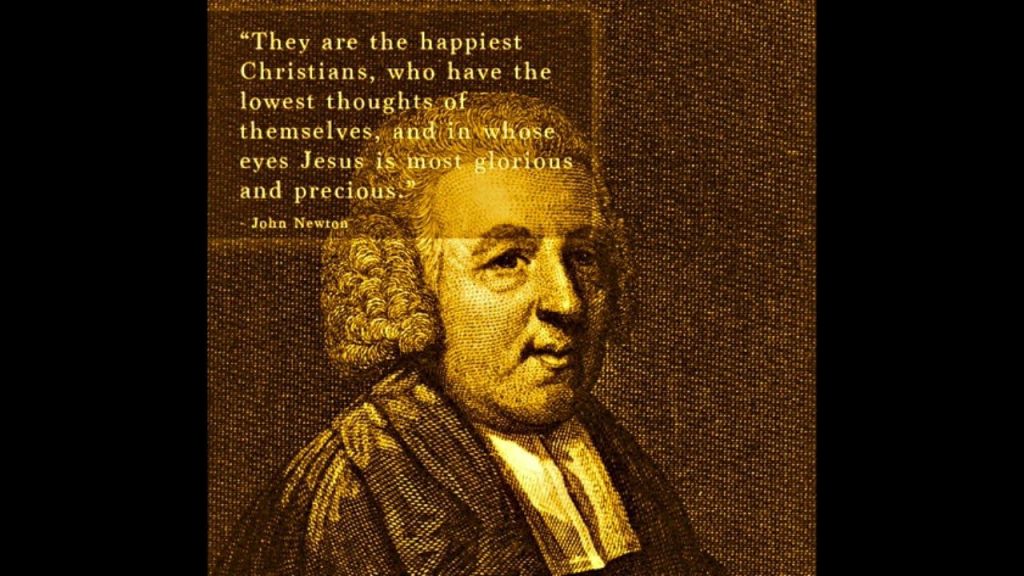
John Newton’s Christian mother had died, leaving him to the care of his sailor father. He followed his father into the British Navy, and eventually became involved in the slave trade. Newton was a very unsavory character – leading others to follow him into debauchery. Some years later , as captain of a ship, they were struck by a storm of such severity – that it was doubtful any would survive. Newton – as many do when faced with death – cried out to God – “Lord have mercy on us.”
That was May 10, 1748, the date of Newton’s conversion. Newton continued in the slave trade for a while, though now treating the slaves with some humanity. But, in the natural course of maturing as a Christian – he gave up seafaring entirely in 1755. He eventually became a minister, teaching himself Greek and Hebrew. He died December 21, 1807, secure in his faith. He wrote the words to his own epitaph –
“John Newton, Clerk, once an infidel and libertine, a servant of slaves in Africa, was, by the rich mercy of our Lord and Saviour Jesus Christ, preserved, restored, pardoned, and appointed to preach the faith he had long labored to destroy.”
John Newton (1725 – 1807 ) left us a great legacy, perhaps the most beloved hymn of all time.
At 82, Newton said,
“My memory is nearly gone, but I remember two things, that I am a great sinner, and that Christ is a great Saviour.”
4 But God, Who is rich in mercy, for His great love wherewith He loved us,5 Even when we were dead in sins, hath quickened us together with Christ, (by grace ye are saved;) 6 And hath raised us up together, and made us sit together in heavenly places in Christ Jesus: 7 That in the ages to come He might shew the exceeding riches of His grace in His kindness toward us through Christ Jesus. 8 For by grace are ye saved through faith; and that not of yourselves: it is the gift of God: 9 Not of works, lest any man should boast. Ephesians 2: 4-9
C. Austin Miles (1868-1946) was a pharmacist turned hymn writer and church music director. He was also an amateur photographer. One day in March, 1912, while in his dark room waiting for film to develop, Miles had a profound spiritual experience in which he saw an incredible vision of Mary Magdalene visiting the empty tomb. He saw her leave the tomb and walk into a garden where she met the Master and heard Him speak her name.
When Miles came to himself his nerves were vibrating and his muscles tense; the words to a new song were filling his mind and heart. He quickly wrote out the lyrics to In The Garden and later that evening composed the musical score. The song was published that same year and became a theme song of the Billy Sunday evangelistic crusades. (faithclipart.com)
In The Garden
I come to the garden alone, While the dew is still on the roses, And the voice I hear falling on my ear, The Son of God discloses . . .
And He walks with me, and He talks with me, And He tells me I am His own, And the joy we share as we tarry there, None other, has ever, known!
He speaks and the sound of His voice, Is so sweet the birds hush their singing, And the melody that he gave to me, Within my heart is ringing . . .
And He walks with me, and He talks with me, And He tells me I am His own, And the joy we share as we tarry there, None other, has ever, known!
And the joy we share as we tarry there, None other, has ever, known!
11 But Mary stood without at the sepulchre weeping: and as she wept, she stooped down, and looked into the sepulchre,
12 And seeth two angels in white sitting, the one at the head, and the other at the feet, where the body of Jesus had lain.
13 And they say unto her, Woman, why weepest thou? She saith unto them, Because they have taken away my Lord, and I know not where they have laid Him.
14 And when she had thus said, she turned herself back, and saw Jesus standing, and knew not that it was Jesus.
15 Jesus saith unto her, Woman, why weepest thou? Whom seekest thou? She, supposing him to be the gardener, saith unto Him, Sir, if thou have borne Him hence, tell me where thou hast laid Him, and I will take Him away.
16 Jesus saith unto her, Mary. She turned herself, and saith unto Him, Rabboni; which is to say, Master.
17 Jesus saith unto her, Touch Me not; for I am not yet ascended to My Father: but go to My brethren, and say unto them, I ascend unto My Father, and your Father; and to My God, and your God.
18 Mary Magdalene came and told the disciples that she had seen the Lord, and that He had spoken these things unto her.
Curtis Hutson was a wonderful preacher. He majored in leading people to Jesus. In this video he was close to death and he knew it. His wife is in the audience and she shed some tears. Short video but worth watching and listening to.
As I sit hear alone, I am overwlemed with this song. Truly, I need Him every hour. A short story about the author as you listen but please don’t miss the words.
Annie Hawks wrote: “One day as a young wife and mother of 37 years of age, I was busy with my regular household tasks. Suddenly, I became so filled with the sense of nearness to the Master that, wondering how one could live without Him, either in joy or pain, these words, “I Need Thee Every Hour,” were ushered into my mind, the thought at once taking full possession of me.”
After writing the lyrics, Hawks gave them to her pastor, Robert Lowry, who added the tune and refrain. The hymn was first published at the National Baptist Sunday School Convention in Cincinnati, Ohio, in November 1872. Some years later, after the death of her husband, Hawks wrote:
“I did not understand at first why this hymn had touched the great throbbing heart of humanity. It was not until long after, when the shadow fell over my way, the shadow of a great loss, that I understood something of the comforting power in the words which I had been permitted to give out to others in my hour of sweet serenity and peace.”
I need Thee every hour, most gracious Lord No tender voice like Thine can peace afford
I need Thee every hour, stay Thou nearby Temptations lose their power When Thou art nigh
I need thee, oh, I need thee, every hour I need Thee I need thee, I need thee, I need Thee every hour
I need Thee every hour in joy or pain Come quickly and abide or life is in vain I need Thee, oh, I need Thee, every hour I need Thee I need Thee, I need Thee, I need Thee every hour I need Thee, I need Thee, I need Thee every hour
Oh, bless me now, my Savior, I come to Thee Oh, bless me now, my Savior, I come to Thee I need Thee every hour, teach me Thy will And Thy rich promises in me fulfill
I need Thee, oh, I need Thee Oh I need Thee every hour I need Thee, I need Thee, I need Thee every hour I need Thee, I need Thee, I need Thee every hour
“Click on the link in order to watch this on youtube! Embedding is disabled, but you can still view it.”
It Is Well With My Soul
When peace like a river, attendeth my way, When sorrows like sea billows roll; Whatever my lot, Thou hast taught me to know, It is well, it is well, with my soul.
Refrain: It is well, with my soul, It is well, with my soul, It is well, it is well, with my soul.
Though Satan should buffet, though trials should come, Let this blest assurance control, That Christ has regarded my helpless estate, And hath shed His own blood for my soul.
My sin, oh, the bliss of this glorious thought! My sin, not in part but the whole, Is nailed to the cross, and I bear it no more, Praise the Lord, praise the Lord, O my soul!
For me, be it Christ, be it Christ hence to live: If Jordan above me shall roll, No pang shall be mine, for in death as in life, Thou wilt whisper Thy peace to my soul.
But Lord, ’tis for Thee, for Thy coming we wait, The sky, not the grave, is our goal; Oh, trump of the angel! Oh, voice of the Lord! Blessed hope, blessed rest of my soul.
And Lord, haste the day when my faith shall be sight, The clouds be rolled back as a scroll; The trump shall resound, and the Lord shall descend, Even so, it is well with my soul.
Horatio Spafford
Horatio Gates Spafford 1828-1888
Born: October 20, 1828, North Troy, New York. Died: October 16, 1888, Jerusalem, Israel, of malari
This hymn was written by a Chicago lawyer, Horatio G. Spafford. You might think to write a worship song titled, ‘It is well with my soul’, you would indeed have to be a rich, successful Chicago lawyer. But the words, “When sorrows like sea billows roll … It is well with my soul”, were not written during the happiest period of Spafford’s life. On the contrary, they came from a man who had suffered almost unimaginable personal tragedy.
Horatio G. Spafford and his wife, Anna, were pretty well-known in 1860’s Chicago. And this was not just because of Horatio’s legal career and business endeavors. The Spaffords were also prominent supporters and close friends of D.L. Moody, the famous preacher. In 1870, however, things started to go wrong.
The Spaffords’ only son was killed by scarlet fever at the age of four. A year later, it was fire rather than fever that struck. Horatio had invested heavily in real estate on the shores of Lake Michigan. In 1871, every one of these holdings was wiped out by the great Chicago Fire.
Aware of the toll that these disasters had taken on the family, Horatio decided to take his wife and four daughters on a holiday to England. And, not only did they need the rest — DL Moody needed the help. He was traveling around Britain on one of his great evangelistic campaigns. Horatio and Anna planned to join Moody in late 1873. And so, the Spaffords traveled to New York in November, from where they were to catch the French steamer ‘Ville de Havre’ across the Atlantic. Yet just before they set sail, a last-minute business development forced Horatio to delay. Not wanting to ruin the family holiday, Spafford persuaded his family to go as planned.
He would follow on later. With this decided, Anna and her four daughters sailed East to Europe while Spafford returned West to Chicago. Just nine days later, Spafford received a telegram from his wife in Wales. It read:
“Saved alone.”
On November 2nd 1873, the ‘Ville de Havre’ had collided with ‘The Lochearn’, an English vessel. It sank in only 12 minutes, claiming the lives of 226 people. Anna Spafford had stood bravely on the deck, with her daughters Annie, Maggie, Bessie and Tanetta clinging desperately to her. Her last memory had been of her baby being torn violently from her arms by the force of the waters. Anna was only saved from the fate of her daughters by a plank which floated beneath her unconscious body and propped her up.
When the survivors of the wreck had been rescued, Mrs. Spafford’s first reaction was one of complete despair. Then she heard a voice speak to her, “You were spared for a purpose.”
And she immediately recalled the words of a friend, “It’s easy to be grateful and good when you have so much, but take care that you are not a fair-weather friend to God.”
Upon hearing the terrible news, Horatio Spafford boarded the next ship out of New York to join his bereaved wife. Bertha Spafford (the fifth daughter of Horatio and Anna born later) explained that during her father’s voyage, the captain of the ship had called him to the bridge. “A careful reckoning has been made”, he said, “and I believe we are now passing the place where the de Havre was wrecked. The water is three miles deep.” Horatio then returned to his cabin and penned the lyrics of his great hymn.
biblestudycharts.com
Colossians 3:15
And let the peace of God rule in your hearts, to the which also ye are called in one body; and be ye thankful.
Standing on the promises of Christ my King, Through eternal ages let His praises ring, Glory in the highest, I will shout and sing, Standing on the promises of God. Standing on the promises that cannot fail,
Refrain: Standing, standing, Standing on the promises of God my Savior; Standing, standing, I’m standing on the promises of God.
When the howling storms of doubt and fear assail, By the living Word of God I shall prevail, Standing on the promises of God.
Standing on the promises I now can see Perfect, present cleansing in the blood for me; Standing in the liberty where Christ makes free, Standing on the promises of God.
Standing on the promises of Christ the Lord, Bound to Him eternally by love’s strong cord, Overcoming daily with the Spirit’s sword, Standing on the promises of God.
Standing on the promises I cannot fall, List’ning every moment to the Spirit’s call, Resting in my Savior as my all in all, Standing on the promises of God.
Russell Kelso Carter (1849-1928) was a star athlete of a military academy and an excellent student academically, who went on to be a successful teacher and coach. He then spent several years as an ordained Methodist minister, after which he went to medical school. He spent the last of his professional years as a doctor of medicine. Carter was also a musician and songwriter. In 1886, he co-edited Songs of Perfect Love with John Sweney (1837-1899), who wrote the music for such beloved songs as Beulah Land and Fill Me Now. This hymnbook included Carter’s most famous hymn, Standing on the Promises.
Although Carter was a professed Christian most of his life, it wasn’t until a crisis with his natural heart that he began to understand the reality and power of Bible promises. At age 30, his health was in critical condition and the physicians could do no more for him. Carter turned to God for help and healing.He knelt and made a promise that healing or no, his life was finally and forever, fully consecrated to the service of the Lord.
It was from that moment that the written Word of God became alive to Carter. He began to stand upon the promises of healing, determining to believe no matter what his physical condition, no matter how he felt. Over the course of the next several months his strength returned, and his heart was completely healed! Carter lived another healthy 49 years. The hymn Carter had written several years before his healing miracle became more than words and music to him. Standing on the Promises became an integral part of his life.
To God be the glory, great things He hath done, So loved He the world that He gave us His Son, Who yielded His life an atonement for sin, And opened the life gate that all may go in.
Refrain: Praise the Lord, praise the Lord, let the earth hear His voice! Praise the Lord, praise the Lord, let the people rejoice! Oh, come to the Father, through Jesus the Son, And give Him the glory, great things He hath done.
Oh, perfect redemption, the purchase of blood, To every believer the promise of God; The vilest offender who truly believes, That moment from Jesus a pardon receives.
Great things He hath taught us, great things He hath done, And great our rejoicing through Jesus the Son; But purer, and higher, and greater will be Our wonder, our transport, when Jesus we see
Fanny Crosby
1820-1915
Frances Jane “Fanny” Crosby (1820-1915), American hymn writer and poetess who wrote over 8,000 hymns. Once a preacher sympathetically remarked, “I think it is a great pity that the Master did not give you sight when He showered so many other gifts upon you.” She replied quickly, “Do you know that if at birth I had been able to make one petition, it would have been that I should be born blind?” “Why?” asked the surprised minister. “Because when I get to heaven, the first face that shall ever gladden my sight will be that of my Savior!”
4 Say to them that are of a fearful heart, Be strong, fear not: behold, your God will come with vengeance, even God with a recompense; He will come and save you.
5 Then the eyes of the blind shall be opened, and the ears of the deaf shall be unstopped.
6 Then. shall the lame man leap as an hart, and the tongue of the dumb sing: for in the wilderness shall waters break out, and streams in the desert. Isaiah 35: 4-6
And can it be that I should gain An interest in the Savior’s blood? Died He for me, who caused His pain— For me, who Him to death pursued? Amazing love! How can it be, That Thou, my God, shouldst die for me? Amazing love! How can it be, That Thou, my God, shouldst die for me?
’Tis mystery all: th’Immortal dies: Who can explore His strange design? In vain the firstborn seraph tries To sound the depths of love divine. ’Tis mercy all! Let earth adore, Let angel minds inquire no more. ’Tis mercy all! Let earth adore; Let angel minds inquire no more.
He left His Father’s throne above So free, so infinite His grace— Emptied Himself of all but love, And bled for Adam’s helpless race: ’Tis mercy all, immense and free, For O my God, it found out me! ’Tis mercy all, immense and free, For O my God, it found out me!
Long my imprisoned spirit lay, Fast bound in sin and nature’s night; Thine eye diffused a quickening ray— I woke, the dungeon flamed with light; My chains fell off, my heart was free, I rose, went forth, and followed Thee. My chains fell off, my heart was free, I rose, went forth, and followed Thee.
Still the small inward voice I hear, That whispers all my sins forgiven; Still the atoning blood is near, That quenched the wrath of hostile Heaven. I feel the life His wounds impart; I feel the Savior in my heart. I feel the life His wounds impart; I feel the Savior in my heart.
No condemnation now I dread; Jesus, and all in Him, is mine; Alive in Him, my living Head, And clothed in righteousness divine, Bold I approach th’eternal throne, And claim the crown, through Christ my own. Bold I approach th’eternal throne, And claim the crown,through Christ my own.
Charles Wesley
Greatest hymn writer of all time
(18 December 1707 – 29 March 1788)
“O for a thousand tongues to sing / My dear Redeemer’s praise / The glories of my God and King, / The triumphs of his grace!”
He was said to have averaged 10 poetic lines a day for 50 years. He wrote 8,989 hymns, 10 times the volume composed by the only other candidate (Isaac Watts) who could conceivably claim to be the world’s greatest hymn writer. He composed some of the most memorable and lasting hymns of the church: “Hark! The Herald Angels Sing,” “And Can It Be,” “O for a Thousand Tongues to Sing,” “Love Divine, All Loves Excelling,” “Jesus, Lover of My Soul,” “Christ the Lord Is Risen Today,” “Soldiers of Christ, Arise,” and “Rejoice! the Lord Is King!“
Have you been to Jesus for the cleansing pow’r? Are you washed in the blood of the Lamb? Are you fully trusting in His grace this hour? Are you washed in the blood of the Lamb?
Refrain: Are you washed in the blood, In the soul-cleansing blood of the Lamb? Are your garments spotless? Are they white as snow? Are you washed in the blood of the Lamb?
Are you walking daily by the Savior’s side? Are you washed in the blood of the Lamb? Do you rest each moment in the Crucified? Are you washed in the blood of the Lamb?
When the Bridegroom cometh will your robes be white? Are you washed in the blood of the Lamb? Will your soul be ready for the mansions bright, And be washed in the blood of the Lamb?
Lay aside the garments that are stained with sin, And be washed in the blood of the Lamb; There’s a fountain flowing for the soul unclean, Oh, be washed in the blood of the Lamb!
Words & Music: Elisha Albright Hoffman Born: May 7, 1839, Orwigsburg, Pennsylvania. Died: November 25, 1929, Chicago, Illinois. Buried: Oak Woods Cemetery, Chicago, Illinois.
A minister’s son, Hoffman attended Union Seminary in New Berlin, Pennsylvania, and was ordained in 1868. Afterward, he worked with the Evangelical Association’s publishing arm in Cleveland, Ohio for 11 years. He pastored in Cleveland and Grafton, Ohio, in the 1880s; at the First Presbyterian Church in Benton Harbor, Michigan, around the turn of the century; and in Cabery, Illinois (1911-1922). In his lifetime, he wrote over 2,000 Gospel songs and edited 50 song books. [practicalbible.com]
Forasmuch as ye know that ye were not redeemed with corruptible things, as silver and gold, from your vain conversation received by tradition from your fathers;
But with the precious blood of Christ, as of a lamb without blemish and without spot. 1 Peter 1:18-19
Proverbs 14:34 Righteousness exalteth a nation: but sin is a reproach to any people. Commentary Tennessee just enacted a proclamation calling on name of the Lord Jesus to heal the state from all the sin and destruction that is destroying the state! Governor Bill Lee called for the people to pray and fast starting July…
Have you read the Book of Job? I’ve read it dozens of times, and the part that always stands out to me is this –
Job 42:5-6
5 I have heard of Thee by the hearing of the ear: but now mine eye seeth Thee.
6 Wherefore I abhor myself, and repent in dust and ashes.
Day after day, I fail Him, and day after day, He shows indescribable mercy. The secret pride, the self complacency, the surreptitious coveting, the sluggishness, O God – please – please – help me. And He does. Again and again and again. Again and again when I don’t deserve it. Again and again when I forget Him and allow the cares of this world to consume me. There He is, so gracious, so merciful, so longsuffering.
How can He love me – still. He is so wonderful, my puny vocabulary is insufficient to praise Him. What can I do, this horrible sinner, but give His own perfect Words back to Him?
Psalm 47:1-6
47 O clap your hands, all ye people; shout unto God with the voice of triumph.
2 For the Lord most high is terrible; he is a great King over all the earth.
3 He shall subdue the people under us, and the nations under our feet.
4 He shall choose our inheritance for us, the excellency of Jacob whom he loved. Selah.
5 God is gone up with a shout, the Lord with the sound of a trumpet.
6 Sing praises to God, sing praises: sing praises unto our King, sing praises.
Thank you, thank you, thank you, our dear precious Savior, our Lord and Righteous King, Jesus Christ.
This beloved hymn came from the grateful heart of Fanny Crosby after she had received a direct answer to her prayer.
One day when she desperately needed five dollars and had no idea where she could obtain it, Fanny followed her usual custom and began to pray about the matter. A few minutes later a stranger appeared at her door with the exact amount.
I have no way of accounting for this, she said, except to believe that God put it into the heart of this good man to bring the money. My first thought was that it is so wonderful the way the Lord leads me, and I immediately wrote the poem.
_________________________________________________
For this God is our God for ever and ever: He will be our guide even unto death.
Refrain: Trust and obey, for there’s no other way To be happy in Jesus, but to trust and obey.
When we walk with the Lord in the light of His Word, What a glory He sheds on our way! While we do His good will, He abides with us still, And with all who will trust and obey.
Refrain
Not a shadow can rise, not a cloud in the skies, But His smile quickly drives it away; Not a doubt or a fear, not a sigh or a tear, Can abide while we trust and obey.
Refrain
Not a burden we bear, not a sorrow we share, But our toil He doth richly repay; Not a grief or a loss, not a frown or a cross, But is blessed if we trust and obey.
Refrain
But we never can prove the delights of His love Until all on the altar we lay; For the favor He shows, for the joy He bestows, Are for them who will trust and obey.
Refrain
Then in fellowship sweet we will sit at His feet. Or we’ll walk by His side in the way. What He says we will do, where He sends we will go; Never fear, only trust and obey.
John H. Sammis (1846-1919), gave up his life as a businessman and part-time YMCA worker to study for the ministry. He was ordained a Presbyterian minister in 1880 and then served at several pastorates. In his later years, Sammis taught at the Bible Institute of Los Angeles.
Daniel B. Towner (1850-1919) was music director for several well-known churches and schools, including the Moody Bible Institute. He published several music books and wrote the music for many well-loved hymns, including At Calvary and Only A Sinner Saved By Grace.
In 1887, just following an evangelistic meeting held by Dwight L. Moody, a young man stood to share his story in an after-service testimony meeting. As he was speaking, it became clear to many that he knew little about the Bible or acceptable Christian doctrine. His closing lines, however, spoke volumes to seasoned and new believers alike: I’m not quite sure. But I’m going to trust, and I’m going to obey.
Daniel Towner was so struck by the power of those simple words that he quickly jotted them down, then delivered them to John Sammis, who developed the lyrics to Trust and Obey. Towner composed the music and the song quickly became a favorite. It remains popular with hymn singers today.
The Lord redeemeth the soul of of His servants; and none of them that trusteth in Him shall be desolate.
“Man of Sorrows!” what a name For the Son of God, who came Ruined sinners to reclaim. Hallelujah! What a Savior!
Bearing shame and scoffing rude, In my place condemned He stood; Sealed my pardon with His blood. Hallelujah! What a Savior!
Guilty, vile, and helpless we; Spotless Lamb of God was He; “Full atonement!” can it be? Hallelujah! What a Savior!
Lifted up was He to die; “It is finished!” was His cry; Now in Heav’n exalted high. Hallelujah! What a Savior!
When He comes, our glorious King, All His ransomed home to bring, Then anew His song we’ll sing: Hallelujah! What a Savior!
Philip Paul Bliss
1838-1876
Born: July 9, 1838, Clearfield County, Pennsylvania. His most popular song was Hold the Fort! (1870) which was based on the events of a Civil War battle in October 1864 near Atlanta, GA. He is especially noted for his hymns and character songs. Among his most popular hymns were I Am So Glad, Daniel’s Band, More to Follow, Free From the Law, Whosoever Will, Man of Sorrows, Almost Persuaded, I Know Not the Hour, and Meet Me at the Fountain.
Died: December 29, 1876, Ashtabula, Ohio. Bliss and his wife died in a tragic train wreck caused by a bridge collapse. He survived the initial impact, but went back into the flames in an unsuccessful attempt to rescue his wife.
The night before that terrible railroad accident at Ashtabula…he said to his audience, I may not pass this way again; then he sang a solo, I’m Going Home Tomorrow. This indeed proved prophetic of his own home going.
3 He is despised and rejected of men; a Man of sorrows, and acquainted with grief: and we hid as it were our faces from Him; He was despised, and we esteemed Him not.
4 Surely He hath borne our griefs, and carried our sorrows: yet we did esteem Him stricken, smitten of God, and afflicted.
5 But He was wounded for our transgressions, He was bruised for our iniquities: the chastisement of our peace was upon Him; and with His stripes we are healed.
6 All we like sheep have gone astray; we have turned every one to his own way; and the Lord hath laid on Him the iniquity of us all.
7 He was oppressed, and He was afflicted, yet He opened not his mouth: He is brought as a lamb to the slaughter, and as a sheep before her shearers is dumb, so He openeth not His mouth.
8 He was taken from prison and from judgment: and who shall declare His generation? for He was cut off out of the land of the living: for the transgression of My people was He stricken.
9 And He made his grave with the wicked, and with the rich in His death; because He had done no violence, neither was any deceit in His mouth.
Think of a new-born baby, umbilical cord still attached – abandoned in the center of a forest full of wild animals. Exposed to the elements, and unable to fend for or care for itself. Well – that’s exactly what happens when you lead someone to Christ, and then drop them! As the baby Christian’s spiritual “foster parent,” you have great responsibility to nurture the new born Christian to ensure he/she is established and on the best food and water, has shelter, and is protected from the elements.
Acts 2:41-42
41 Then they that gladly received his word were baptized: and the same day there were added unto them about three thousand souls.
42 And they continued stedfastly in the apostles’ doctrine and fellowship, and in breaking of bread, and in prayers.
Hmmm. Did you get that part? Any question about what happened to the three thousand after they were saved? Nothing vague about that. When you, personally lead a person to Christ, then you, personally, are responsible. Yes, you will receive the soul winners crown at the Judgment Seat of Christ, but the responsibility does not end with your joy at the birth! Abandonment of spiritual babies, is one of the reasons for stunted growth, and future backsliding. It also stunts the growth of the church, because spiritual babies, are not ever matured enough to reproduce themselves.
THERE ARE SEVEN THINGS YOU CAN DO TO HELP THE BABY CHRISTIAN TO GROW SPIRITUALLY. THIS ALSO APPLIES IF YOU, GRACIOUS ONE, HAVE ADOPTED THE BABY OF ANOTHER BELIEVER.
1. Put a King James Bible directly into their hands. Remember – new born babies cannot even bring food to their own mouths. Write something personal on the dedication page, open the Bible and demonstrate its features.
2. Make sure the Bible has a good concordance and index, and it might also be a good idea to show the baby how to use the computer to search Bible verses. This is subjective, because the internet is overflowing with corruption and can potentially confuse, or even seduce the baby Christian.
4. Start him out right – not on junk food. Not force feeding, but make sure it is plentiful enough to sustain the baby until the next “feeding.” It’s important to make clear, that we are to be obedient to the Lord in all things.
5. Lead him to a New Testament church. Invite him to be your guest at your church! Take him with you, and sit with him. When the invitation is given, encourage him to go forward with you, and make public profession of his faith in Jesus Christ. Remember – babies can’t walk without help!
6. Encourage him to tell others about his new birth. Psalm 107:2 – “Let the redeemed of the Lord say so, whom He hath redeemed from the hand of the enemy.”
7. Either teach him the basics of Bible doctrine, or get him enrolled in a “new believers class.” He will not be able to reproduce (witness) effectively, until he has a solid foundation. Some of the essentials include the Trinity of the Godhead, the deity of Christ, and the inerrancy and divine inspiration of the Bible. If you do not have a class for new believers near you, the studies on our Apologetics and Doctrines page are thorough, doctrinally sound, and may be used to give the new believer a solid foundation. You are free to print off and use any of those articles.
ONCE THE NEW CHRISTIAN HAS BEEN FIRMLY ESTABLISHED IN THE SOLID BIBLE DOCTRINES – THEY WILL BE READY TO:
And the Spirit and the bride say, Come. And let him that heareth say, Come. And let him that is athirst come. And whosoever will, let him take the water of life freely.
SUGGESTIONS FOR GIVING THE INVITATION:
After sharing God’s Plan of Salvation, invite the person to whom you are witnessing, to accept, by faith, the Lord Jesus Christ as his/her personal Savior. You can ask them to kneel with you, but no pressure! If you just get down on your knees, it is likely that they will follow – but it is not necessary. If you are on an airplane, or in a foxhole, kneeling is not going to happen. You lead the way!
While you are kneeling, or other posture of reverence, out loud, pray that the Lord will convict him of his sinfulness, and bring him to a state of repentance. If he does not follow you, then arise and make another appointment to meet with him again. If he does follow you to his knees, ask the Lord to save him now. You will need to lead him – like a baby. Yes – even coach- if need be. Just be sure, that however you do it, that he/she acknowledges the complete Gospel. Be sure he:
Admits God loves him
Admits Christ died bearing his sins
Thanks the Lord for convicting him
Admits that he is a sinner
Admits that he is dead in sins
Admits that he cannot save himself
Cries out to the Lord to save him
Please don’t be preoccupied with the “sinner’s prayer.” Let the Holy Spirit lead you, as you lead the lost one to his Savior. The prayer should flow from the heart – not a prescribed formula from an “expert.”
When you finish leading him through prayer, stand up, and ask him – “Did you by faith accept the Lord Jesus Christ as your personal Savior?” If he says yes, confirm it – “Upon the authority of God’s Word you are now a child of God.” Give thanks and praise to God!
Romans 10:13
For whosoever shall call upon the name of the Lord shall be saved.
Neither is there salvation in any other: for there is none other name under heaven given among men, whereby we must be saved.
WHEN YOU ARE WITNESSING TO SOMEONE, THERE ARE SEVEN PROVEN STEPS TO TAKE WHEN SHARING GOD’S PLAN OF SALVATION.
1. The best place to start – is with your own, personal testimony. Not your life story! It shouldn’t take more than a few minutes to tell how the LORD saved you. As you come to the close of giving your testimony – that would be a good time to bring out your Bible – or a tract or booklet containing God’s Plan of Salvation. Try saying – “May I share with you God’s Plan of Salvation that changed my life?”
2. The first thing to cover, would be fact #1 – GOD LOVES YOU. Read John 3:16, and talk more about how much someone must love to sacrifice themselves for another. Be frank, and ask the person if they will admit that God loves them. Lead them to admit it if you need to. This admission enacts their participation in God’s Plan of Salvation.
3. The next step, will be to cover Fact#2 – IT IS A FACT THAT YOU ARE A SINNER. Read directly from Romans 3:23, and make sure that the person understands that you, along with everyone else, has fallen short of the glory of God. It is not a matter of comparing ourselves with the sinfulness of others – it is how we compare to God’s standards. After the person has taken this in, ask them if they will now admit they are a sinner. It may require some prompting from you – which is normal. But the person needs to know, that God’s loves them, even though they are sinful.
4. After the two admissions, the next step will be to share Fact #3 – YOU ARE NOW DEAD IN SINS. Read directly from Romans 6:23, making sure he/she fully understands what death is according to Scripture. When you are sure they understand what death is, ask them to admit that they are dead in sins. Stress, that even though they are dead in sins, that God still loves them.
5. At this point, share Fact #4 – CHRIST DIED FOR YOU. Read Romans 5:6, emphasizing that Jesus Christ, judged completely innocent, took upon Himself the sins of the world. Ask him/her to admit that Christ died for them, personally. The person needs to know, that Christ loves them so much, that He died on Calvary bearing their sins. He did not die for the righteous – He died for sinners.
6. Now share with them Fact #5 – YOU CAN BE SAVED BY FAITH IN THE LORD JESUS CHRIST. Read Acts 16:30, stressing that they must believe in their heart, their innermost being, that –
Christ died for our sins
He was buried
He rose again the third day
Ask the person to acknowledge the Gospel, and be ready to ask him/her to accept Christ as their personal Savior.
7. If they have actually done all of the above, now would be the time to lead them to call upon the name of the Lord in prayer. There is no formulaic prayer!
Please make full use of God’s Plan of Salvation, which may be printed off from this site – free of charge. It will greatly fortify your soul winning endeavors. The next segment covers How to Give the Invitation!.
3 And he spake many things unto them in parables, saying, Behold, a sower went forth to sow;
4 And when he sowed, some seeds fell by the way side, and the fowls came and devoured them up:
5 Some fell upon stony places, where they had not much earth: and forthwith they sprung up, because they had no deepness of earth:
6 And when the sun was up, they were scorched; and because they had no root, they withered away.
7 And some fell among thorns; and the thorns sprung up, and choked them:
8 But other fell into good ground, and brought forth fruit, some an hundredfold, some sixtyfold, some thirtyfold.
9 Who hath ears to hear, let him hear.
How simple this parable appears on the surface – yet we could plumb the depths of it for the rest of our lives. The Parable of the Sower aptly demonstrates for us, among other things, the importance of “follow through.” Only one fourth of the seed that was sown, brought forth fruit. The Lord explained the Parable in the verses 18-23:
The sower is the witness
The seed is the Word of God
The soil is the heart of the sinner
We also learn that there are four different kinds of hearts:
The hard heart; this is the wayside heart; fertile but hard
The shallow heart; this is the stony soil, fertile but depthless
The worldly heart; this is the thorny soil; fertile but possessed
The understanding heart; this is the good soil; fertile and prepared
Simple and straightforward – if we expect the seed (the Word of God) to take root and bear fruit, the sinner’s heart must be made ready.
The hard heart must be broken
The shallow heart must be given depth
The worldly heart must learn that the things of this world are temporal
CULTIVATING THE SOIL (SINNER’S HEARTS) REQUIRES TIME, WORK, AND PATIENCE. VERY FEW SOULS ARE WON ON THE FIRST ENCOUNTER. GO THROUGH ALL THE DOCTRINES – STARTING WITH THE FACT THAT THE BIBLE IS GOD’S WORD, PROGRESSING TO THE DEITY OF CHRIST, ALL THE WAY TO GOD’S PLAN OF SALVATION.
If you are unsure of any of the fundamental doctrines – please make use of the Apologetics and Doctrines page. You are free to print off and use all of it.
Never fear beloveds! This is easier than you think. Often we are afraid of giving witness, because we just don’t know how to approach the “target.” Sometimes, it seems, the Lord places someone right in our paths. Other times, it may seem as though it’s been a long time between witnessing opportunities.
THERE ARE TWO WAYS TO APPROACH THE PERSON YOU ARE WITNESSING TO:
1. The direct approach. This approach can be used when witnessing to:
A relative. Andrew used the direct approach with his brother Simon Peter, bringing him to Christ. John 1:40-42
A friend. Philip the apostle used the direct approach to bring Nathaniel to Christ. John 1: 45-46
The concerned. Jesus Christ used the direct approach to win the heart of Nicodemus. John 3: 1-21
The seeker. Paul and Silas used the direct approach to lead the Philippian jailer to Christ. Acts 16: 19-34
2. The second, is the indirect approach. This approach can be used when witnessing to:
A stranger. Jesus used the indirect approach to win the heart of the Samaritan women. John 4: 7-26
The religious. Philip the evangelist used the indirect approach to lead the Ethiopian eunuch to Christ. Acts 8: 26-39
Never be afraid to share your faith! The method used, will vary according to the leading of the Holy Spirit. Either way – direct or indirect – be sure to follow through (the subject of the next article on How to Witness) until you have presented God’s Plan of Salvation and invited them to accept Christ as their personal Savior. Remember that you have the witness of your faith to add strength to your work – and that witnessing for Him – is the true work of every child of God.
Isaiah 43:10-12
10 Ye are My witnesses, saith the Lord, and My servant whom I have chosen: that ye may know and believe Me, and understand that I am He: before Me there was no God formed, neither shall there be after Me.
11 I, even I, am the Lord; and beside Me there is no saviour.
12 I have declared, and have saved, and I have shewed, when there was no strange god among you: therefore ye are my witnesses, saith the Lord, that I am God.
6 As ye have therefore received Christ Jesus the Lord, so walk ye in Him:
7 Rooted and built up in Him, and stablished in the faith, as ye have been taught, abounding therein with thanksgiving.
A QUALIFIED WITNESS IS ONE WHO IS:
1. Established in the faith.
This does not exclude young believers! Even the young can be mature – spiritually. To be established in the faith is to be rooted and grounded in God’s Word. Peter said, “Be ready to give an answer to every man that asketh you a reason of the hope that is in you with meekness and fear.” 1 Peter 3:15 The doctrinal studies on this blog, in your Sunday school class, and other sources are there to help you get firmly anchored in His Holy Word. Study them, and carry your Bible with you to ponder any portion of one of the great doctrines. They will give you a rock solid foundation to build your faith on. And in this day and age – it is easier than ever to carry the Word with you via technology.
2. Saved and know it!
I know that I am saved, because God tells me so in His Word and God cannot lie! You and I have the same witness! We have the:
Witness of the Spirit. Rom. 8:16 – The Spirit itself beareth witness with our spirit, that we are the children of God:
Witness of the Word. 1 John 5:13 – These things have I written unto you that believe on the name of the Son of God; that ye may know that ye have eternal life, and that ye may believe on the name of the Son of God.
Witness of saving faith. 1 John 5: 9,10 – 9 If we receive the witness of men, the witness of God is greater: for this is the witness of God which he hath testified of His Son. 10 He that believeth on the Son of God hath the witness in himself: he that believeth not God hath made Him a liar; because he believeth not the record that God gave of His Son.
There is nothing more important than reaching the lost for Christ. Nothing. If it is important to you ( and as a child of God it should be ) make an effort to be rooted firmly in the Bible, and then you will be able to speak volumes with very few words! In a courtroom setting, the witnesses are chosen based on their credibility. Our firm conviction that we are saved, and our absolute faith and dependance in the Word of God is our credibility to witness for Him.
For whosoever shall call upon the name of the Lord shall be saved.
It is of vital importance NOT to lift the above verse out of context. Many, many false shepherds stop with verse thirteen – leading to many, many false conversions. Progressing to the next verse – the Lord gives us three essential questions, that must be considered along with verse thirteen.
Romans 10:14
How then shall they call on Him in whom they have not believed? and how shall they believe in Him of whom they have not heard? and how shall they hear without a preacher?
1. The first question, “How then shall they call on Him in Whom they have not believed?”
The answer? The lost CANNOT call on the Lord to be saved until they believe –
That Christ died for our sins according to the Scriptures.
That Christ was buried.
That Christ rose again the third day according to the Scriptures.
15 Moreover, brethren, I declare unto you the gospel which I preached unto you, which also ye have received, and wherein ye stand;
2 By which also ye are saved, if ye keep in memory what I preached unto you, unless ye have believed in vain.
3 For I delivered unto you first of all that which I also received, how that Christ died for our sins according to the scriptures;
4 And that He was buried, and that He rose again the third day according to the scriptures: (1 Cor. 15:1-4)
2. The second question – “How shall they believe in Him of Whom they have not heard?”
The answer? The lost CANNOT believe in Him until they hear the good news of salvation.
3. The third question, “How shall they hear without a preacher (witness)?”
The answer? They CANNOT hear the good news of salvation without a witness.
Three thousand were saved at Pentecost because of the witnessing of the 120.
The eunuch was saved because Philip witnessed.
Paul was saved because Stephen witnessed. (Acts 7: 54-60), and Jesus the God-man witnessed, and Annanias witnessed. (Acts 9:1-18)
Cornelius and his house were saved because Peter witnessed.
The Philippian jailer and his house were saved because Paul and Silas witnessed.
You were saved because someone witnessed to you.
According to the inspired Word of God, the lost CANNOT be saved without a witness. They must have a witness to hear, they must hear to believe, they must believe to call on Him, and they must call on Him in order to be saved. But – they CANNOT call until they believe, and they CANNOT believe until they hear, and the CANNOT hear without a witness!
Romans 10:17
So then faith cometh by hearing, and hearing by the Word of God.
we are not born with saving faith. it only comes when we hear the gospel. it is of utmost importance that every single born again child of god is obedient to the word of god.
One day, as Jesus walked by the sea of Galilee, He saw two fishermen, Simon (later named Peter) and his brother Andrew. He said unto them . . .
Matt. 4:19
Follow Me, and I will make you fishers of men.
SOUL WINNERS ARE MADE – NOT BORN! FOR YOU TO BECOME AN EFFECTIVE WITNESS – YOU MUST BE TRAINED, EQUIPPED, AND MOTIVATED BY THE POWER OF THE HOLY SPIRIT.
Our Lord spent three years teaching and training His disciples in the art of soul winning. After His resurrection, He told them to stay in Jerusalem and wait for the “promise of the Father.” [Acts 4:1-8] When the disciples asked if He would restore the kingdom right then, He told them, “It is not for you to know the times or the seasons, which the Father hath put in His own power.” It is not the job of the church to predict or focus on the Tribulation, or be continuously searching for hidden meanings in natural events. Our job is to witness! “and ye shall be witnesses unto Me both in Jerusalem, and in all Judaea, and in Samaria, and unto the uttermost part of the earth.”
ANY BELIEVER WHO ACQUIRES THE KNOW- HOW, CAN BECOME AN EFFECTIVE SOUL WINNER!
You can know – that you and the Holy Spirit are a witnessing team.
Acts 5:32
And we are His witnesses of these things; and so is also the Holy Ghost, whom God hath given to them that obey Him.
Therefore, when you are witnessing, remember that you are not alone!
1 Corinthians 6:19
What? know ye not that your body is the temple of the Holy Ghost which is in you, which ye have of God, and ye are not your own?
WHEN YOU WITNESS, YOU CAN TRUST THE HOLY SPIRIT TO DO THREE THINGS –
Illuminate the mind of the unbeliever. This is the work of the Holy Spirit. All lost souls are in spiritual darkness. 2 Cor. 4:3 – But if our gospel be hid, it is hid to them that are lost: 4 In whom the god of this world hath blinded the minds of them which believe not, lest the light of the glorious gospel of Christ, who is the image of God, should shine unto them.
Stir the heart of the unbeliever. As Peter preached Christ to the listeners . . . Acts 2:37 – Now when they heard this, they were pricked in their heart, and said unto Peter and to the rest of the apostles, Men and brethren, what shall we do?
Move the will of the unbeliever. When the prodigal son “came to himself,” and returned home he said. . . Luke 15:18 – I will arise and go to my father, and will say unto him, Father, I have sinned against heaven, and before thee. . . The prodigal had a change of will.
Many graduates of Bible schools have learned all of the up-to-date techniques for “modern” soul winning. They may even be able to quote the necessary Scriptures without flaw, and stir an emotional response from their audience. But, if witnessing is not done in the power of the Holy Spirit, all their witnessing efforts will be ineffective. As we progress though this series on effective witnessing, please keep your heart and mind open to the Holy Spirit, and be willing to become Fishers of Men.
“Ye are all the children of light, and the children of the day: we are not of the night, nor of darkness.”
The best fishermen not only know where the fish are biting, but exactly what type of bait or lure is needed to catch the big ones. That’s why I say that the best fisherman of all is not a man but a bird.
The black heron knows exactly where and when the fish are biting. He goes fishing for his food by wading into shallow lakes and ponds. But there’s a problem. Fish avoid the water’s surface to avoid the bright rays of the sun. Even if a fish does come close to the surface, the black heron is unable to see it because he is blinded by the sun’s reflection.
But like I said, this bird is a master fisherman. What he does is shape his wings into a large black umbrella. He then crouches down until his wings are almost touching the water, effectively turning daylight into darkness, and attracting fish to the shade. Under cover of his umbrella, the black heron pokes his head into the water and comes out with a squirming fish in his beak.
This kind of fishing is known as canopy feeding. How did the black heron learn to fish like this? Creationists know, but evolutionists have no reasonable answer. They only have a term. Yes, evolutionists are good at coming up with terms like “canopy feeding”, but when it comes to explaining how such a thing originated in the first place, they are still very much in the dark.
This article intrigued me so much, that I decided to investigate further. My father was an avid fisherman, and always took the boat to shady areas of the lake for the best fishing. Even my mother would have admitted that my dad’s brain was larger than the umbrella bird’s brain is. This is another fascinating example of God’s provision and care. My father learned through experience to fish in shady areas. The Black Heron does this without being taught.
From wiki: The black heron (Egretta ardesiaca) also known as the black egret, is an Africanheron. It is a medium-sized (42.5–66 cm in height), black-plumaged heron with black legs and yellow feet. It is found south of the Sahara Desert, including Madagascar, and prefers shallow open waters, such as the edges of freshwater lakes and ponds. It may also be found in marshes, river edges, rice fields, and seasonally flooded grasslands. In coastal areas, it may be found feeding along tidal rivers and creeks, in alkaline lakes, and tidal flats. Its breeding range is between Senegal and Sudan and to the south. It is found mainly on the eastern half of the continent. It has also been observed in Greece.[2]
This map displays the Black Heron’s (umbrella birds) distribution:
Notice the narrator in the next video repeatedly mentions how amazing it is that this bird “adapted” itself to fish in this ingenious manner. Very clever bird-brain!
As you can see, black heron are colony nest builders. Many heron families live together in the same large tree. It is quite noisy at feeding time!
IN THE BIBLE, ALL HERON SPECIES ARE IN THE LIST OF UNCLEAN FLYING CREATURES.
Leviticus 11:18-20
18 And the swan, and the pelican, and the gier eagle,
19 And the stork, the heron after her kind, and the lapwing, and the bat.
20 All fowls that creep, going upon all four, shall be an abomination unto you.
Deuteronomy 14:17-19
17 And the pelican, and the gier eagle, and the cormorant,
18 And the stork, and the heron after her kind, and the lapwing, and the bat.
19 And every creeping thing that flieth is unclean unto you: they shall not be eaten.
It is to be noted that birds of prey, and carnivorous animals were named as being abominations for food. While we are not under such dietary laws now – it is interesting to think about God’s care for His people. Animals and birds that eat other creatures are prone to more parasites and diseases than herbivores are. Scientifically – they are not safe to eat!http://www.eufic.org/article/en/food-safety-quality/animal-health/expid/review-animal-diseases/
Egyptian and other cultures surrounding Israel, had diets that included many of these “unclean” animals.
And said, If thou wilt diligently hearken to the voice of the Lord thy God, and wilt do that which is right in his sight, and wilt give ear to his commandments, and keep all his statutes, I will put none of these diseases upon thee, which I have brought upon the Egyptians: for I am the Lord that healeth thee.
Even children learn that plants and animals depend on one another. Plants release oxygen for animals to breathe, and plants make food—mostly sugar—for animals to eat. In turn, animals produce carbon dioxide so plants can grow using sunlight. This ecological interdependence shows enough divine design to inspire any honest thinker to consider a Creator, but a recently discovered interaction between pitcher plants and bats shows even more.1
Pitcher plants in tropical Borneo, the largest island in Asia, attract a particular species of bat to roost right inside their pitchers. The plants absorb nitrogen from the bat waste that drops to the bottom of the pitchers, and the bats enjoy comfy digs. Researchers already knew that pitcher plants in South American jungles grow flowers that attract bats for pollination, but the Asian version is unique. They give bats a safe place to roost during daylight hours. How do bats discern these preferred pitcher plants from the surrounding dense jungle foliage, and does the answer to that question help explain how this all might have evolved?
German specialists worked with biologists from Brunei, Borneo to track down the specifics on how pitcher plants attract bats. They published their results in Current Biology.2 The pitcher plants present concave reflectors that attract their bat buddies. Bats’ high-pitched sound waves bounce off the reflector, so it stands out against the drab-sounding jungle background. The pitcher’s sonic reflector has three other precise design features.
1. The plant’s reflector is situated just above the pitcher’s opening. To the bat, the reflector sounds very loud, but the opening below absorbs sound. The bats easily pick out this distinct contrast.
2. The area containing the reflector is larger than related pitcher plants that attract insects, increasing its sonic signal.
3. It reflects distinct sonic patterns on either side so that the bats can detect it from many angles.
The plant reflector’s size and side-reflecting patterns only work when a certain range of sound frequencies strike it. Of course, these exactly match the vocal range of these local bats, which happen to hold the record for highest frequencies of all bats so far measured. For more about animal sonar, watch our short video here.
How did all this interdependent fine-tuning happen? For a pitcher plant to construct the right size and shape reflector in the right place, it needs just the right building instructions in its DNA. And no number of high-pitched bat calls can somehow reach into plant-seed DNA and write new reflector construction code.
The Current Biology study authors wrote, “In the Neotropics, a few bat-pollinated plants found an efficient solution to attract bats by developing floral ultrasound reflectors, which enabled them to exploit the bats’ echolocation system.”2 But when is the last time a plant, animal, or any non-person willfully changed its DNA to solve an environmental challenge? Plus, how would these plants ever “know” about the benefits of bat guano’s nitrogen until after they already had fully formed bat homes to attract it?
The plants found no solution, developed no reflectors, and exploited no echolocation. People alone can perform these kinds of creative tasks, and the best example is the person of the Lord Jesus Christ, “For by Him all things were created that are in heaven and that are on earth, visible and invisible.”3
Pitcher plant reflectors reflect creation—His creation—and this interdependent pitcher plant-bat system showcases the ingenious design within that creation.
References
Also, all animals either directly or indirectly get their necessary sugar energy from plants. See Demick, D. 2000. The Unselfish Green Gene. Acts & Facts. 29 (7): i-iv.
Schoner, M. G. et al. 2015. Bats Are Acoustically Attracted to Mutualistic Carnivorous Plants. Current Biology. 25 (14): 1911-1916.
Colossians 1:16a.
*Mr. Thomas is Science Writer at the Institute for Creation Research.
In the Bible, bats are considered “night birds.” They are mentioned as being unclean to eat, and are also mentioned as part of the end-times judgment. Bats are fascinating creatures in God’s creation. They testify of His wonders, and may we never tire of learning about Him.
Leviticus 11: 13And these are they which ye shall have in abomination among the fowls; they shall not be eaten, they are an abomination: the eagle, and the ossifrage, and the ospray, 14And the vulture, and the kite after his kind; 15Every raven after his kind; 16And the owl, and the night hawk, and the cuckow, and the hawk after his kind, 17And the little owl, and the cormorant, and the great owl, 18And the swan, and the pelican, and the gier eagle, 19And the stork, the heron after her kind, and the lapwing, and the bat.
Isaiah 2: 17And the loftiness of man shall be bowed down, and the haughtiness of men shall be made low: and the LORD alone shall be exalted in that day. 18And the idols he shall utterly abolish. 19And they shall go into the holes of the rocks, and into the caves of the earth, for fear of the LORD, and for the glory of his majesty, when he ariseth to shake terribly the earth. 20In that day a man shall cast his idols of silver, and his idols of gold, which they made each one for himself to worship, to the moles and to the bats; 21To go into the clefts of the rocks, and into the tops of the ragged rocks, for fear of the LORD, and for the glory of his majesty, when he ariseth to shake terribly the earth.
The Scriptural use of bats relates to the spiritual darkness of man in the world. They fly only at night, which is the same domain of the spiritually lost. The light of the world is Jesus Christ, the god of this world is Satan, and there is no light in him. Lucifer is the false light. The light that the evil one emits, can be likened to the light given off by electric bug zappers. The insects fly towards the light, which deceives them into thinking it is the moon. But, the false light of the bug zapper, only leads to their destruction, just as the false light of Lucifer leads to man’s destruction.
Jesus is the Light of the World. As believers, we reflect His glorious light to a lost and dying world.
2 Corinthians 4:3-5
3 But if our gospel be hid, it is hid to them that are lost:
4 In whom the god of this world hath blinded the minds of them which believe not, lest the light of the glorious gospel of Christ, who is the image of God, should shine unto them.
5 For we preach not ourselves, but Christ Jesus the Lord; and ourselves your servants for Jesus’ sake.
I do set My bow in the cloud, and it shall be for a token of a covenant between Me and the earth.
A rainbow is a multi-colored arc that forms in the sky.
Rainbows are created by both reflection and refraction (bending) of light in water(Jesus is the Water of Life) droplets in the atmosphere, which results in a spectrum of light appearing.
A rainbow is in fact a full circle of light.(Jesus is the Light of the World)However, due to most people viewing a rainbow on the ground we only see a semi-circle or arc of the rainbow.
A rainbow is not situated at a specified distance, instead it will always be visible to a person at the precise angle freshwater droplets reflect the light which is 42 (6×7) degrees in the opposite direction of the sun.
A rainbow is not an object, it cannot be approached or physically touched.
No two people see the same rainbow, in fact even our individual eyes see slightly different rainbows. If someone appears to be standing under a rainbow you can see, they will see a different rainbow at the same angle but further away.
Rainbows can be seen not just in rain but also mist, spray, fog, and dew, whenever there are water drops in the air and light shining from behind at the right angle.
Sir Isaac Newton identified the 7 colors of the visible spectrum that together make up white light. All of which are present in a rainbow in the order red, orange, yellow, green, blue, indigo and violet (the acronym or name ROY G BIV is a good way to remember these colors and their order).
Most rainbows we see will be a “primary rainbow” whereby the color red can be seen on the outer edge through to violet on the inner edge.
The sky within a primary rainbow is brighter than the sky outside of the arc. This is due to the fact that the millions of droplets needed to make a rainbow are spherical and overlap to create white light. At the edge however, these colored discs don’t overlap so display their individual colors producing the rainbow arc.
A “double rainbow” is where a second, much fainter arc can be seen outside of the primary arc. This is caused by the light reflecting twice inside the water droplets. As a result of this double reflection the colors of the second arc are inverted with violet on the outer edge and red on the inner edge.
The dark, unlit sky between the primary arc and secondary arc is called Alexander’s band, after Alexander of Aphrodisias who first described it in 200 AD.
Very rarely, light can be reflected 3 or 4 times within a water droplet which produces even fainter tertiary (third) and quaternary (fourth) rainbows in the direction of the sun.
A “moonbow” is a rare lunar rainbow or night time rainbow produced by light from the moon. Our eyes see it as white even though all colors are faintly present.
A “fogbow” is formed by cloud and fog droplets, they are almost white with very faint colors visible. Fogbows are quite large and much broader than a rainbow.
Then spake Jesus again unto them, saying, I am the light of the world: He that followeth Me shall not walk in darkness, but shall have the light of life.
The light of the sun is made up of seven distinct colors as shown in the rainbow. In music, there are seven distinct notes. Seven is often referred to as God’s seal. It is the perfect number. The number of completion. The number seven speaks of Perfection, Completion, and Eternal.
There are “literally” thousands of “patterns of sevens” in the 66 Books of the Bible.
When we see or think of rainbows, let us be awestruck at His Holiness and Majesty. How insignificant we are in face of all creation. Truly, His ways are so far above ours, that it should bring us to a point of rapture just thinking about it all. How He reveals Himself to us through His creation, is thrilling beyond anything.
Psalm 8:2-4
2 Out of the mouth of babes and sucklings hast Thou ordained strength because of Thine enemies, that Thou mightest still the enemy and the avenger.
3 When I consider Thy heavens, the work of Thy fingers, the moon and the stars, which Thou hast ordained;
4 What is man, that Thou art mindful of him? and the son of man, that Thou visitest him?
Psalm 139:5-7
5 Thou hast beset me behind and before, and laid Thine hand upon me.
6 Such knowledge is too wonderful for me; it is high, I cannot attain unto it.
7 Whither shall I go from Thy spirit? or whither shall I flee from Thy presence?












 The black heron knows exactly where and when the fish are biting. He goes fishing for his food by wading into shallow lakes and ponds. But there’s a problem. Fish avoid the water’s surface to avoid the bright rays of the sun. Even if a fish does come close to the surface, the black heron is unable to see it because he is blinded by the sun’s reflection.

 The Vine Vigil


